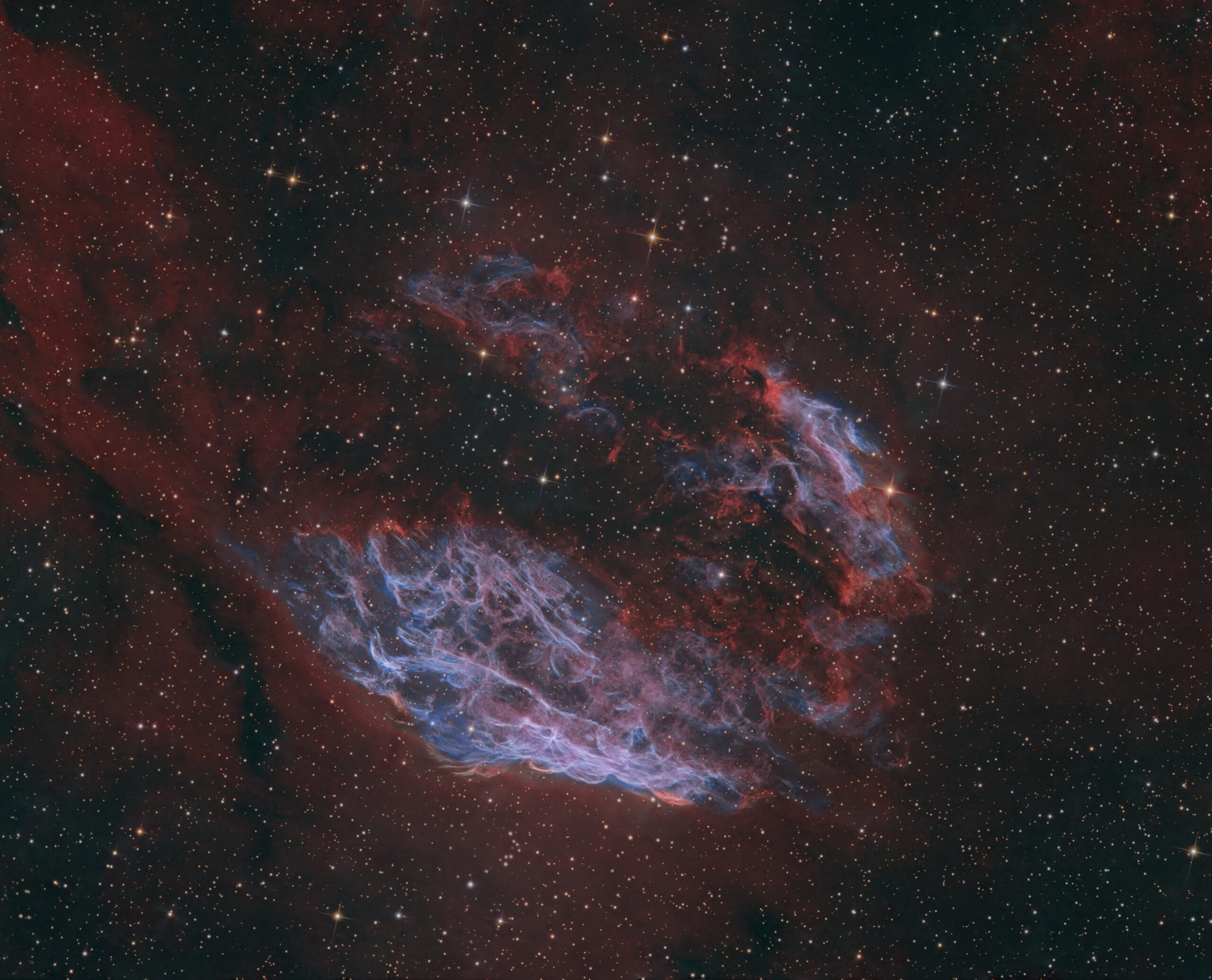
The graveyard of a star, with one of the strangest neutron stars known at its heart — seen as it was 10,000 years ago
RCW 103 is a Type II supernova remnant lying about 10,100 light-years away in the southern constellation Norma. The shell spans roughly 10 arcminutes on the sky, which at that distance corresponds to a physical diameter of about 30 light-years. Its visible magnitude is faint and diffuse — this is an object defined entirely by its filamentary emission rather than any integrated brightness figure
The remnant is the expanding debris of a core-collapse supernova whose progenitor was a relatively low-mass massive star, around 10–12 solar masses. Age estimates from optical proper-motion studies and X-ray kinematics place the explosion between 2,000 and 4,400 years ago — but a clarification is needed here. That “age” refers to how old the remnant appeared at the moment the light in this image left it. Because RCW 103 is about 10,100 light-years away, the photons captured here have been traveling for roughly ten millennia. The remnant we are seeing is therefore showing us its appearance around 10,000 years ago, when it was 2,000 years old. In its own present-day frame, RCW 103 is now closer to 12,000 years old and has continued to expand, cool, and interact with its surrounding medium — but we have no way of seeing that current state, and won’t for another 10,000 years. Every deep-sky image is, in this sense, a fossil photon record rather than a live view. At its geometric center sits 1E 161348−5055, one of the strangest compact objects known: a magnetar with an extraordinarily long spin period of 6.67 hours, orders of magnitude slower than any ordinary young neutron star. Whether that slow rotation is intrinsic, magnetically braked, or the result of interaction with a fallback disk remains an open question
Structurally, RCW 103 shows a nearly circular shell with the southern limb dramatically brighter than the north — a brightness asymmetry that traces the remnant’s collision with a dense molecular cloud along its southern edge. In this image the H-alpha emission renders as a deep ruby red, marking the shocked hydrogen front and the surrounding interstellar medium, while the OIII emission traces the hotter, higher-velocity shock fronts as cool blue and violet filaments woven through the interior. The intricate, almost fibrous texture is characteristic of a radiative shock cooling against a clumpy, inhomogeneous medium — every filament is gas being compressed, ionized, and re-emitting as it slows
Astrophysically, RCW 103 is a key laboratory for two related questions: how massive stars at the lower end of the core-collapse range end their lives, and how the magnetar phenomenon arises and evolves. The detection of nitrogen-rich circumstellar material around the remnant points to a progenitor that shed substantial mass through stellar winds in its red supergiant phase, while gamma-ray emission from the southern limb traces ongoing cosmic-ray acceleration where the blast wave grinds into the molecular cloud. RCW 103 is, in effect, a still-active engine — a young remnant where the physics of explosion, magnetic field amplification, and shock-cloud interaction are all happening simultaneously and visibly
Imaged in HOO with RGB stars on the ASA Astrosysteme AZ 1500, Camera Moravian C5A 150M, at Observatorio El Sauce, Chile Image Acquisition and Processing: Mike Selby