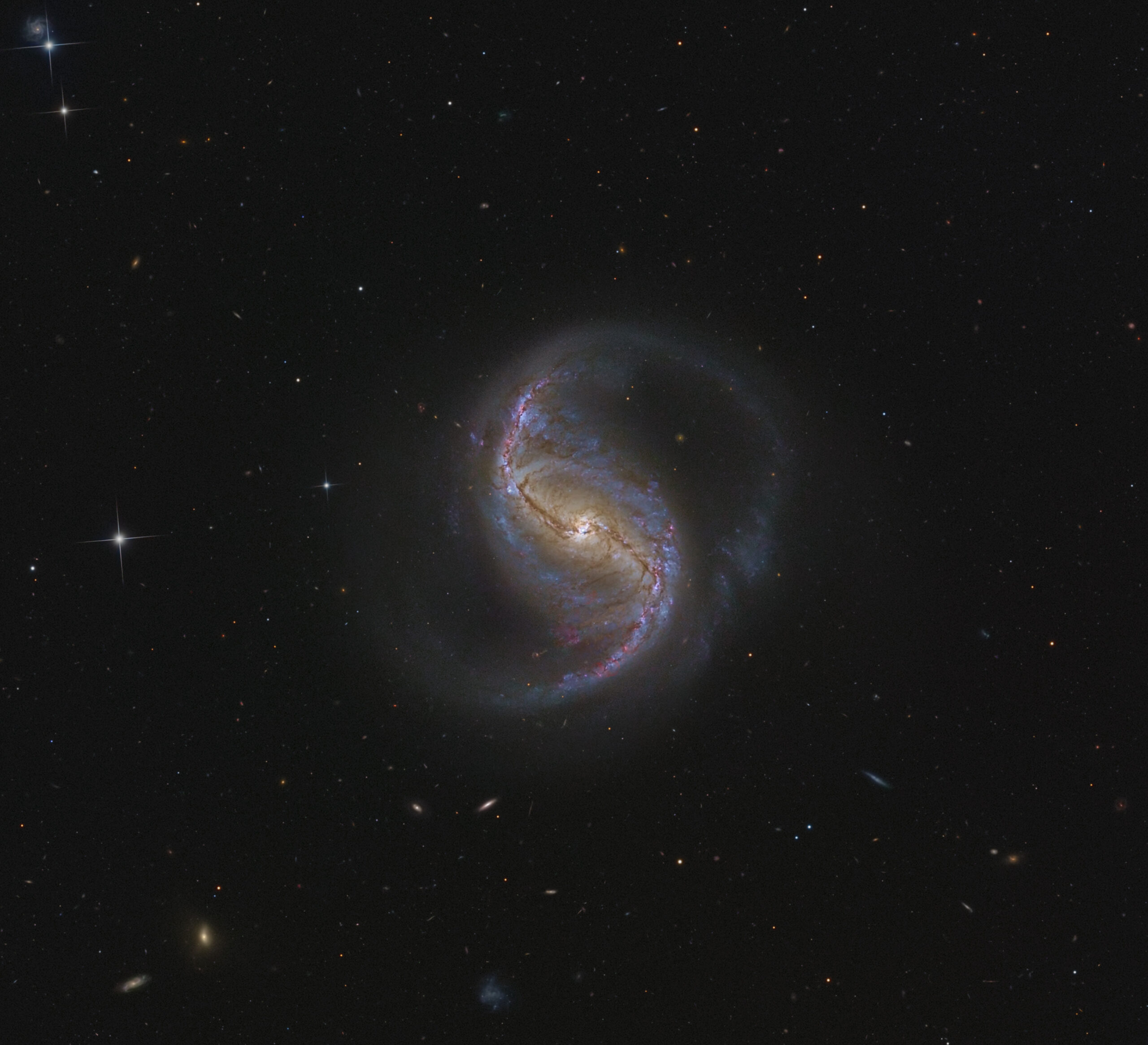
A cosmic pinwheel in the Furnace, where a straight stellar bar channels gas inward to a nucleus alight with newborn stars
NGC 986 is a barred spiral galaxy in the southern constellation Fornax, classified SB(rs)ab, with a faint outer pseudo-ring that gives it the fuller designation (R’1)SB(rs)b
It lies about 76 million light-years away and is receding at 1,974 kilometres per second; in visible light it spans 3.9 by 3.0 arcminutes, about 86,000 light-years across its main disk, and its faintest outer light extends to roughly 112,000 light-years; it shines at visual magnitude 10.9
A bright, narrow bar crosses the centre, lined on either side by two straight, sharply defined dust lanes that run inward to the nucleus; these lanes mark where gas flowing along the bar collides, loses momentum and begins its fall toward the core. Two sets of arms leave each end of the bar: an inner pair that curls tightly and almost closes into an inner ring, and a wider grand-design outer pair that fades within about an eighth of a turn into the faint blue arcs of the outer pseudo-ring. Star formation is most intense near the ends of the bar and along the inner parts of the outer arms, where pink-red hydrogen-alpha knots and blue clusters of young stars trace the spiral pattern
At the ten o’clock position, just beyond the outer edge of the disk, a short straight streak at first looks like a jet issuing from the galaxy; closer inspection resolves it into a chance alignment of small, very distant background galaxies, among them an edge-on disk, a compact orange spheroid and a faint reddish pair sharing a common glow, which by coincidence fall along a single line of sight. Below the galaxy, a pair of background galaxies is seen by light that left them about 1.4 billion years ago, nearly twenty times farther away than NGC 986 itself
NGC 986 shows how a bar can act as an engine of slow internal evolution, draining gas from the disk into the centre, where it fuels the star-forming region that makes the nucleus a strong source of radio emission; over billions of years this inflow is thought to build a dense central bulge and reshape the galaxy from within, a process that is also believed to be at work in our own barred Milky Way
Imaged in LRGB and Hα on ASA AZ 1500, Camera Moravian C5A 150M, at Observatorio El Sauce, Chile
Image Acquisition and Processing: Mike Selby