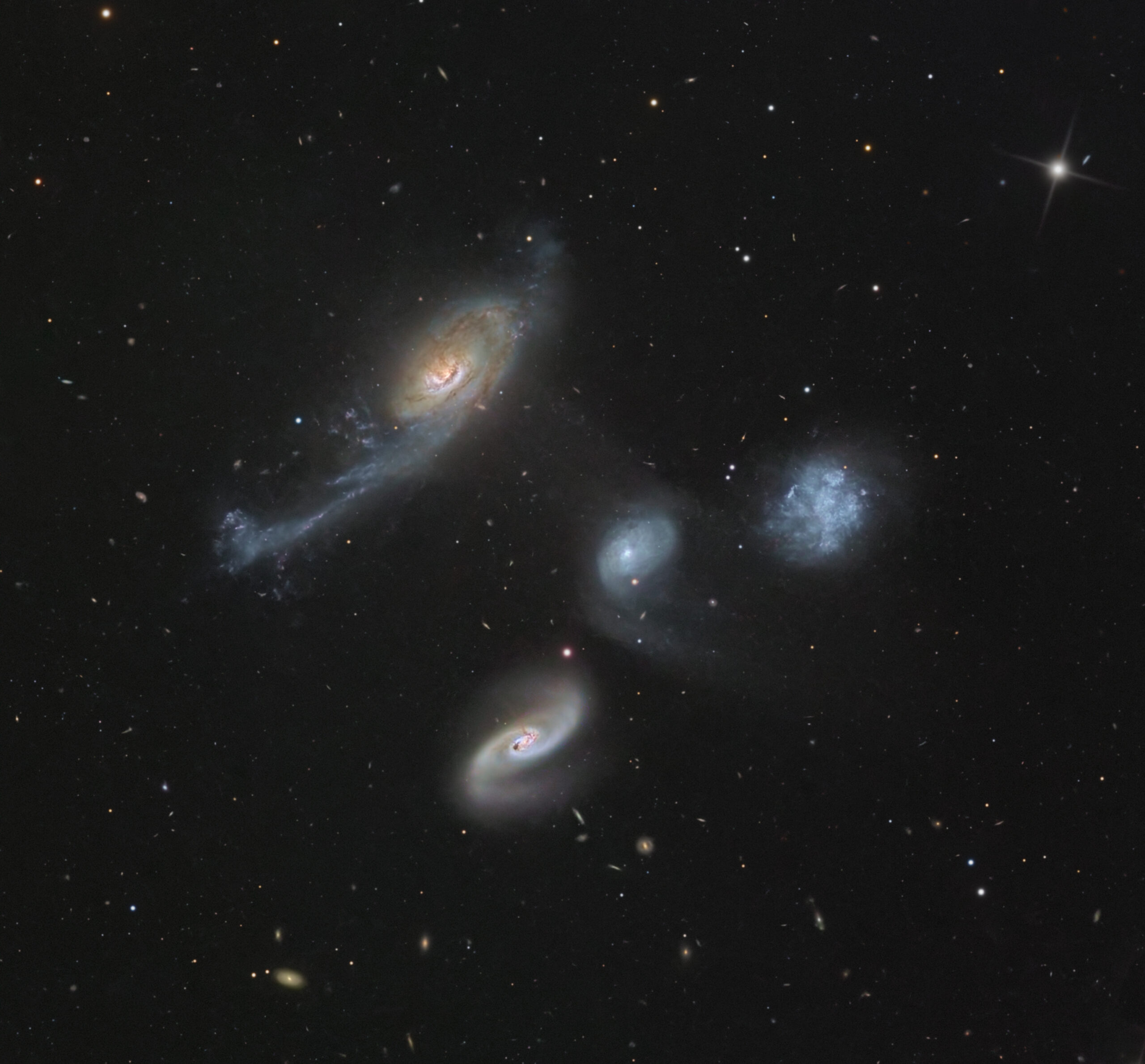
Robert’s Quartet — four galaxies caught in a slow gravitational embrace, one of them unspooling a river of newborn stars into intergalactic space
Robert’s Quartet, catalogued as AM 0018-485, is a compact group of four interacting galaxies in the southern constellation Phoenix — NGC 92, a peculiar early-type spiral classified SAa pec; NGC 89 and NGC 88, both peculiar barred lenticular systems classified SB0/a pec; and NGC 87, a peculiar barred Magellanic irregular classified IBm pec
Based on their recession velocities, NGC 92 lies about 145 million light-years away, NGC 89 about 149 million, NGC 88 about 153 million and NGC 87 about 155 million light-years; NGC 92 spans 1.9′ × 0.9′ of sky, roughly 82,000 light-years across, at magnitude 13.7; NGC 89 measures 1.2′ × 0.6′, about 52,000 light-years, at magnitude 14.2; NGC 88 measures 48″ × 29″, about 35,000 light-years, at magnitude 15.1; and NGC 87 measures 52″ × 43″, about 39,000 light-years, at magnitude 14.7
NGC 92 dominates the group with a warm golden core laced with dark dust lanes, while a long tidal tail stretches some 80,000 light-years from its nucleus, studded with blue star clusters and pink star-forming knots and ending in a bright clump of young stars, with a fainter plume rising from the opposite side of its disk; NGC 89 shows a compact core crossed by dark dust, wrapped in a pale inner ring and two smooth arms that sweep into a broad oval; NGC 88 has a blue inner disk surrounded by a faint diffuse envelope; and NGC 87 is a ragged, clumpy irregular glowing with young blue star-forming regions
A tenuous plume of stars sweeps out from NGC 88 toward NGC 87 — while it is possible that this is a tidal bridge linking the two galaxies, I am not able to confirm it as it is very faint
All four galaxies share recession velocities between 3,219 and 3,415 km/s and lie within a projected span of about 125,000 light-years, confirming a genuine physical group rather than a chance alignment along the line of sight
Repeated close passages have drawn gas out of NGC 92 into its tail, where compression is igniting new generations of stars, while NGC 87 burns with the same interaction-driven star formation and three of the four nuclei show low-ionisation activity — over hundreds of millions of years the members are expected to continue spiralling together, with compact groups like this one thought to end their lives as a single large elliptical galaxy
Imaged in LRGB on ASA AZ 1500, Camera Moravian C5A 150M, at Observatorio El Sauce, Chile
Image Acquisition and Processing: Mike Selby