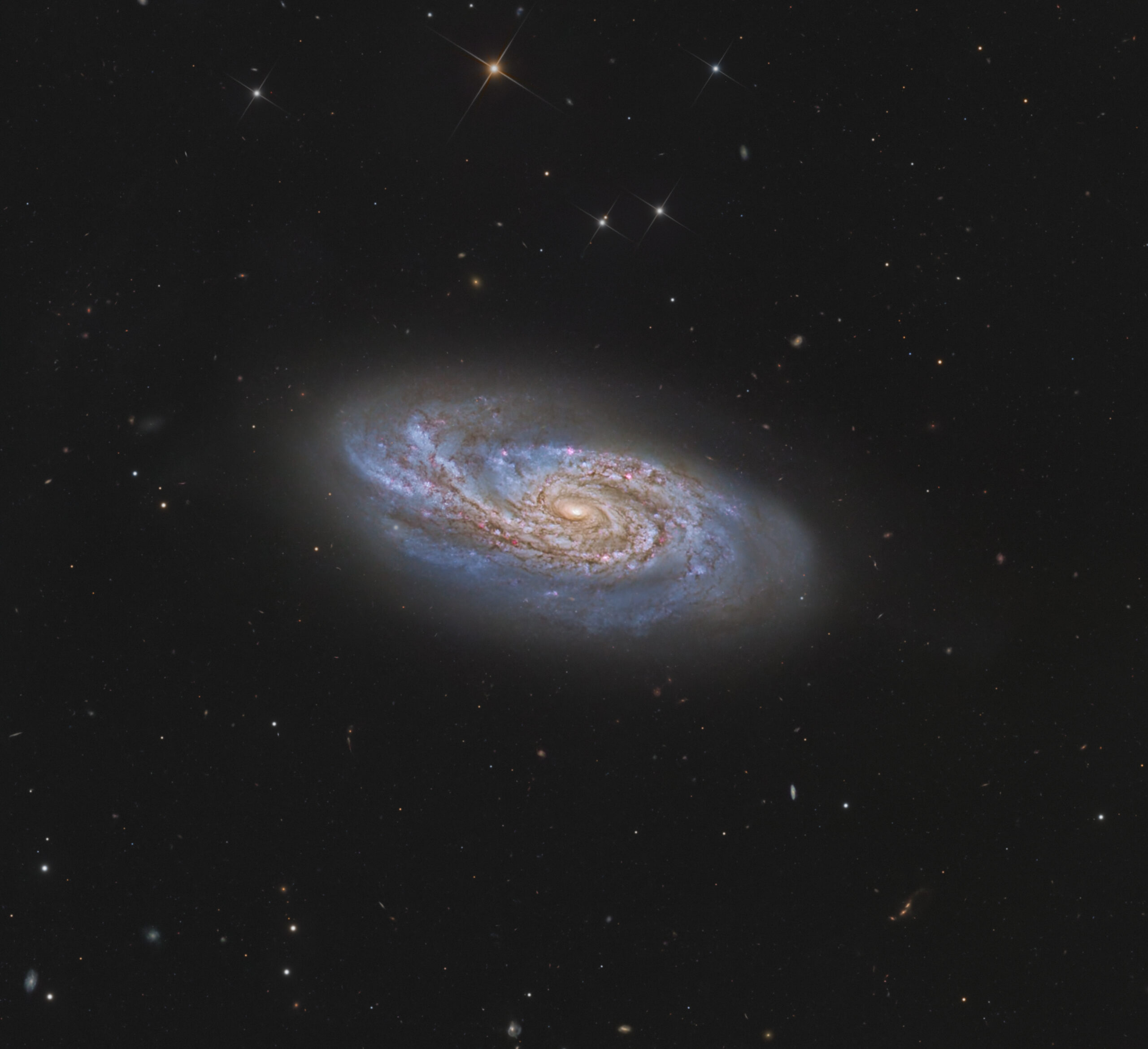
A spiral ablaze with new stars, its arms twisted by a galaxy that has since vanished from view
NGC 908 is an unbarred spiral galaxy in the constellation Cetus, classified SA(s)c, and catalogued for its abundant HII regions
It lies approximately 51 million light-years away, spans 6.1 × 2.7 arcminutes on the sky, which corresponds to a true diameter of roughly 91,000 light-years, and shines at visual magnitude 10.2
Tightly wound brown dust lanes spiral into a compact, warm-toned nucleus, while the outer disk opens into broad blue arms crowded with young star clusters and studded with pink hydrogen-alpha emission from active stellar nurseries
The galaxy carries three spiral arms rather than the usual two, and the pattern is markedly uneven: on one side an arm thickens and splits into a wide ribbon that lifts away from the plane of the disk, while the opposite side remains more tightly wound, and faint diffuse plumes of starlight extend beyond both ends of the visible disk
NGC 908 is the dominant member of a small galaxy group, yet none of its neighbours lies close enough to account for the disturbance
The distorted arms and the elevated rate of star formation point to a close gravitational encounter in the past, one that compressed the gas in the disk and set off the wave of star birth still under way
Two supernovae of very different kinds have been recorded here: SN 1994ai marked the collapse of a massive stripped star, while SN 2006ce was the thermonuclear detonation of a white dwarf that reached magnitude 12.4
Hundreds of far more distant galaxies are scattered across the background field
Imaged in LRGB and Hα on ASA AZ 1500, Camera Moravian C5A 150M, at Observatorio El Sauce, Chile
Image Acquisition and Processing: Mike Selby