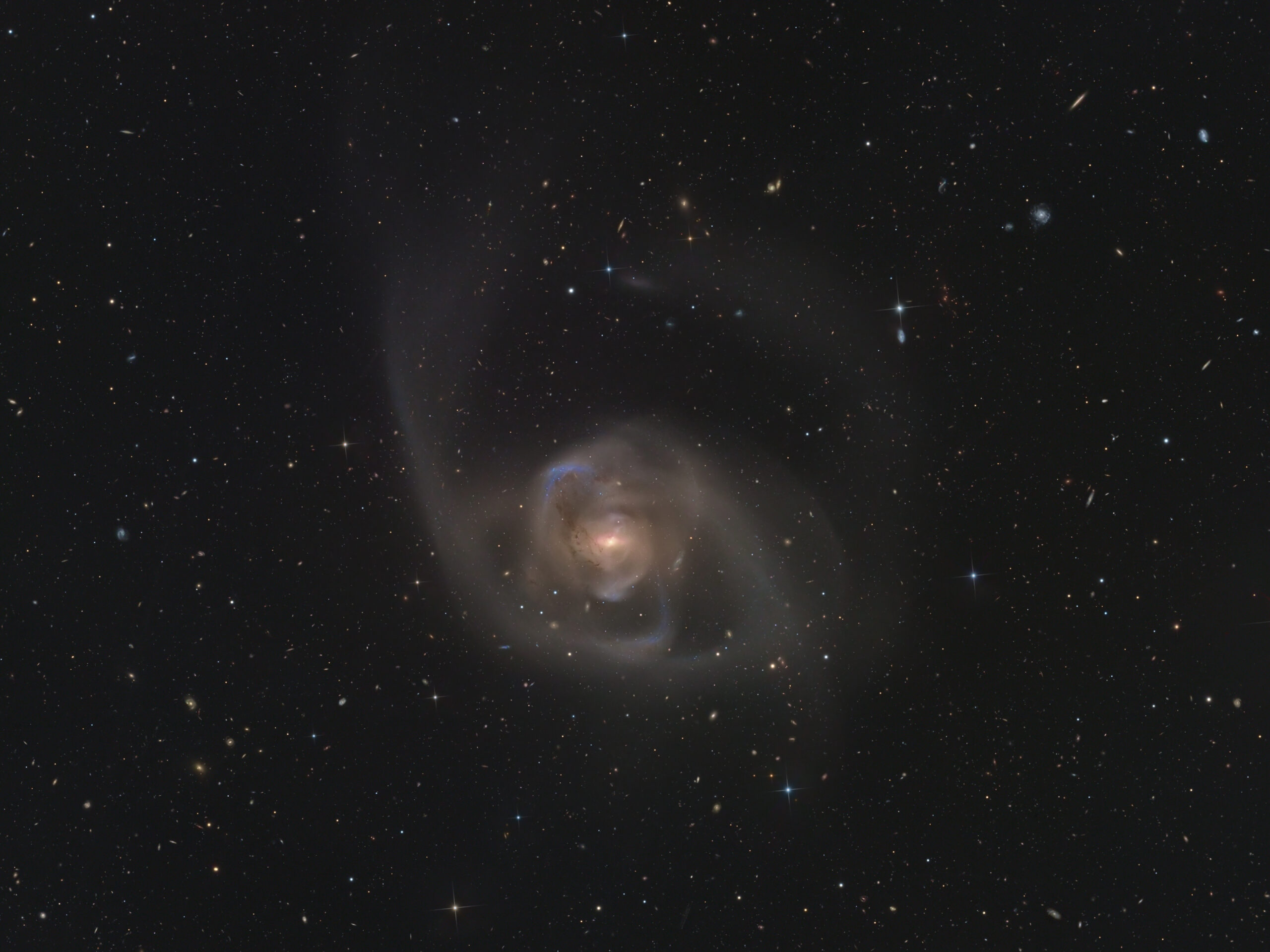
A billion years after two spiral galaxies collided, both of their hearts still beat side by side at the center of what remains
NGC 7727, cataloged as Arp 222 in the Atlas of Peculiar Galaxies, is a peculiar galaxy in the constellation Aquarius, classified SAB(s)a pec, the reshaped remnant of a merger between two spiral galaxies
It lies about 73 million light-years away and spans about 4.8 arcminutes, corresponding to roughly 102,000 light-years across its main body, shining at visual magnitude 11.5
A smooth, warm envelope of old stars surrounds a bright nucleus, crossed by a broken lane of dark dust that cuts diagonally through the inner body. Thin blue arcs curl around the core and loop beneath it, lit by young stars that formed as gas was compressed during the collision. Beyond the bright body, long faint tidal tails sweep outward in opposite directions, the most prominent stretching about 160,000 light-years, while a delicate outer arc at upper right marks stellar debris still settling around the merged galaxy
Both nuclei can be seen at the center, the bright original core of NGC 7727 and, just beside it, a fainter point of light that is all that remains of the galaxy it consumed. Separated by only about 3.6 arcseconds, roughly 1,300 light-years, each holds a supermassive black hole, one of about 154 million solar masses and the other about 6.3 million, among the closest pairs of supermassive black holes known, and the two are expected to merge within about 250 million years
NGC 7727 shows how collisions turn orderly spiral galaxies into smooth, elliptical-like systems. The bursts of star formation set off by the merger produced a population of young globular clusters, and the second nucleus, stripped of almost everything but its dense core, is becoming an ultracompact dwarf galaxy. This offers direct evidence of how these compact objects form and how galaxies grow by absorbing their neighbors
Imaged in LRGB and Hα On the ASA AZ 1500 at Observatorio El Sauce, Chile Camera Moravian C5 100, at Observatorio El Sauce, Chile
Image Acquisition and Processing: Mike Selby