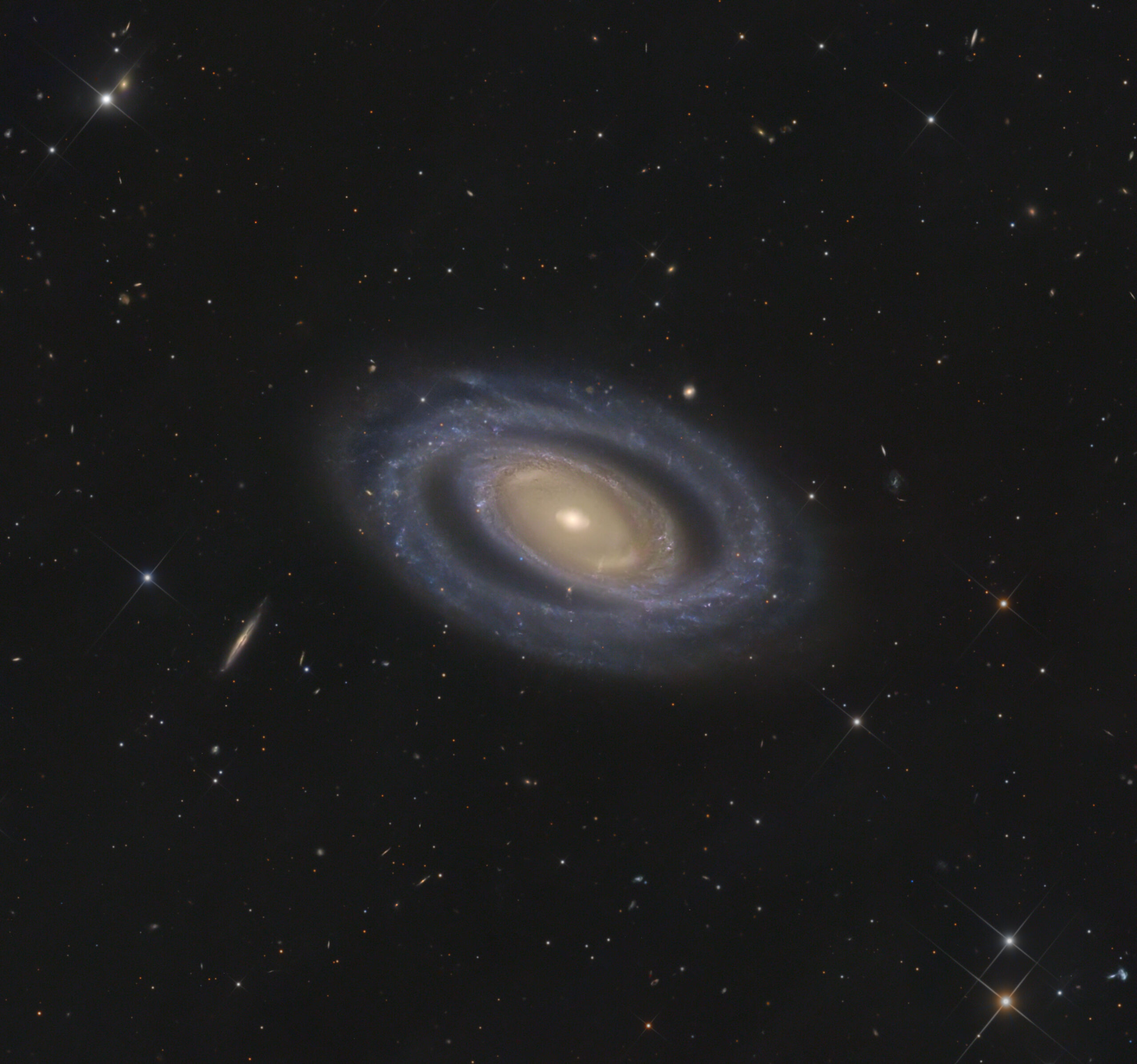
NGC 7098 – a galaxy that built itself in rings
Three concentric structures, each a different chapter of one galaxy’s history, all locked in step around a single luminous core
NGC 7098 is a double-barred ringed spiral in the far southern constellation of Octans, classified (R)SAB(rs)a, where the (R) denotes a detached outer ring and (rs) a transitional inner ring wrapped around the bar
It lies about 95 million light-years away and recedes at 2381 km/s, spanning 5.5 arcminutes on the sky, which at that distance corresponds to a true diameter of roughly 152,000 light-years, making it appreciably larger than the Milky Way, and it shines at visual magnitude 11.3
The structure is layered from the inside out. A bright, smooth, warm-toned bulge sits within a broad oval lens formed by the large-scale bar, its ends flaring into faint ansae. Around this lies the inner ring, tightly wound and studded with small dust knots and faint reddish star-forming clumps. A deep dark gap of almost empty disc separates it from the outer ring, a wide band of bluish arms that appear to have wrapped around the galaxy so completely that they closed into a near-perfect ellipse. Beyond that, a faint diffuse halo fades into the background. A slender edge-on background spiral lies just to the west, unrelated and far more distant, with numerous faint galaxies scattered across the field
NGC 7098 has no confirmed companion at comparable velocity within this field, so its rings are a product of internal dynamics rather than interaction. Bars drive gas to their resonances, where it piles up and forms stars, and the inner and outer rings mark exactly those orbital resonances. The double bar, a small secondary bar nested inside the main one, is an efficient channel for feeding gas inward toward the nucleus. The galaxy is a textbook example of how a bar can reorganise an entire disc into rings without any outside help
Imaged in LRGB on ASA AZ 1500, Camera Moravian C5A 150M, at Observatorio El Sauce, Chile
Image Acquisition and Processing: Mike Selby