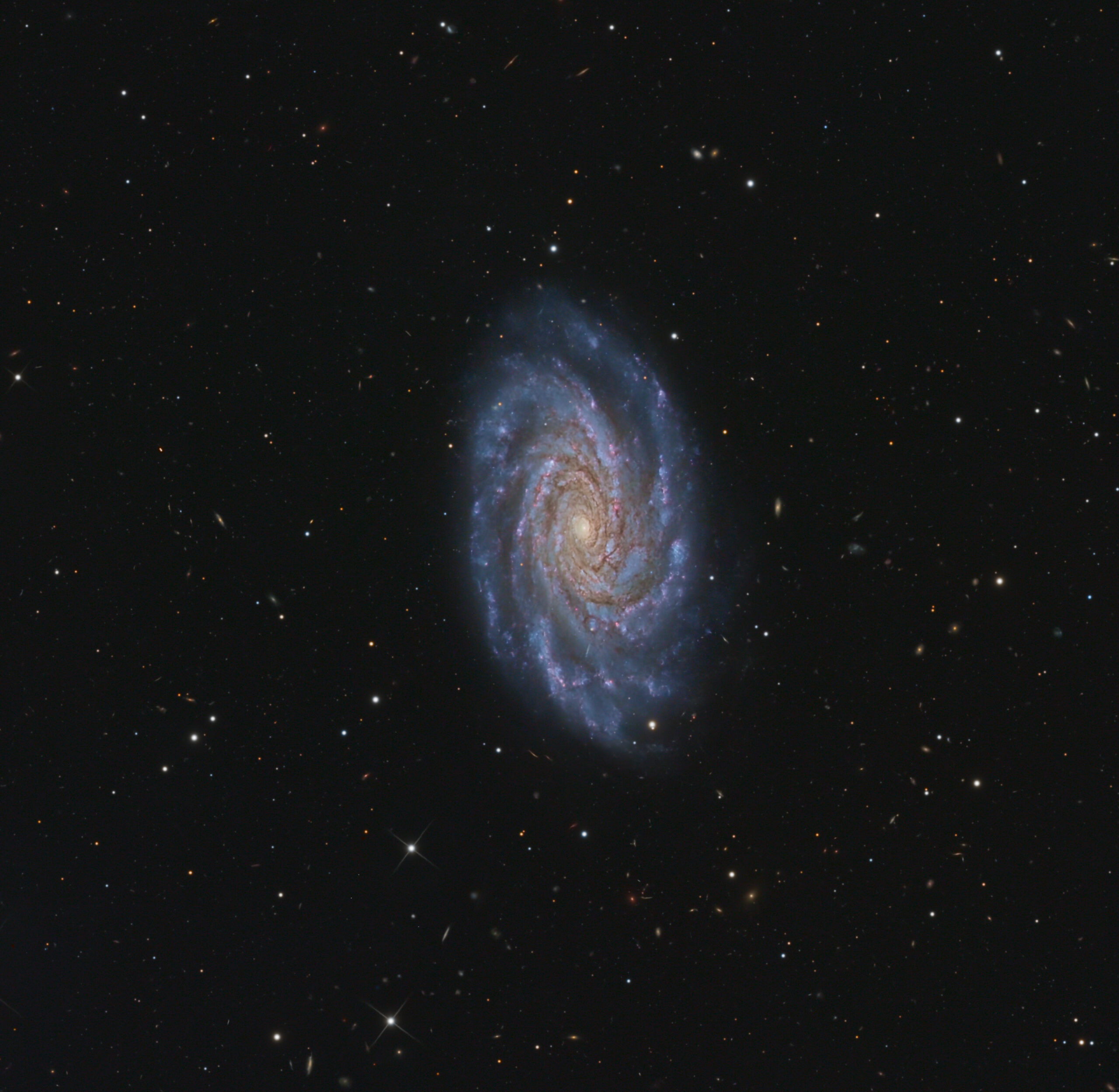
A southern spiral larger than the Milky Way, seen as it was 108 million years ago
NGC 7083 is a spiral galaxy in the far-southern constellation Indus, discovered by James Dunlop from Parramatta in 1826. It is classified SA(s)bc in the Third Reference Catalogue, with the alternate classification SAB(rs)c pointing to a weak bar and an inner ring, and it hosts a LINER nucleus, a sign of low-level activity around its central black hole
Its light has travelled about 108 million years to reach us. The galaxy spans roughly 4.9 arcminutes on the sky, which at that distance corresponds to a true diameter of about 152,000 light-years, making it somewhat larger than the Milky Way. It shines at a total blue magnitude of about 11.9
The disk centres on a compact pale-yellow nucleus ringed by the tightest segments of the spiral pattern, which close around the bulge into a near-complete inner ring. From there two principal arms unwind, each splitting within its first quarter turn into a tight inner ridge and a broad outer sweep, the southern branch reaching well beyond its northern counterpart before dissolving into a faint tail. The inner disk is laced with a dense network of brown dust lanes that cut spurs across the gaps between the arms, while chains of pink hydrogen-alpha regions and two conspicuously bright blue star-forming complexes mark the ridges where new stars are being born. NGC 7083 has hosted at least three observed supernovae, including SN 2009hm and SN 2019qar, both core-collapse events of Type Ib, a mark of the massive stars forming along its arms
Beyond the galaxy the field is scattered with far more distant systems, edge-on spirals and orange ellipticals lying hundreds of millions of light-years behind it
The combination of a LINER nucleus, vigorous star formation that reaches into the faint outer disk, and a history of stripped-envelope supernovae makes NGC 7083 a galaxy caught mid-stride, feeding its core at a modest rate while its outer disk continues to build new generations of stars
maged in LRGB on ASA Astrosysteme AZ 1500, Camera Moravian C5A 150M, at Observatorio El Sauce, Chile
Image Acquisition and Processing: Mike Selby