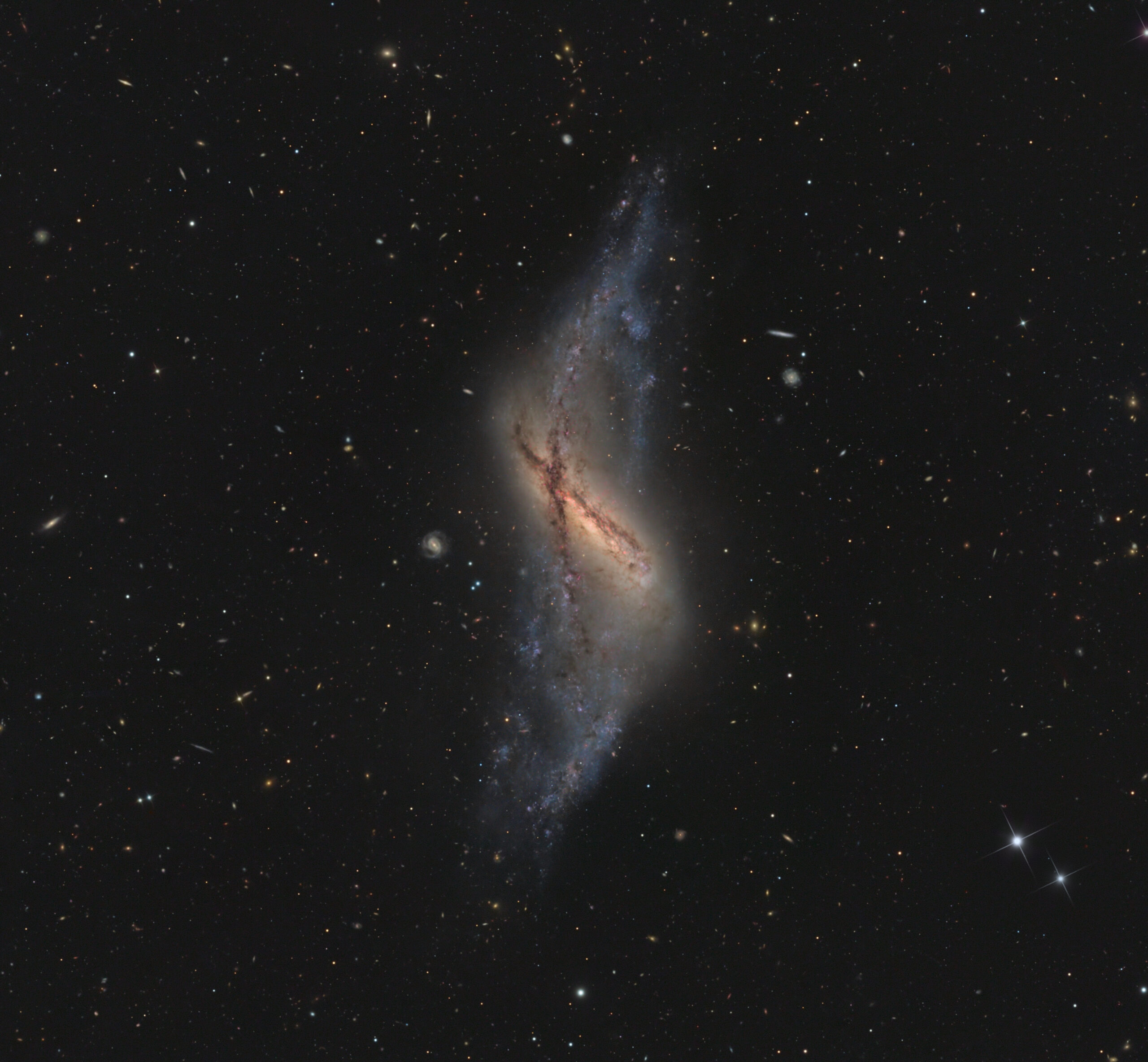
NGC 660 in Pisces is one of only a few dozen confirmed polar ring galaxies, a rare class in which a vast ring of stars, gas and dust orbits far out of the plane of the main disk; classified SB(s)a pec, it is more unusual still because its host is a dusty barred spiral rather than the smooth lenticular galaxy found at the heart of nearly every other known polar ring system
It lies about 44 million light-years away and spans roughly 4.6 by 1.7 arcminutes on the sky, corresponding to about 59,000 light-years along its major axis, with a visual magnitude of 11.3
The inner disk is seen almost edge-on, its warm golden bulge cut by dark dust lanes that cross in a striking X near the center, while the ring sweeps across it at an angle of about 45 to 55 degrees, studded with clusters of hot blue stars and pink hydrogen-alpha knots marking active star-forming regions; a faint, smooth halo of older stars envelops the whole system, and a rich scatter of distant background galaxies fills the surrounding field
NGC 660 belongs to the small M74 group of galaxies, and its ring is thought to have formed about a billion years ago when it captured gas from a passing gas-rich galaxy; that gas settled into its tilted orbit and has been forming stars ever since, with the youngest stars in the ring only about 7 million years old, while gas channeled toward the center feeds an intense nuclear starburst that produced a powerful radio outburst in 2012
Because the ring and the disk orbit in different planes, their motions trace the gravity of the surrounding dark matter halo in three dimensions, making NGC 660 a natural laboratory for mapping the shape of the unseen mass that holds galaxies together
Imaged in LRGB and Hydrogen-alpha, OTA Planewave CDK 1000, Camera Moravian C5 100, at Observatorio El Sauce, Chile
Image Acquisition and Processing: Mike Selby