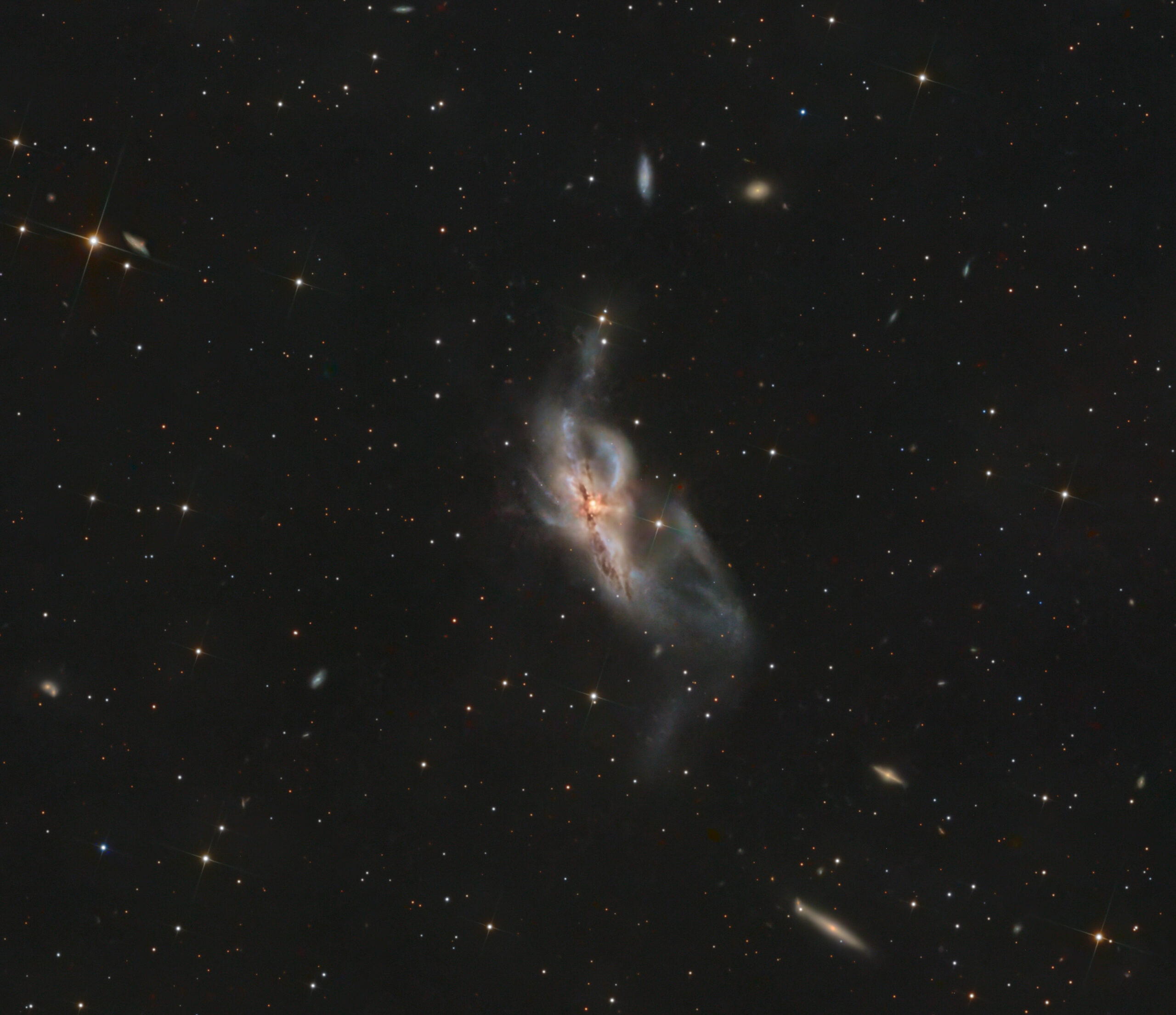
Three galaxies, three black holes, and a single violent act of creation
NGC 6240, the Starfish Galaxy, is one of the most dramatic merger remnants in the nearby universe, a chaotic tangle of gas, dust, and stars in the constellation Ophiuchus roughly 366 million light-years away. Its sprawling loops, wisps, and tidal tails give it the branching form that earns its name, the wreckage of a collision drawn out across some 240,000 light-years of space
Classified as a peculiar system and one of the nearest ultraluminous infrared galaxies, NGC 6240 shines more than a trillion times brighter than the Sun in infrared light, its dust superheated by furious bursts of star formation triggered by the collision. Long assumed to be the merger of two galaxies, high-resolution observations in 2019 revealed something rarer still, a central region hosting three supermassive black holes, each more massive than ninety million Suns, crowded into a volume less than three thousand light-years across. It was the first triple supermassive black hole system ever found, evidence that not two but three galaxies came together to build this single disturbed remnant
The reddened, dusty core at the heart of the image marks the turbulent zone where those nuclei are drawn together, wrapped in thick lanes of obscuring dust that redden the light passing through them. Around it, the tidal loops and faint outer plumes trace stars and gas flung outward during the encounter, the visible record of gravity dismantling and rebuilding on a scale that dwarfs our own galaxy. One of these loops curves gracefully around the upper body of the galaxy and can look, at first glance, like a ring, but it is not one. A true ring galaxy forms when one galaxy plunges almost squarely through the disk of another, driving a wave of star formation outward into a closed circle. What we see here is instead a tidal stream, a ribbon of stars and gas drawn out along a curved path by the merger and glimpsed at an angle that lends it the illusion of a ring
Over the coming tens to hundreds of millions of years the nuclei will continue to spiral inward, and in the distant future their black holes will merge into a single greater one, an event that will send gravitational waves rippling out across the cosmos. What looks like destruction is also assembly, three galaxies becoming one, caught here in the long violent middle of that transformation
Imaged in LRGB on the ASA Astrosysteme AZ 1500, Camera Moravian C5A 150M, at Observatorio El Sauce, Chile
Image Acquisition and Processing: Mike Selby