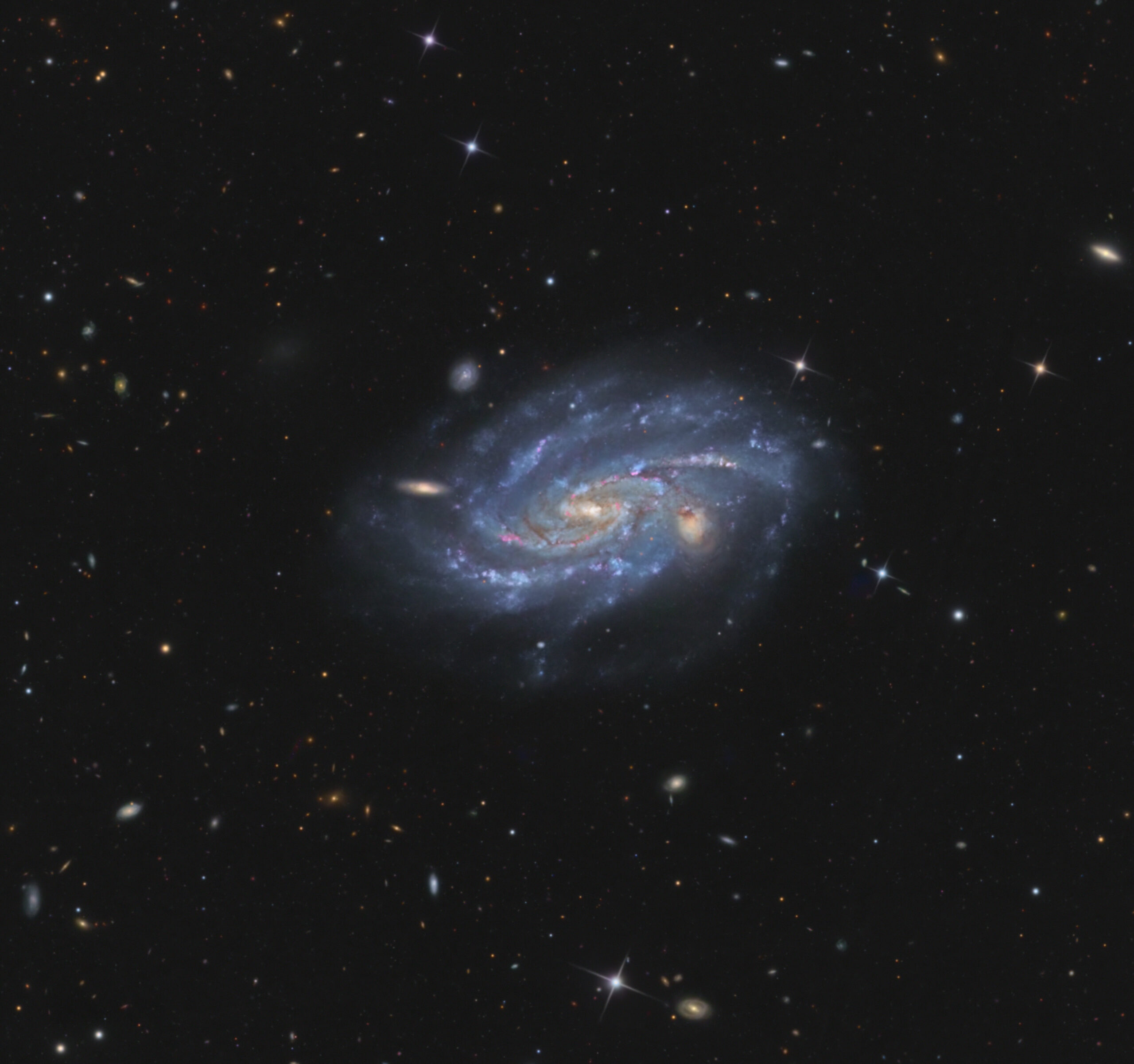
A loosely wound spiral still busy building stars, its light leaving 59 million years ago as the young Himalayas were beginning to rise
NGC 578 is a weakly barred spiral galaxy in the constellation Cetus, classified SAB(rs)c, a late-type spiral with a modest central bar and an inner pseudo-ring from which open, loosely wound arms unfold outward
It lies about 59 million light-years away, spans roughly 7 arcminutes on the sky and measures about 121,000 light-years across, somewhat larger than our own Milky Way, with an apparent magnitude of [magnitude]
A compact, warm-toned bulge and short bar give way to two principal arms that loosen and fragment as they travel outward, threaded with dark dust lanes and studded with blue clusters of young stars and pink knots of ionized hydrogen marking active stellar nurseries
The galaxy shines across the whole spectrum, with nearly as much energy emerging in the far infrared as in the ultraviolet, a sign that much of the light from its hot young stars is absorbed by dust and reradiated as heat, while its radio glow at 1.4 GHz traces fast electrons accelerated by generations of supernovae, together revealing a disk where star formation is steady, widespread and very much ongoing
Imaged in LRGB, OTA ASA AZ 1500, Camera Moravian C5A 150M, at Observatorio El Sauce, Chile
Image Acquisition and Processing: Mike Selby