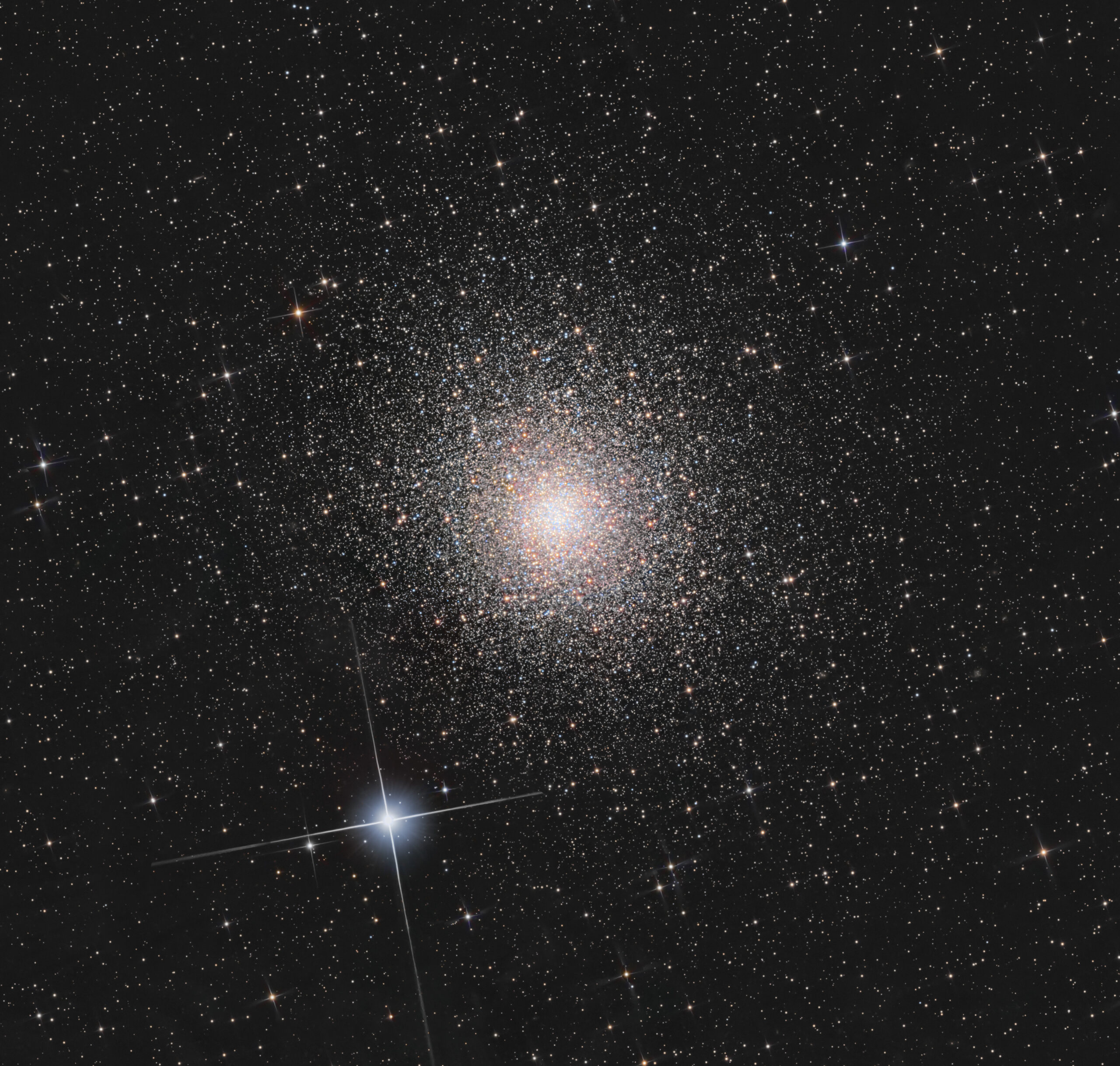
NGC 5286 — one of the Milky Way’s most ancient globular clusters, a 12.5-billion-year-old relic likely torn from a dwarf galaxy swallowed long ago
NGC 5286, also catalogued as Caldwell 84, is a class V globular cluster in the southern constellation Centaurus, a gravitationally bound swarm of several hundred thousand stars discovered by James Dunlop in 1827 and lying just 4 arcminutes north of the naked-eye star M Centauri
At a distance of about 35,900 light-years, with an apparent diameter of 9.1 arcminutes and an integrated apparent magnitude of V 7.6, the cluster measures roughly 95 light-years across and holds a mass near 710,000 times that of the Sun; it sits about 29,000 light-years from the Galactic Center, orbiting through the Milky Way’s halo with a metal-poor composition of [Fe/H] −1.41, only a few percent of the Sun’s heavy-element content
The cluster is fully resolved here from its dense, slightly elongated core out into the sparse outer halo, the stellar population spread across a rich range of color — hot blue horizontal-branch stars mingling with the warm yellow and orange-red light of evolved red giants, the chromatic fingerprint of an ancient, chemically primitive population that formed in the early universe
At an estimated 12.5 billion years old, NGC 5286 ranks among the oldest globular clusters known in the Milky Way, and its halo orbit and chemistry tie it to the Gaia-Enceladus event — the merger of a substantial dwarf galaxy with the young Milky Way, from which this cluster was most likely accreted rather than born within our own Galaxy
Studies have even hinted at an intermediate-mass black hole of less than 6,000 solar masses lurking in its core, the kind of object that may bridge the gap between stellar-mass black holes and the supermassive giants at galactic centers
The brilliant blue-white star anchoring the lower-left field is a foreground Milky Way star, far closer than the cluster itself, while the surrounding sky is dusted with the more distant stars of Centaurus — but the eye is held by the ancient swarm at the center, a fossil of galactic assembly still wheeling through the halo after twelve and a half billion years
Imaged in LRGB on the ASA Astrosysteme AZ 1500, Camera Moravian C5A 150M, at Observatorio El Sauce, Chile
Image Acquisition and Processing: Mike Selby