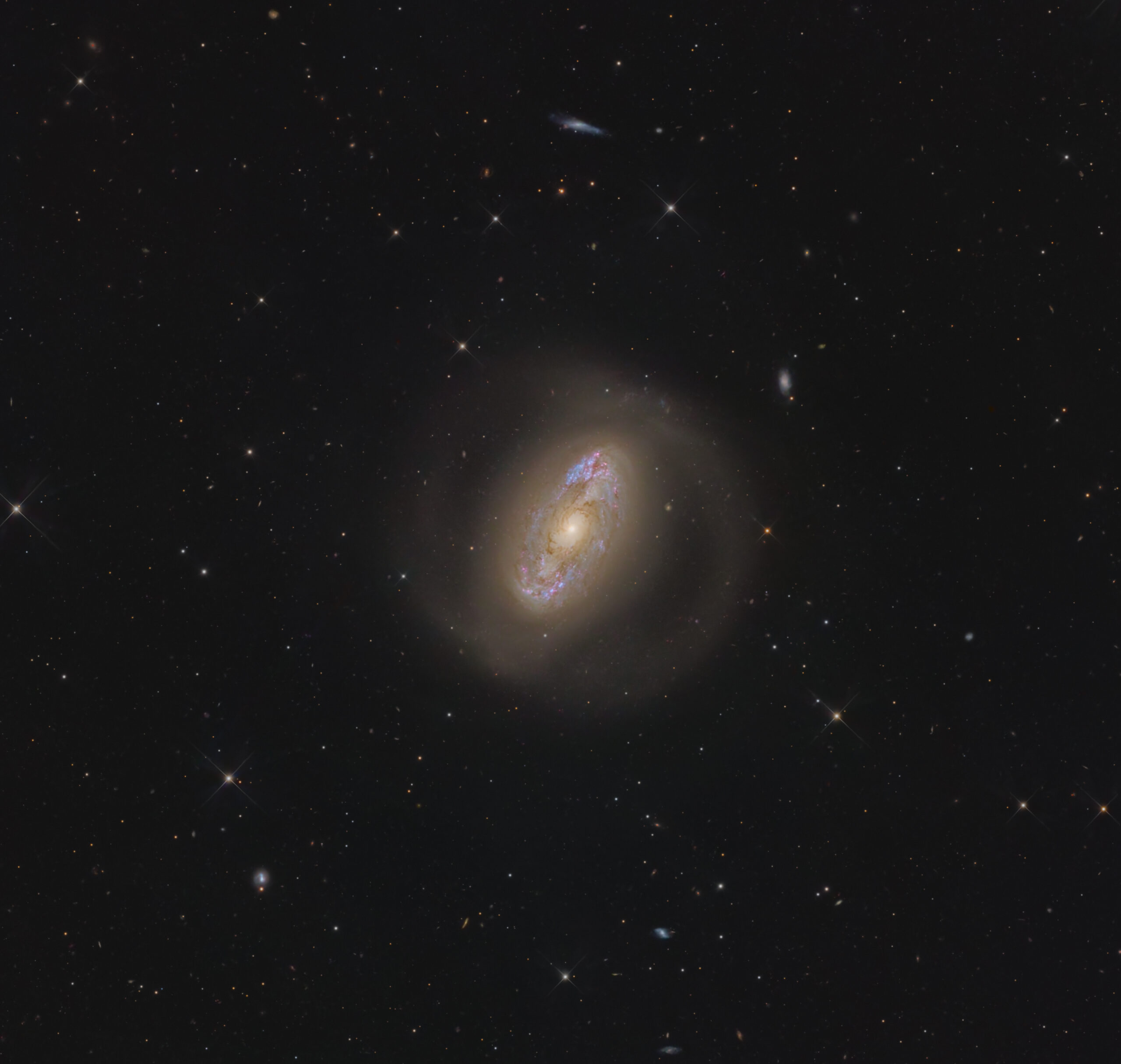
A spiral whose true distance is still in dispute
NGC 5134 is a spiral galaxy in Virgo, classified SA(s)b? in RC3 and noted in NED as (R)SAB(r)a HII, an inner-ring intermediate-bar system with HII-region star formation and a possible weak active nucleus. The NED CMB-frame Hubble flow distance is 99.2 ± 7.0 Mly (cz 2061 ± 21 km/s, H₀ 67.8), and at that distance the ESO-LV “Quick Blue” major axis of 5.09 arcminutes corresponds to roughly 147,000 ly across the faint outer disk, while the bright inner spiral pattern measures about 2.8 × 1.7 arcminutes. V magnitude is 11.7. The distance to NGC 5134 is unsettled — NED’s redshift-independent mean from 20 measurements gives 28.53 ± 3.93 Mly, ESA’s current Webb press releases publish 65 Mly, and the Hubble flow value used here is 99.2 Mly, with the redshift-independent mean implying an unphysical peculiar velocity for a galaxy in this group and the Hubble flow value the most cosmologically clean of the three
The image shows the classic architecture of an intermediate-type barred spiral: a warm yellow bulge inside a tightly wound, dust-threaded inner spiral pattern with bright blue HII complexes lining the leading edges of the arms, all wrapped in a remarkable low-surface-brightness outer envelope or pseudo-ring extending well beyond the bright disk. The bright inner pattern that defines NGC 5134 in survey images is only the optically dominant core of the galaxy — the faint outer envelope nearly doubles the apparent extent and is what the NED ESO-LV “Quick Blue” measurement of 5.09 arcminutes is actually picking up, but it sits several magnitudes below the surface brightness of the inner disk and is suppressed or clipped in nearly every published amateur and most professional optical images of this object. Recovering it requires very dark sky, deep luminance integration, a faithful background pedestal, and a stretch that does not crush low-signal structure into the noise floor. The structure itself is a relic of disk evolution: an old, faded outer disk component (or a tightly wound outer pseudo-ring) populated by an evolved stellar population with little ongoing star formation, encoding the dynamical history of the bar and the galaxy’s interaction with the wider NGC 5084 group environment
NGC 5134 is the brightest spiral in the NGC 5084 Group (LGG 345), which also contains NGC 5084, NGC 5087, ESO 576-50 and ESO 576-40. The galaxy was discovered by William Herschel on 10 March 1785
Imaged in LRGB on the ASA Astrosysteme AZ 1500, Camera Moravian C5A 150M, at Observatorio El Sauce, Chile
Image Acquisition and Processing: Mike Selby