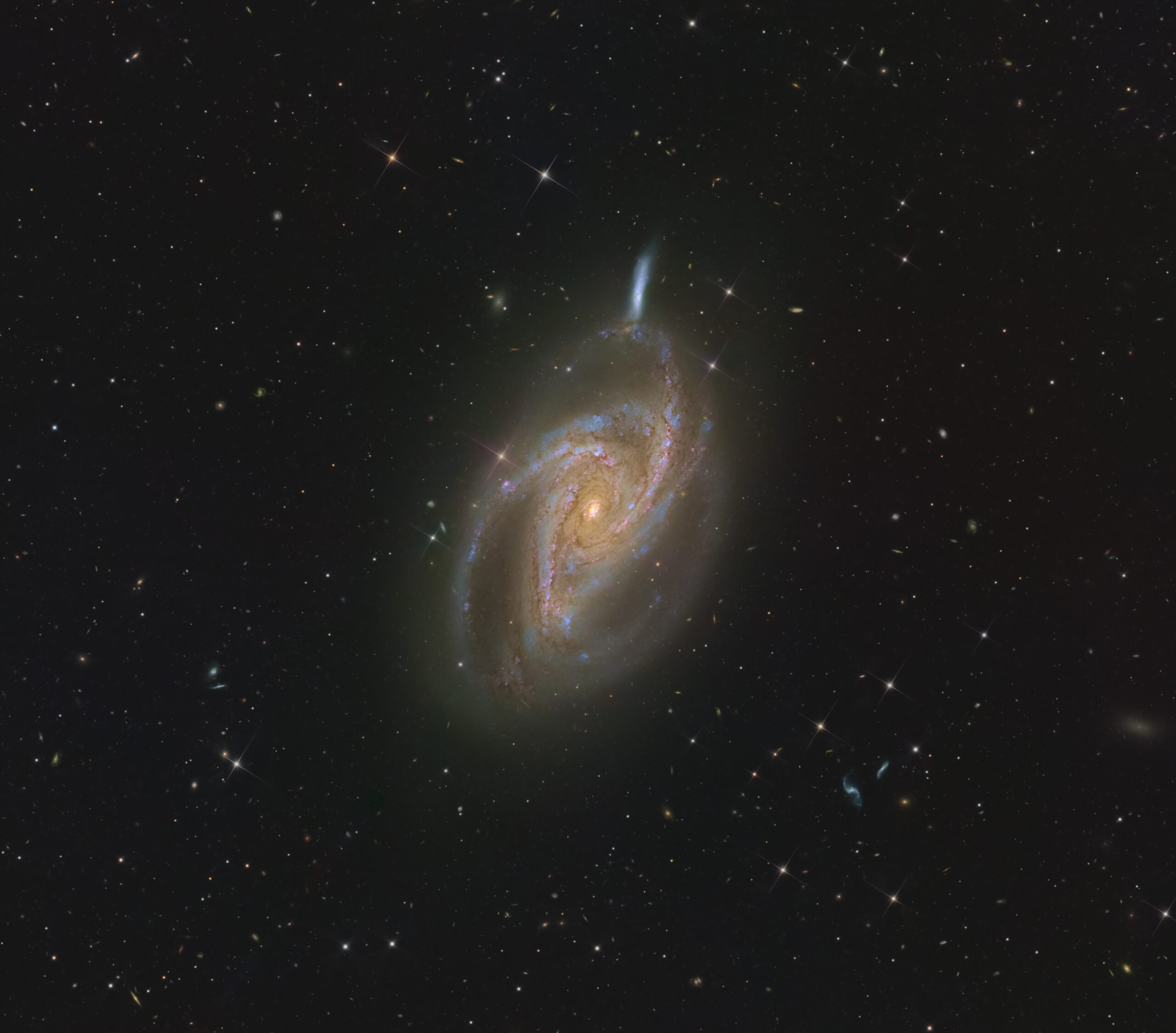
Why Settle for Two Arms — NGC 5054 Has Three
NGC 5054 is a face-on spiral galaxy in the constellation Virgo, classified morphologically as SA(s)bc — an unbarred grand-design spiral with moderately wound arms and a small inner ring structure, hosting an elliptical bulge whose elongation traces a nuclear bar embedded deep within the core
The galaxy lies approximately 55 million light-years away based on redshift-independent measurements compiled in NED, with a heliocentric recession velocity of 1,742 km/s placing it within the local supercluster region, and its apparent optical dimensions of 5.1 by 3.0 arcminutes correspond to a true physical diameter of roughly 85,000 light-years at visual magnitude 10.9
What sets NGC 5054 apart is its rare three-arm grand-design morphology — three prominent spiral arms emerge from the inner disk separated by roughly 120 degrees, with the northern arm more tightly wrapped than its counterparts, each arm carrying a chain of bright HII regions and dust filaments traceable for about half a revolution before fading, and a delicate inner ring formed where the arms anchor to the bulge encircles the bright nucleus and its embedded nuclear bar
The galaxy is actively forming stars at an estimated rate of 2.6 solar masses per year, with the largest HII complexes in the spiral arms reaching about two arcseconds across — visible in this image as the chains of pink and blue knots tracing the arm structure — and at its heart lies a supermassive black hole with a mass estimated between 1.8 and 9.5 million solar masses derived from the pitch angle of the spiral arms themselves, a geometric relationship that links the tightness of a galaxy’s spirals to the gravitational dominance of its central black hole
On 21 February 2004, Berto Monard discovered SN 2004ab in NGC 5054 — a Type Ia supernova that reached magnitude 14.7 about a week past maximum light, the explosion of a white dwarf in a binary system that briefly outshone billions of the galaxy’s stars and offered another anchor point in the network of distance measurements that calibrate the expansion of the universe
NGC 5054 is a confirmed member of the NGC 5044 Group, a loose southern extension of the Virgo galaxy concentration anchored by the giant elliptical NGC 5044 and including roughly fifty catalogued spirals and dwarfs scattered across more than a degree of sky, with the small blue edge-on companion MCG-03-34-040 perched directly above the disk in this frame along with several fainter background galaxies hinting at the rich extragalactic environment of the region
Three-armed grand-design spirals are uncommon — most disks settle into two-arm symmetry driven by their density-wave modes — so NGC 5054 stands as one of the cleanest symmetric examples of the morphology, a reminder that spiral galaxies still hold geometric surprises hidden 55 million light-years deep
Imaged in LRGB on the ASA Astrosysteme AZ 1500, Camera Moravian C5A 150M, at Observatorio El Sauce, Chile
Image Acquisition and Processing: Mike Selby
www.throughlightandtime.com
www.instagram.com/throughlightandtime/
www.facebook.com/masterdarksastro/