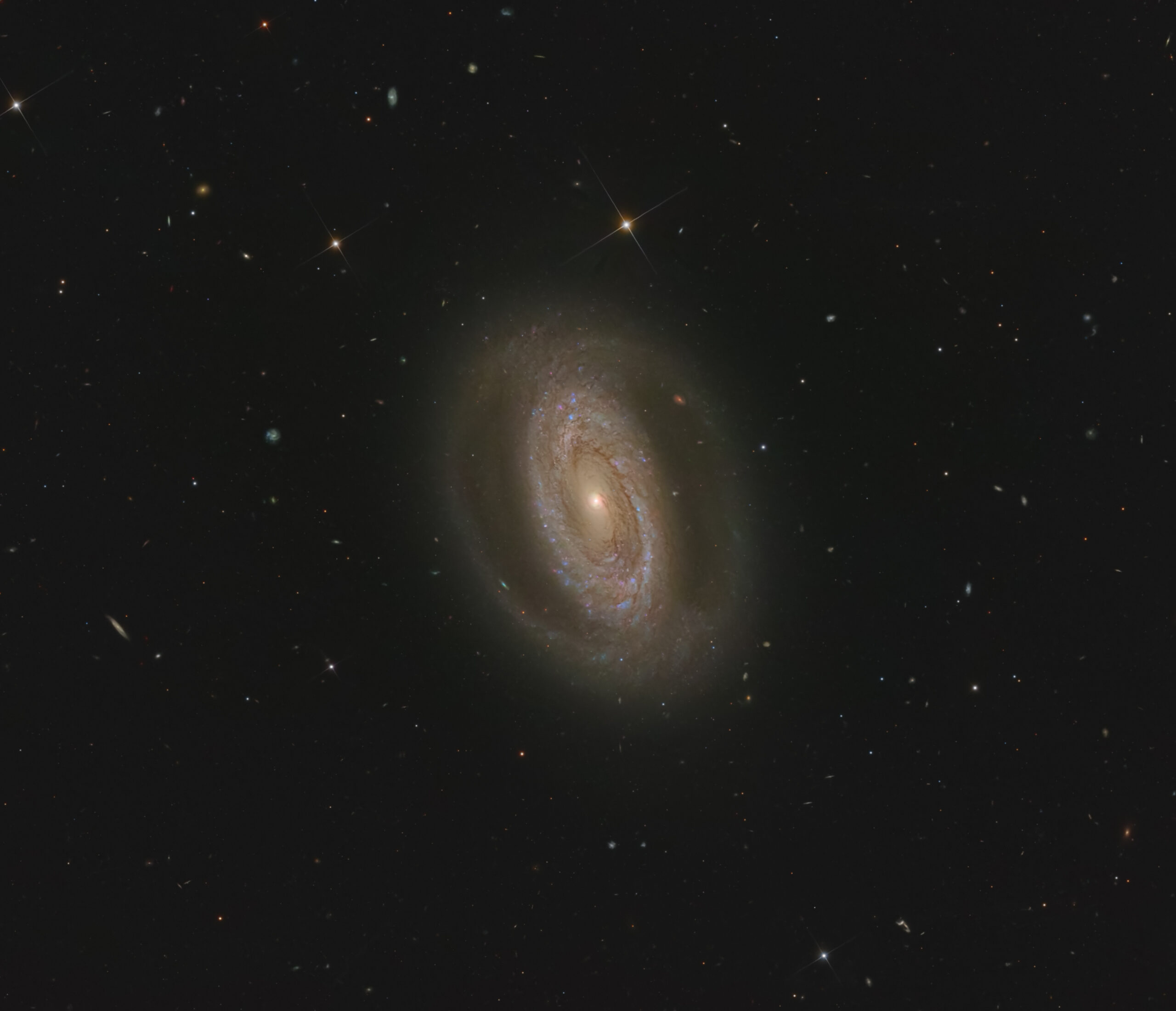
A Compton-thick Heart Within a Misaligned Double Ring
NGC 4941 is an intermediate barred spiral galaxy in the constellation Virgo, morphologically classified as (R)SAB(r)ab according to the Third Reference Catalogue. A weak bar, an inner ring, and a far fainter outer pseudo-ring define its structural framework, with two smooth, low-contrast spiral arms emerging tangentially from the elongated, twisted bulge.
Redshift-independent measurements compiled by NED place NGC 4941 at a mean distance of approximately 44.6 million light-years. With an apparent optical size of 3.9 × 2.7 arcminutes and an integrated visual magnitude of 11.2, the galaxy’s bright optical disk spans roughly 50,000 light-years across, while the smooth near-infrared envelope traced by 2MASS extends to nearly 61,000 light-years — comparable in scale to the Milky Way.
The disk is laced with tightly wound dust lanes that weave through the inner ring and along the leading edges of the arms. Threaded among them, two prominent chains of blue OB complexes mark the galaxy’s current sites of active star formation — one running along the eastern inner ring, the other arcing along the inner edge of the western arm. Several of these knots are accompanied by distinct pink-magenta Hα emission, marking compact HII regions still illuminated by their newly formed massive stars. Star formation in NGC 4941 is sharply confined to the inner ring and innermost arm segments, with the outer disk almost entirely passive — a textbook example of resonance-driven star formation in a barred system, where gas concentrates and ignites at the inner Lindblad resonance while the outer disk evolves quietly. The arms fade after approximately half a turn before merging into the broader disk. Surrounding all of this is the galaxy’s most striking and often overlooked feature: a faint outer envelope corresponding to the outer pseudo-ring, which is visibly misaligned with the inner disk — rounder, more face-on, and rotated relative to the brighter inner ellipse. This decoupled outer geometry is a signature of resonance dynamics in barred systems, where the outer ring forms near the outer Lindblad resonance and traces the orientation of the outer disk rather than the bar-dominated inner structure. Such alignment offsets are diagnostic of a warped outer disk or an underlying oval distortion — features long suspected in NGC 4941 and clearly evident here.
At the heart of the galaxy lies one of the nearest examples of a heavily obscured, Compton-thick Seyfert 2 nucleus, formally classified as such by Véron-Cetty & Véron. X-ray observations from BeppoSAX, Chandra, Suzaku, and NuSTAR have revealed a column density approaching 3 × 10²⁴ cm⁻², together with a prominent Fe Kα emission line — the spectral fingerprint of a low-luminosity active galactic nucleus deeply buried behind a torus of cold, dense gas. The supermassive black hole responsible — estimated at roughly 8 million solar masses — accretes quietly today, but the system remains a benchmark target for studies of obscured AGN demographics in the local universe.
NGC 4941 anchors a small, loose galaxy group bearing its name, with NGC 4951 as its principal companion. Several faint background systems are scattered across the surrounding field of this image — a quiet neighborhood in a quiet corner of Virgo
Imaged in LRGB on the ASA Astrosysteme AZ 1500, Camera Moravian C5A 100M, at Observatorio El Sauce, Chile. Image Acquisition and Processing: Mike Selby.