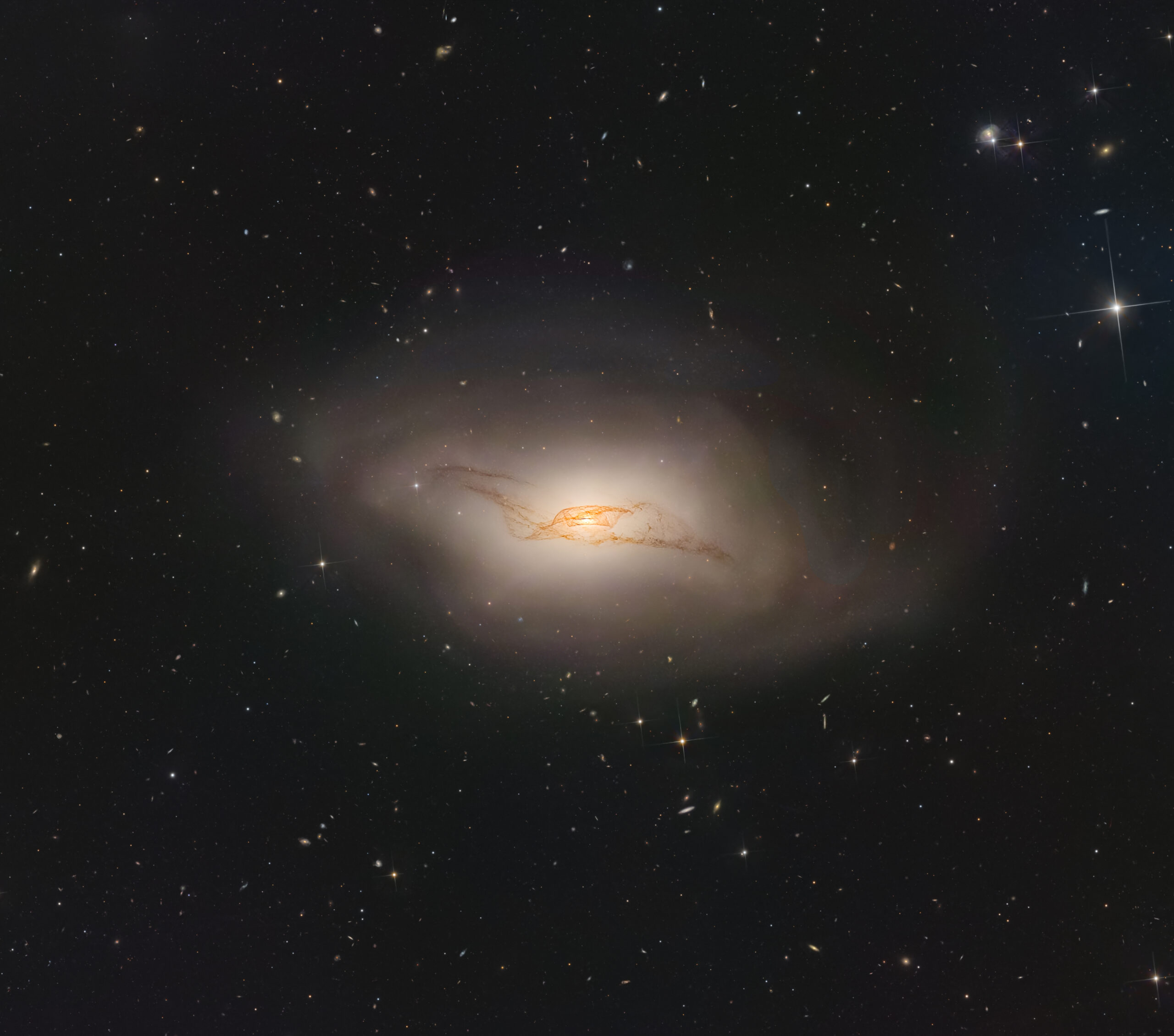
A precessing relic of a galactic feast — the warped dust disc of NGC 4753
NGC 4753 is a peculiar early-type galaxy classified by NED as type I0 (irregular lenticular), originally catalogued by Sandage as a peculiar S0. It is the dominant member of the NGC 4753 Group, one of the MK-groups populating the Virgo Southern Extension
The galaxy lies at a NED mean redshift-independent distance of 18.38 ± 1.28 Mpc, approximately 60 million light-years, in the constellation Virgo. Its optical apparent dimensions span 6.0 × 2.8 arcminutes, corresponding to a major-axis extent of roughly 32,000 light-years, with deeper near-infrared imaging tracing the stellar envelope out to about 128,000 light-years. At apparent magnitude V = 10.85, it is one of the brightest galaxies in this region of the Virgo Southern Extension
The defining feature is unmistakable: a chaotic, intricately twisted system of dust filaments crossing the bright bulge along the photometric major axis. The classic kinematic model of Steiman-Cameron and collaborators interprets this structure as a precessing dust disc, viewed close to edge-on and warped into its braided appearance by differential precession in the galaxy’s triaxial gravitational potential. The dust distribution is significantly more extended than the molecular CO, suggesting the gaseous component remains kinematically unsettled. Surrounding the bulge, a smooth diffuse stellar envelope extends well beyond the dust structure and is punctuated by faint boxy isophotes consistent with a disturbed outer halo
The most plausible origin scenario is the accretion of a gas-rich dwarf companion several orbital times in the past. Over many precessional cycles the captured material has wound itself into the disc seen today — a fossil signature of a merger event whose remnant has otherwise been smoothed away. The galaxy’s elevated Type Ia supernova rate, having produced both SN 1965I and SN 1983G, further hints at a complex stellar population history consistent with a past merger
The field is rich with distant background galaxies extending in every direction, emphasising the depth of view through this low-density region of the local universe.
Imaged in LRGB on the ASA Astrosysteme AZ 1500, Camera Moravian C5A 150M, at Observatorio El Sauce, Chile
Image Acquisition and Processing: Mike Selby