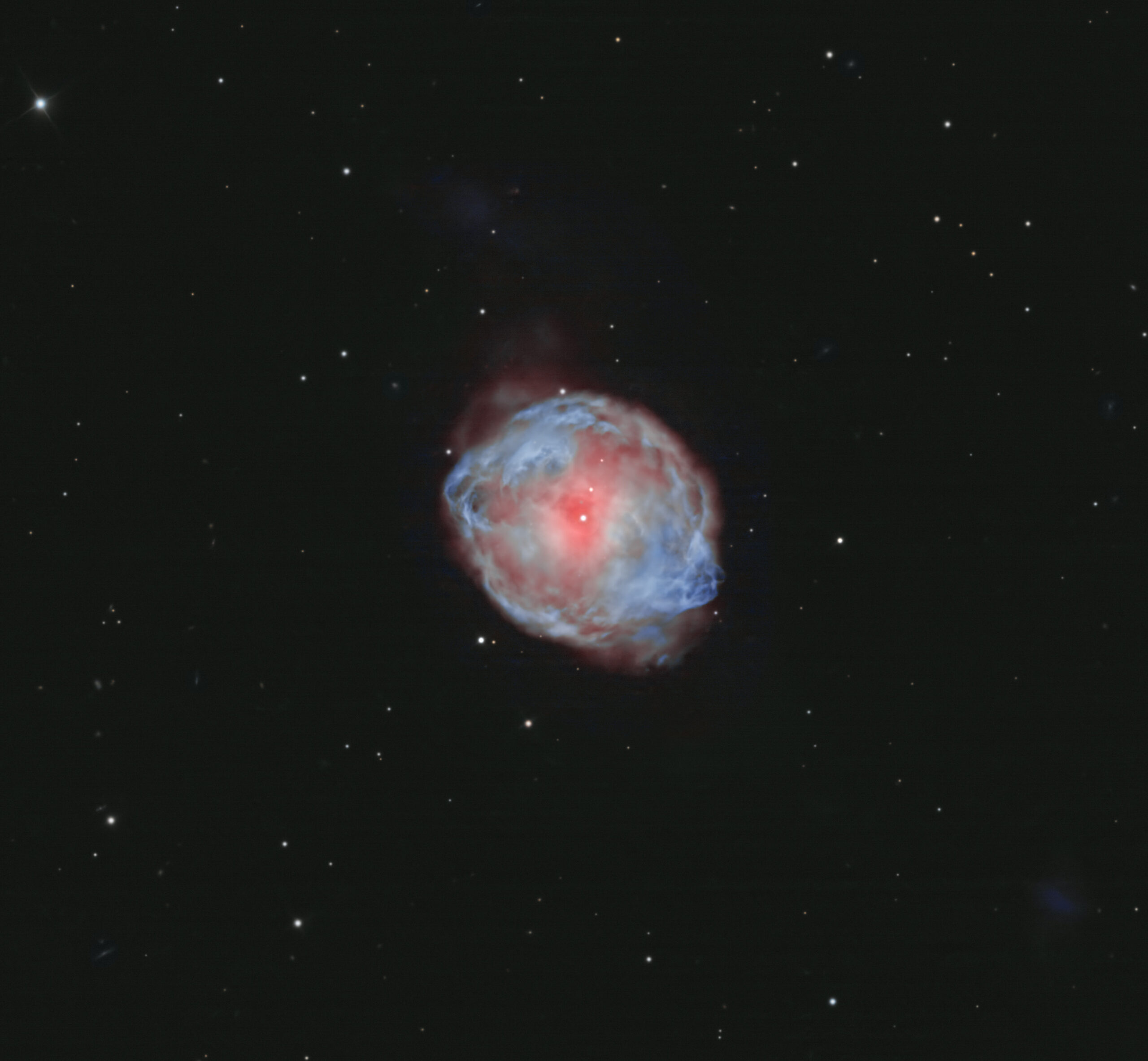
A faint stellar ghost expanding into the darkness
NGC 4361 is a planetary nebula located in the constellation Corvus, classified morphologically as an irregular elliptical planetary nebula with a complex, filamentary structure shaped by asymmetric mass loss. It represents the final evolutionary phase of a low- to intermediate-mass star, where the outer layers are expelled and illuminated by the exposed, hot central white dwarf
Situated at an estimated distance of approximately 3,400 light-years, NGC 4361 spans about 2.1 arcminutes in apparent diameter, corresponding to a physical size of roughly 2.1 light-years, and shines with an integrated visual magnitude of about 10.3. Despite this, its low surface brightness makes it far less prominent per unit area, with much of its extended structure requiring careful processing to reveal. The nebula is estimated to be around 5,000 to 8,000 years old, placing it in a moderately evolved stage where the expanding shell has begun to soften and disperse into the surrounding interstellar medium. At its center lies the exposed stellar remnant, a hot white dwarf with a visual magnitude of approximately 13.0–13.5, still energetically ionizing the surrounding gas
The nebula displays a distinctly uneven shell, with a brighter, compressed inner region and a more diffuse outer envelope. The HOO mapping highlights the ionization stratification: hydrogen emission dominates the central regions, while oxygen emission traces the more extended and structured outer shell. Subtle asymmetries and irregular density variations suggest that the mass ejection was neither uniform nor spherical, possibly influenced by stellar rotation, magnetic fields, or a binary companion. Faint outer layers hint at earlier mass-loss episodes, now expanding outward and gradually fading
NGC 4361 offers a direct view into the late stages of stellar evolution, where a once Sun-like star sheds its envelope and enriches the galaxy with heavier elements. Over time, the nebula will continue to expand and dissipate, leaving behind only the compact white dwarf remnant
Imaged in HOO RGB on the ASA Astrosysteme AZ 1500 at Observatorio El Sauce, Chile.
Image Acquisition and Processing: Mike Selby