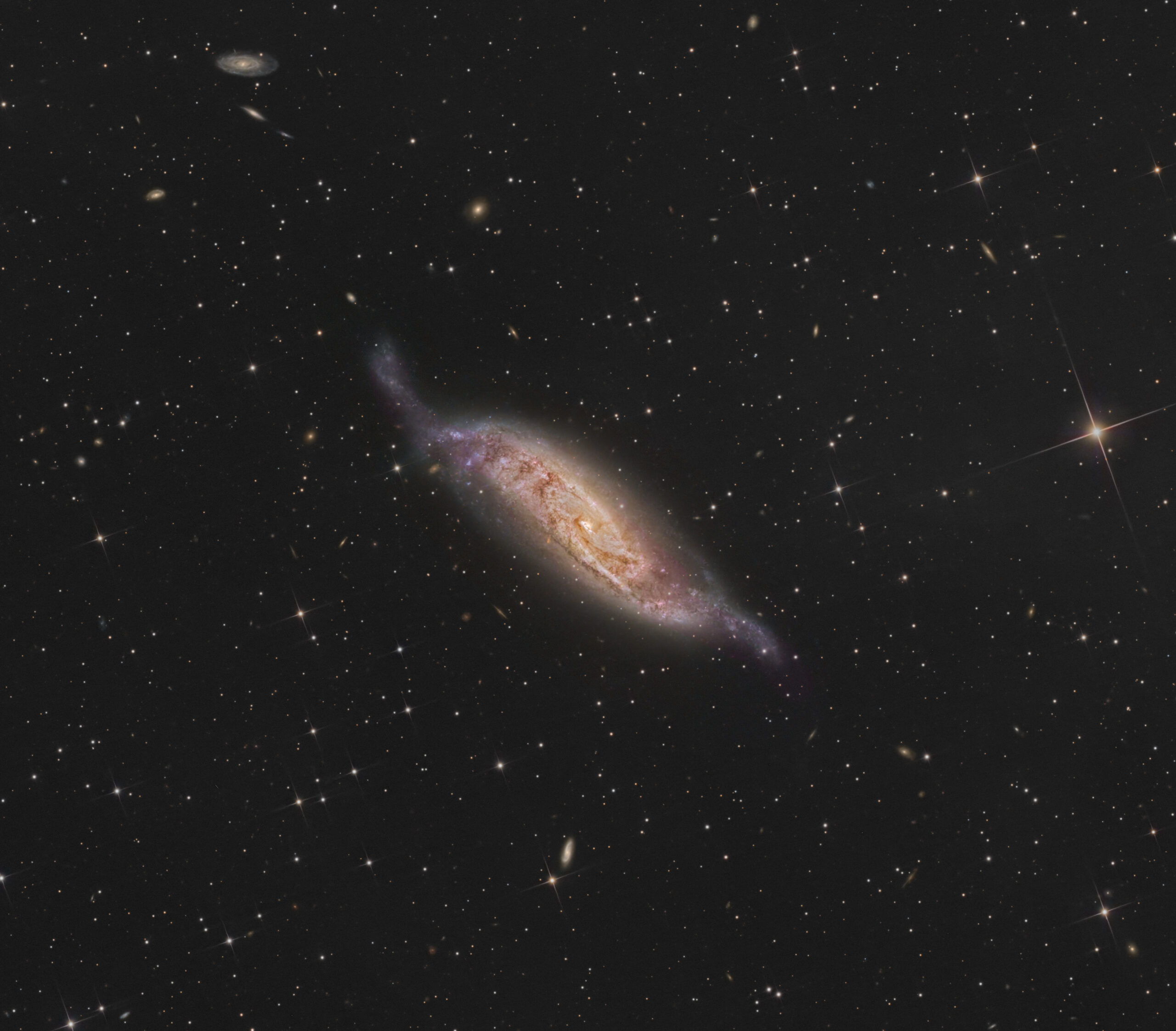
Between order and asymmetry, a spiral in transition
NGC 4219 is a spiral galaxy in Centaurus, classified as SA(s)bc, but it does not display the clean, organized arm structure often associated with that type. Seen at a strong inclination, the galaxy appears elongated and unsettled, with a disk that feels only partly coherent rather than neatly ordered. Its apparent size is 3.7 × 1.1 arcminutes, and at a distance of about 72 million light-years it spans roughly 111,000 light-years
What makes this system especially interesting is the character of its outer disk. The spiral pattern is weak and fragmented, and there are relatively few obvious star-forming regions for a galaxy of this class. The blue stellar concentrations that are present do not trace strong, continuous arms, but instead appear in unusual, offset positions, giving the outer structure a displaced and slightly uneasy appearance. Rather than a luminous grand-design spiral, NGC 4219 looks more like a galaxy whose gas and star formation have become patchy, uneven, and only loosely connected to the underlying spiral geometry
There is also a subtle asymmetry in the galaxy’s outer envelope. One side appears more diffuse and extended, with faint low-surface-brightness structure that suggests the stellar disk is not fully balanced. The dust pattern is weak, the arm contrast is low, and the central regions remain brighter and smoother than the outer disk, reinforcing the impression of a large spiral system whose structure has been shaped more by mild disturbance or internal unevenness than by strong, orderly density waves.
NGC 4219 is a reminder that spiral galaxies are not always elegant, symmetric systems. Some, like this one, occupy a more ambiguous state—still recognizably spiral, yet marked by sparse star formation, fragmented structure, and a disk that hints at a more complex dynamical history
Imaged in LRGB on the ASA Astrosysteme AZ 1500 at Observatorio El Sauce, Chile.
Image Acquisition and Processing: Mike Selby