A collision written in starlight and gravity
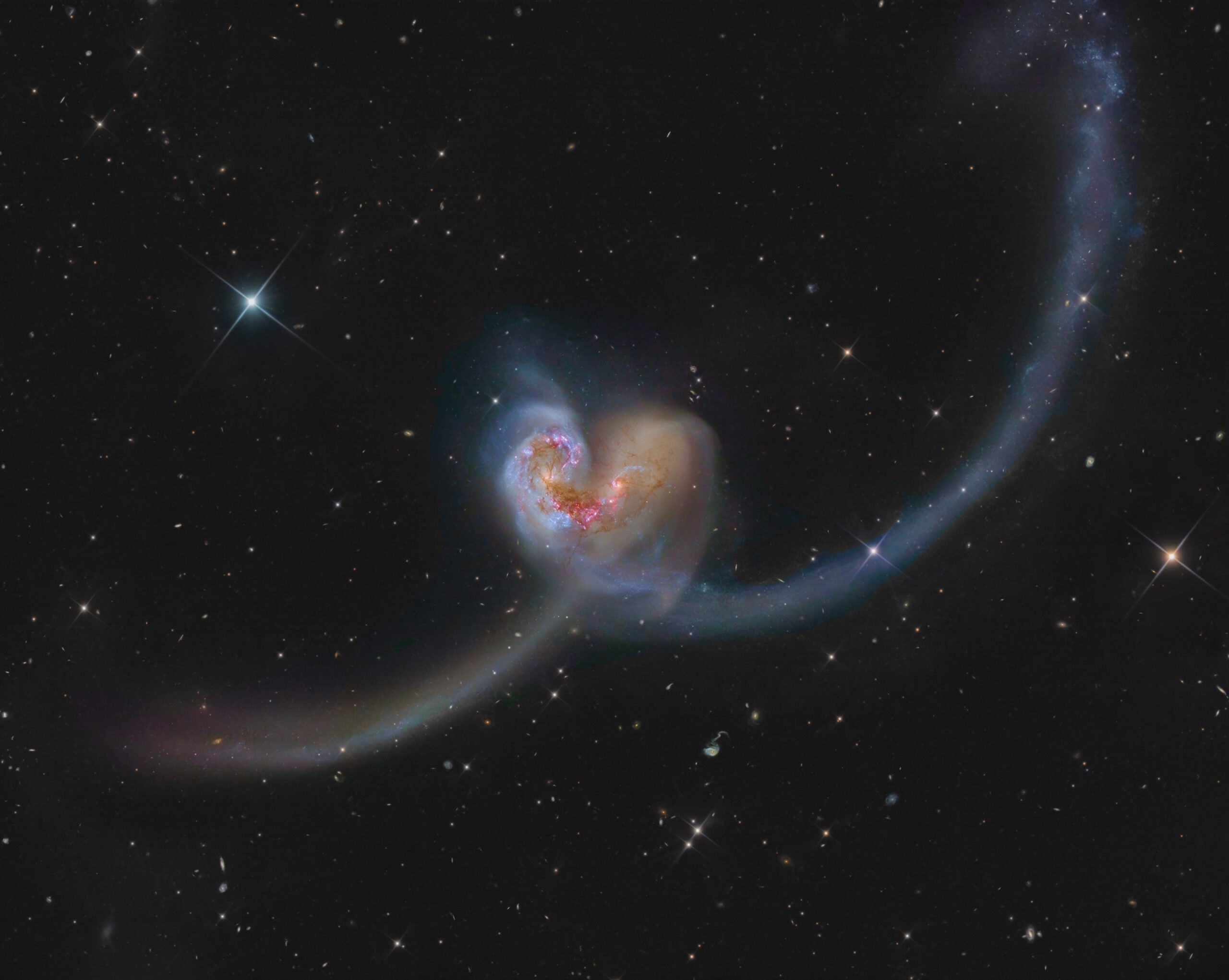
The Antennae Galaxies, NGC 4038 and NGC 4039, form a strongly interacting pair classified as SA(s)m pec + SB(s)m pec in the constellation Corvus. These two spiral galaxies are caught in the late stages of a gravitational encounter, their original structures now profoundly distorted as tidal forces reshape them into one of the most iconic merger systems in the nearby universe. The two nuclei are offset and unequal, revealing an asymmetric interaction where each galaxy responds differently to the encounter — one retaining a more structured, blue star-forming envelope, the other appearing more diffuse and dust-dominated.
Located at a catalog-verified distance of approximately 82.8 million light-years, the system spans about 5.4 × 3.1 arcminutes on the sky, corresponding to a physical extent of roughly 130,000 light-years across when including the full tidal structure. These immense tidal tails trace the orbital history of the interaction, flung outward by gravitational torque and destined to fall back over time as the system evolves toward a single, merged galaxy.
At the heart of the system lies the so-called overlap region — not a single core, but a turbulent zone where gas from both galaxies collides and compresses. This region hosts one of the most intense starburst environments in the nearby universe, giving rise to hundreds of massive, compact young star clusters. Many of these are thought to be proto–globular clusters, offering a rare glimpse of globular cluster formation in progress. The intricate dust lanes and luminous Hα knots embedded within this region trace shock fronts, gas inflows, and the violent dynamics driving rapid star formation.
The sweeping tidal tails — the “antennae” — are not uniform streams but complex structures containing gradients in stellar populations. Their inner regions remain brighter and more structured, while the outer extensions become fainter and in places distinctly bluer, marking regions of more recent star formation. Within these distant reaches, localized condensations of gas and stars may represent the early stages of tidal dwarf galaxies — new galaxies forming from material stripped during the interaction rather than from primordial collapse.
Subtle variations in color and structure throughout the system reveal the underlying physics of the merger: the interplay of gravity, gas dynamics, and star formation reshaping both galaxies in real time. Curved dust lanes and disrupted stellar streams map the flow of material under strong tidal forces, while the contrast between blue stellar populations and red emission regions highlights the ongoing cycle of star birth triggered by the collision.
Over the next few hundred million years, this system will complete its merger, likely forming a single massive elliptical galaxy. In the process, spiral structure will be erased, angular momentum redistributed, and a new, dynamically relaxed system will emerge — a transformation that illustrates how galaxy collisions drive the evolution of structure in the universe
Imaged in LRGB and H alpha on the ASA Astrosysteme AZ 1500 at Observatorio El Sauce, Chile.
Image Acquisition and Processing: Mike Selby