A Spiral Shaped from Within
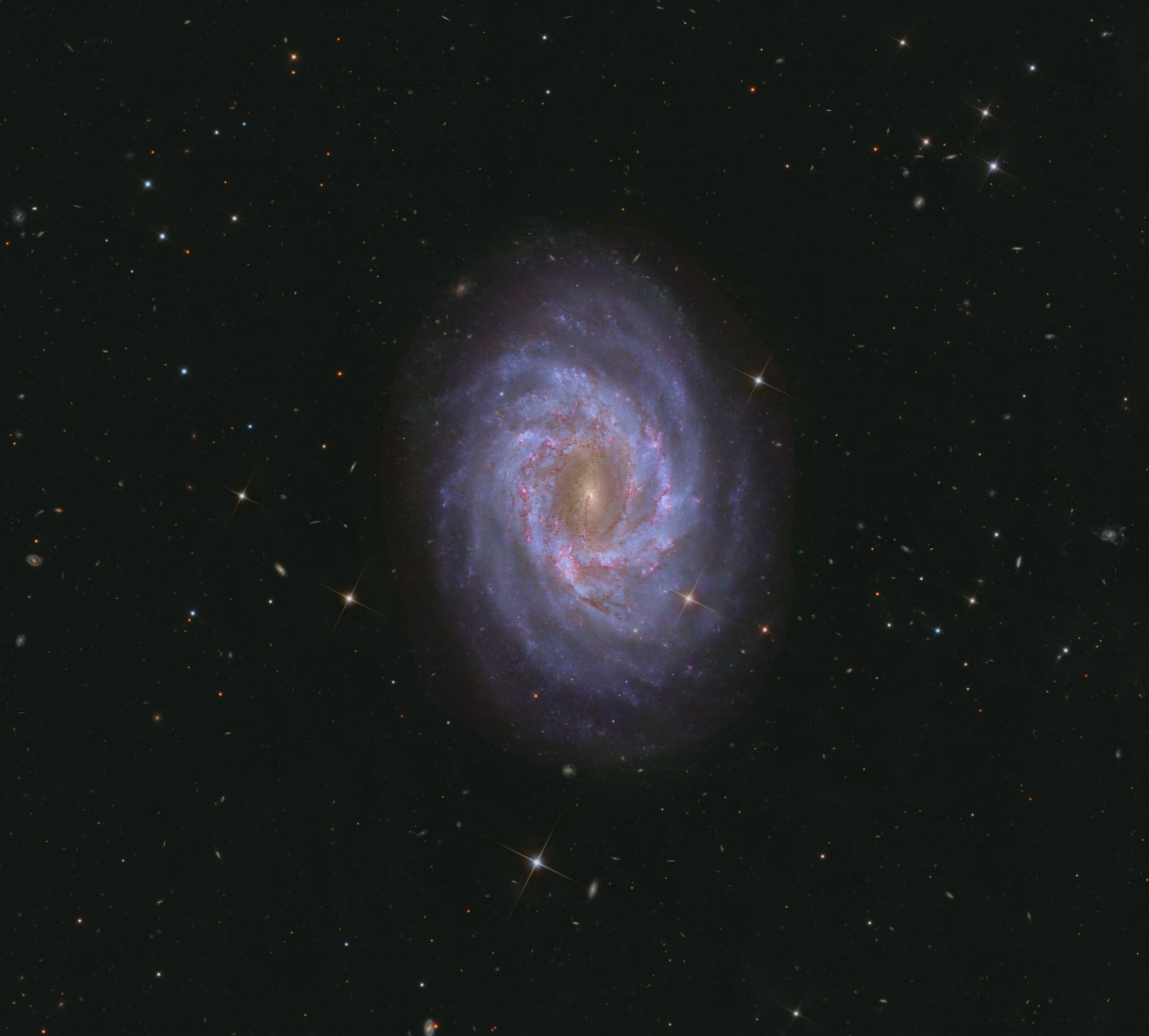
NGC 3887 is a barred spiral galaxy of morphological type SB(r)bc, located in the constellation Crater. Seen nearly face-on, it reveals a coherent internal structure where a strong stellar bar feeds into a subtle inner ring, from which the spiral arms emerge and unwind across the disk
At a distance of approximately 57.7 million light-years, NGC 3887 spans 3.7 × 2.5 arcminutes, corresponding to a physical diameter of about 60,800 light-years. Though smaller than the Milky Way, its structure is well-developed and clearly resolved
The galaxy’s defining feature is the interplay between its bar and ring. The inner ring appears partially blended into the spiral pattern, suggesting an evolving resonance region rather than a sharply defined boundary. The spiral arms are uneven in brightness and structure, showing a mildly flocculent character rather than strict symmetry. Woven through these arms are dark dust lanes, tracing dense interstellar material that outlines the spiral pattern and adds depth and contrast to the disk. Along the same structures, numerous pink H II regions mark active star-forming sites, with a noticeable imbalance in their distribution—one side of the galaxy appears more active, hinting at localized variations in gas density or star formation efficiency
The central region is dominated by an older, warmer stellar population, while the outer arms transition into bluer tones associated with younger stars. This contrast reflects the ongoing redistribution of gas by the bar, which continues to shape the galaxy’s structure through internal, secular processes rather than external interactions.
NGC 3887 stands as a clear example of a spiral galaxy whose form is governed from the inside out, where the slow dynamics of its bar, dust, and star-forming regions continue to sculpt its evolving architecture
Imaged in LRGB on the ASA Astrosysteme AZ 1500 at Observatorio El Sauce, Chile.
Image Acquisition and Processing: Mike Selby