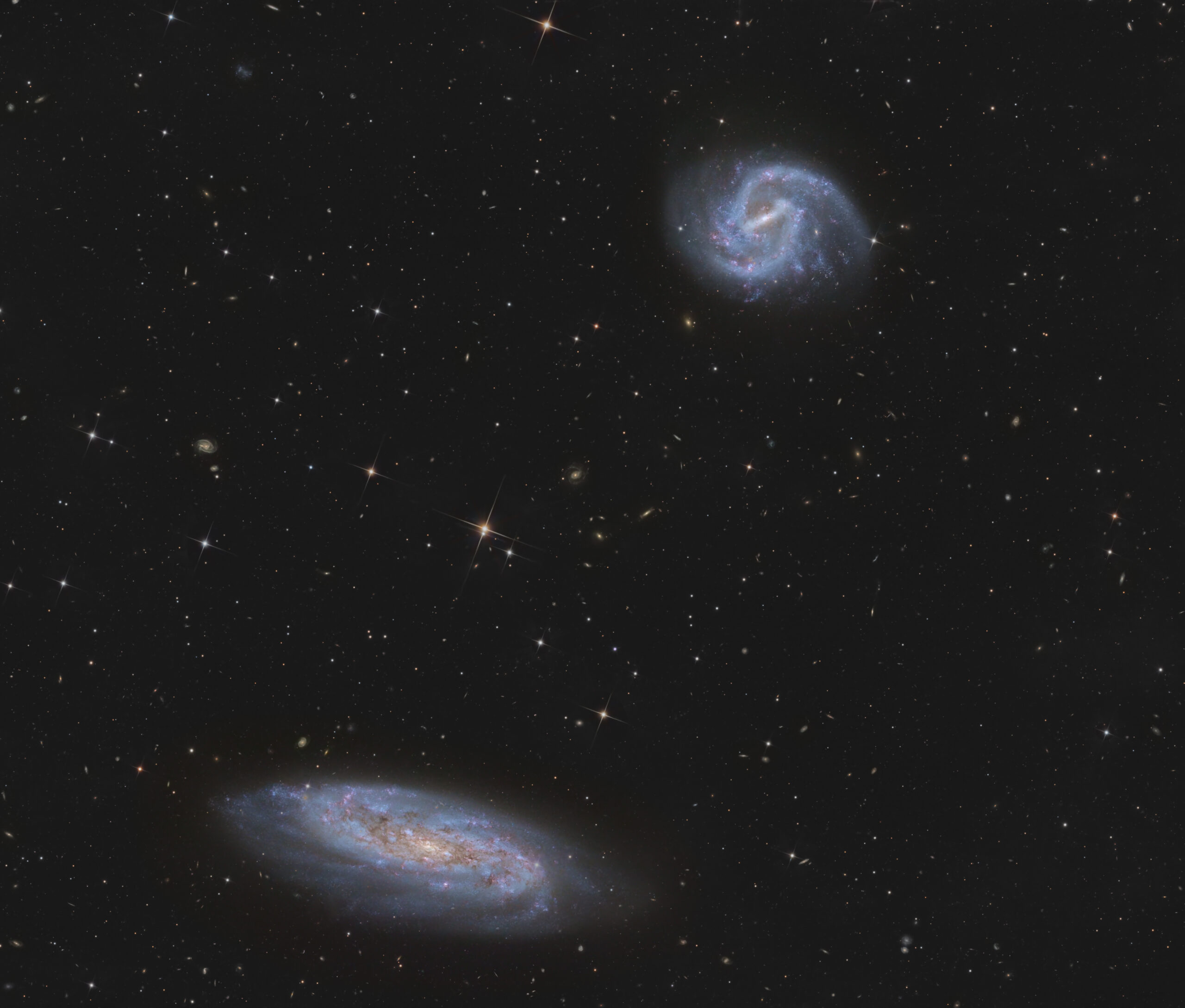
A tilted disk and a face-on spiral, sharing the frame but not the same space
NGC 3511 and NGC 3513 reside in the constellation Hydra, forming a striking visual pairing created by line-of-sight alignment rather than physical interaction. NGC 3511 is classified as SA(s)c, an unbarred spiral seen at a high inclination—tilted rather than fully edge-on—allowing both its disk thickness and internal structure to be visible at once. Its dust lanes appear uneven and fragmented, cutting across a luminous, mottled stellar disk where patches of star formation emerge through the obscuration. Above it, NGC 3513 is a SB(rs)d barred spiral viewed nearly face-on, with a weak central bar and loosely wound, flocculent arms that give it a broken, irregular appearance rather than a coherent grand design.
NGC 3511 lies at a distance of approximately 41.0 million light-years and spans about 9.0 × 2.2 arcminutes, corresponding to a physical diameter near 107,000 light-years. NGC 3513 is slightly farther at roughly 47 million light-years, with an apparent size of 2.7 × 2.3 arcminutes, translating to a physical extent of about 37,000 light-years
Several subtle features add depth to this field. NGC 3511’s inclined geometry reveals both the dust structure and the underlying stellar disk simultaneously, with localized bright knots embedded within the dusty lanes marking active star formation. Its outer disk appears slightly asymmetric and diffuse, hinting at mild warping or past gravitational influence. In contrast, NGC 3513 shows patchy blue star-forming regions scattered along discontinuous arms, emphasizing its flocculent nature rather than a well-organized spiral pattern. The surrounding field is populated with numerous distant background galaxies, many faint and elongated, adding a deeper cosmological context behind the foreground pair.
The pairing highlights how orientation shapes perception: one galaxy revealing layered structure through tilt and dust, the other displaying its spiral architecture openly. Though unrelated in space, together they form a natural comparison of spiral morphology and viewing geometry
Imaged in LRGB on the ASA Astrosysteme AZ 1500 at Observatorio El Sauce, Chile.
Image Acquisition and Processing: Mike Selby