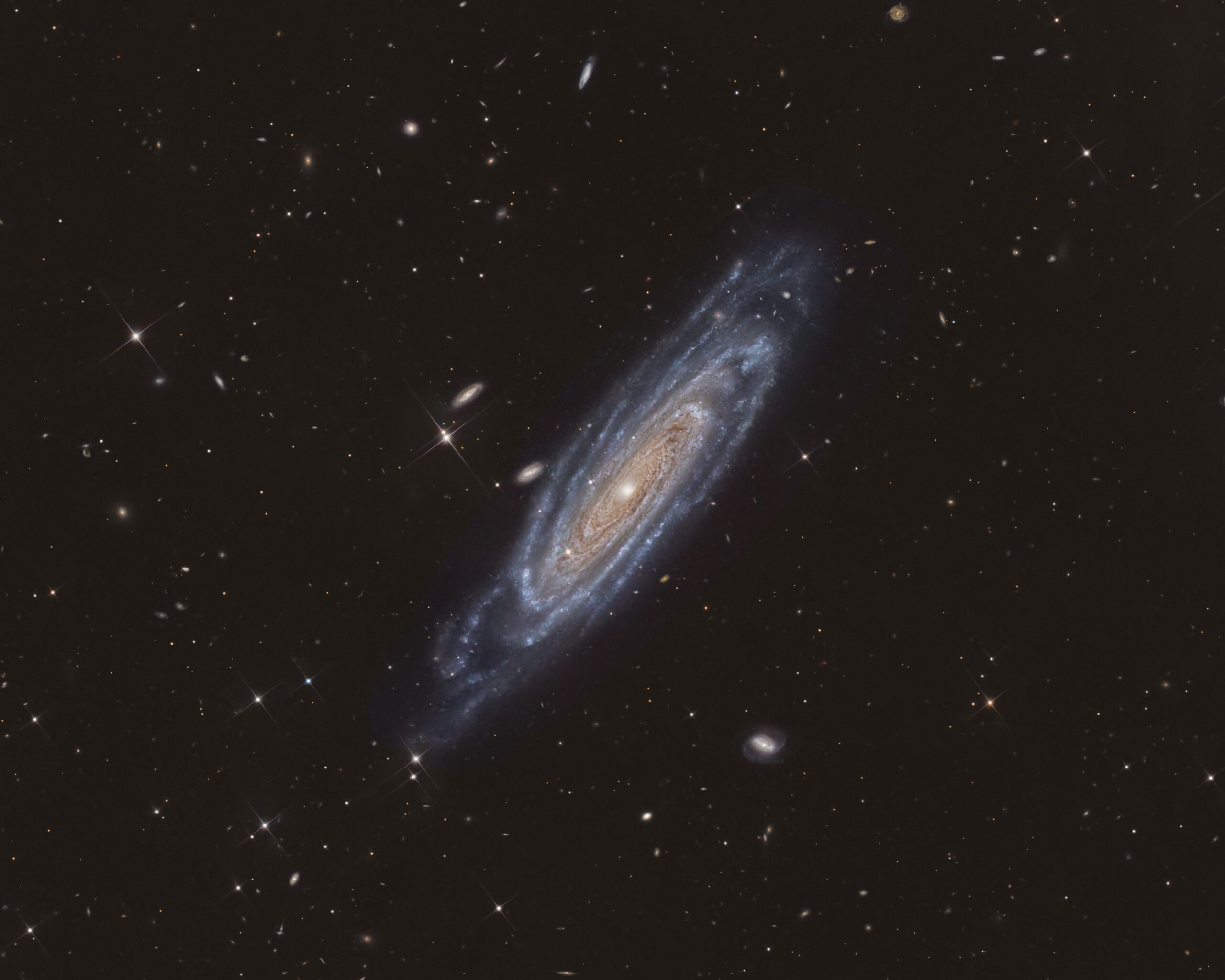
A Vast Spiral Emerging from the Depths of Hydra
NGC 3200 is a spiral galaxy in the constellation Hydra, morphologically classified as SAB(rs)c, indicating a weakly barred spiral with a partial inner ring and loosely wound arms. The galaxy lies roughly 187 million light-years from Earth and shines at an apparent magnitude of about 12.0. On the sky it spans approximately 4.2 × 1.3 arcminutes, corresponding to a true diameter of about 230,000 light-years, making it substantially larger than the Milky Way.
Seen at a moderate inclination, the disk reveals a complex network of spiral arms emerging from a bright central bulge. The inner structure hints at a subtle weak bar, from which the spiral arms appear to originate before sweeping outward through the disk. The arms themselves are irregular and asymmetric, breaking into fragmented segments rather than forming a perfectly symmetric two-arm pattern. Numerous bright star-forming knots are scattered along the arms where dense gas clouds are collapsing to create new generations of stars.
Threaded through the disk is an intricate system of dark dust lanes that curve across the spiral arms and inner disk. These dusty filaments trace cold molecular gas within the galaxy’s interstellar medium and outline the spiral density waves that organize the disk. In several regions the outer arms appear distorted and uneven, suggesting subtle gravitational disturbances or long-term dynamical evolution within the galaxy’s outer disk.
The warm yellow glow of the central bulge is produced by an older stellar population, contrasting with the bluish light of young stars scattered throughout the spiral arms. This mixture of stellar ages highlights the ongoing life cycle of matter within the galaxy as gas clouds collapse, ignite new stars, and gradually enrich the surrounding interstellar environment.
Beyond NGC 3200 itself, the field is filled with dozens of faint background galaxies, some appearing as tiny edge-on disks and others as small elliptical glows. Many of these distant systems lie hundreds of millions or even billions of light-years farther away, creating a layered view of the universe in which this massive spiral stands as the nearest and most prominent island of stars
Imaged in LRGB on the ASA Astrosysteme AZ 1500 at Observatorio El Sauce, Chile.
Image Acquisition and Processing: Mike Selby