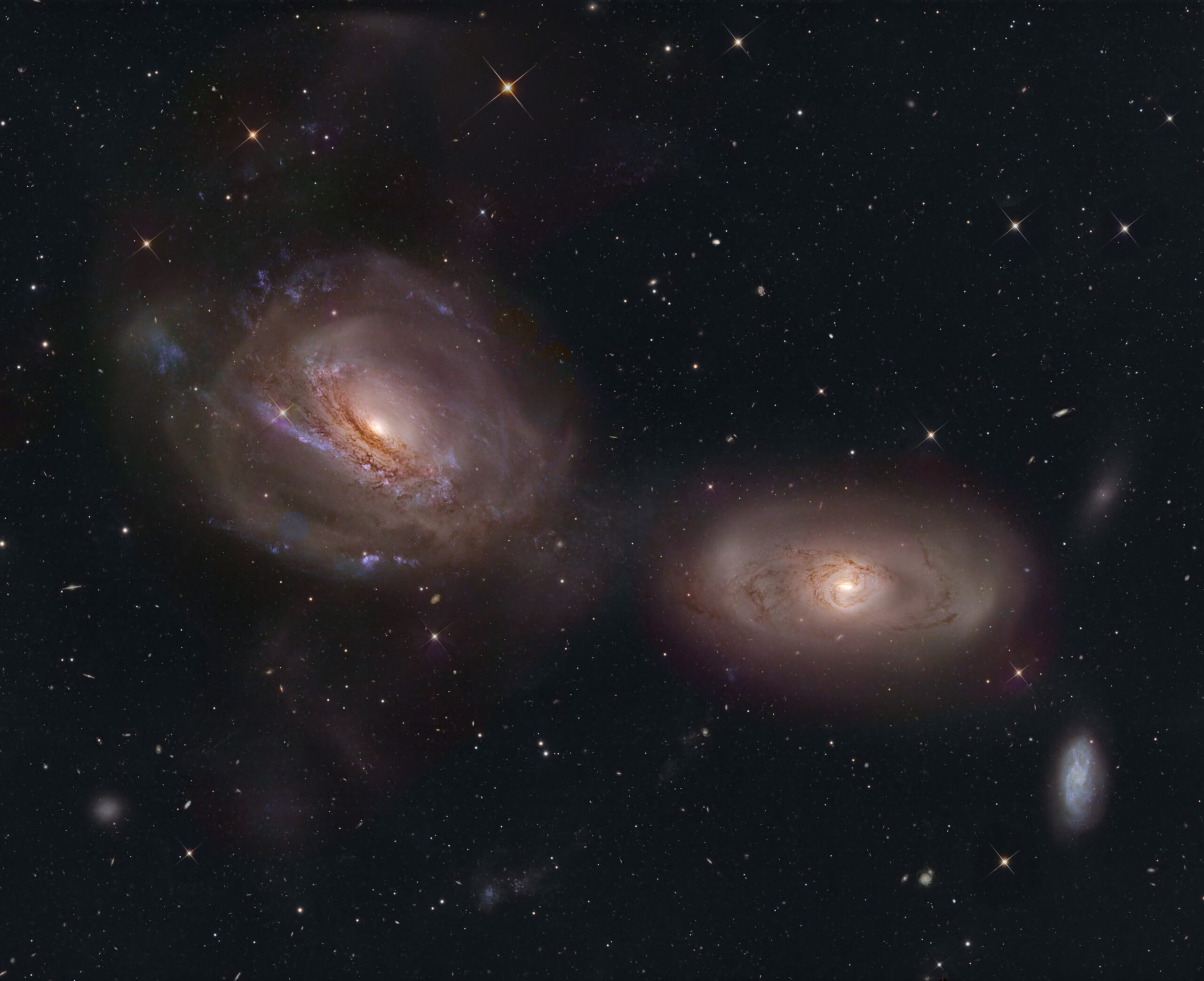
A distorted spiral under tidal stress, caught in the early stages of galactic interaction
NGC 3169 and NGC 3166 form an interacting galaxy pair in the constellation Sextans, separated by only a small distance in space and now beginning to distort one another through tidal forces. NGC 3169 is classified as an SA(s)a spiral galaxy, displaying a bright elongated core and tightly wound arms that are already noticeably asymmetric. Its companion, NGC 3166, is an SA(s)0/a system—a transitional lenticular–spiral galaxy with a smoother disk and a more subdued internal structure
Located at a distance of approximately 70 million light-years, NGC 3169 spans about 110,000 light-years in diameter, with an apparent angular size of roughly 4.6 × 2.1 arcminutes. NGC 3166 is somewhat smaller, measuring about 75,000 light-years across with an apparent size of approximately 3.9 × 2.3 arcminutes. Both galaxies shine near magnitude 10.9, appearing modest in brightness but revealing intricate structure under deep, high-resolution imaging.
The structure of NGC 3169 is already significantly disturbed. Its spiral arms are lopsided and partially unwound, while a warped dust lane cuts irregularly across the luminous core, indicating that the galaxy’s internal dynamics are being affected. Faint blue star-forming regions appear in a patchy, uneven distribution, no longer tracing a clean spiral pattern. Surrounding the galaxy, the outer halo shows subtle distortion and extension, with faint tidal material beginning to stretch toward NGC 3166
In contrast, NGC 3166 appears more orderly at first glance, but closer inspection reveals a system that is not entirely undisturbed. Its disk lacks perfect symmetry, and its outer regions hint at the same gravitational influence shaping its companion. Together, the pair illustrates an early stage of interaction—before dramatic tidal tails fully develop, but after gravity has already begun to reshape structure, redistribute stars, and alter the evolution of both galaxies
Imaged in LRGB on the ASA Astrosysteme AZ 1500 at Observatorio El Sauce, Chile.
Image Acquisition and Processing: Mike Selby