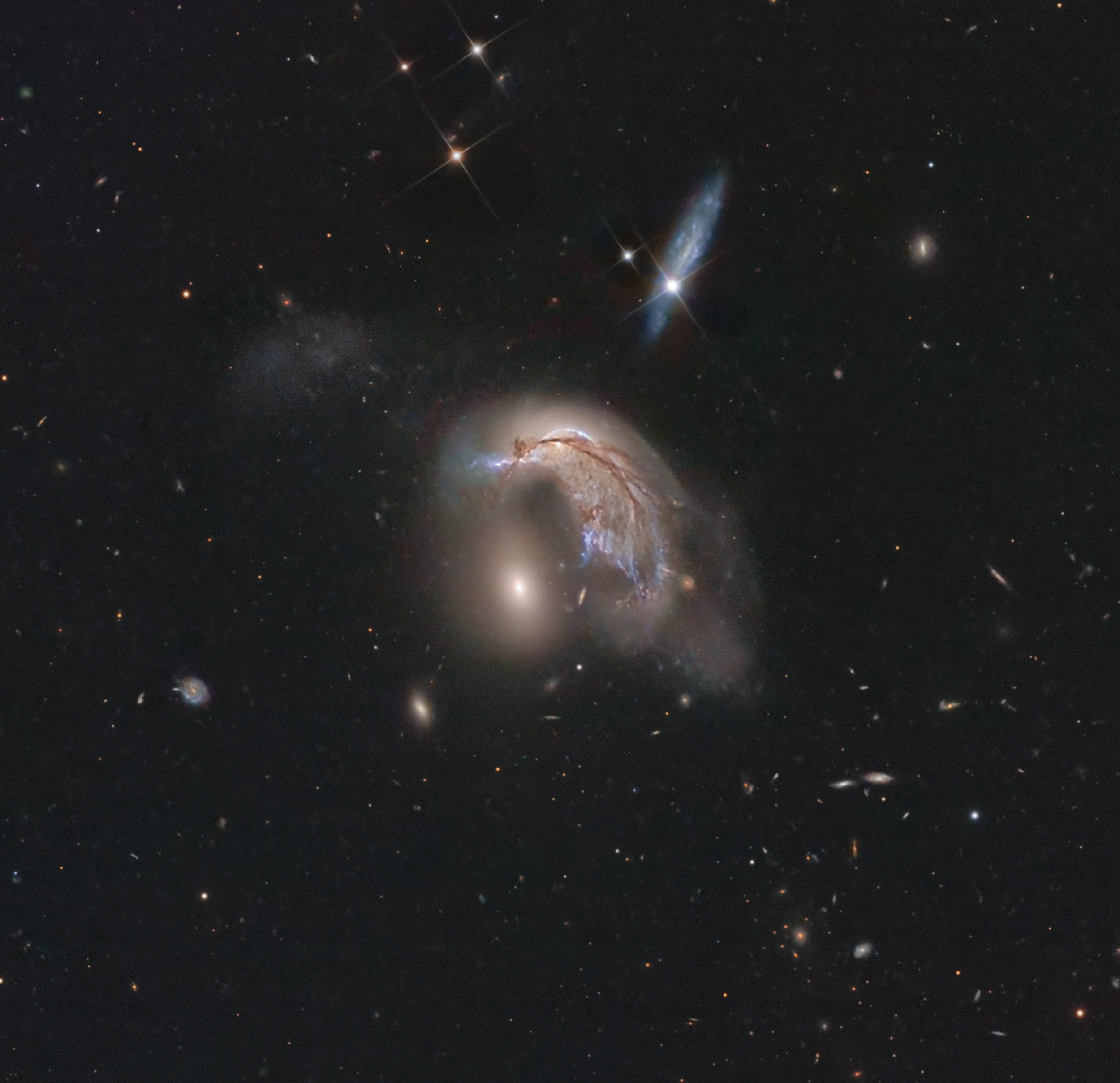
A cosmic penguin emerges as tidal forces unwind a spiral galaxy
NGC 2936, the distorted spiral component of the interacting system Arp 142 in the constellation Hydra, is a striking example of tidal disruption in progress. Originally a spiral galaxy, it is now classified as peculiar/irregular, its structure reshaped by a close gravitational encounter with the elliptical companion NGC 2937.
At a distance of approximately 356 million light-years, NGC 2936 spans about 1.3 arcminutes, corresponding to a physical size of roughly 77,500 light-years. Its present appearance reflects the dominance of tidal forces over intrinsic structure, with much of its original disk stretched, displaced, and drawn into a sweeping tidal arc.
The most prominent feature is this curved plume—remnant spiral structure pulled outward by gravitational forces. Along it, clusters of young, massive stars trace regions of compressed gas, producing the characteristic blue star-forming knots. The inner regions retain warmer tones from older stellar populations, intersected by a pronounced dust lane that marks the surviving core of the disrupted disk. A faint, diffuse stellar envelope surrounds the system, composed of stars stripped into tidal debris, while subtle counter-streaming material hints at the full three-dimensional geometry of the interaction. The companion galaxy, NGC 2937, appears smooth and elliptical, yet its gravitational influence is clearly responsible for the dramatic transformation of its partner.
In the upper-left of the field lies PGC 1237172, an Sc-type spiral galaxy that remains structurally intact. It is located at a distance of approximately 230 million light-years and spans about 0.87 arcminutes, corresponding to a physical size of roughly 58,000 light-years. Its well-defined spiral arms and active star-forming regions provide a clear contrast to the disrupted morphology of NGC 2936, illustrating how disk galaxies can retain ordered structure in the absence of strong gravitational interaction.
This field captures multiple stages of galaxy evolution simultaneously: an undisturbed spiral maintaining coherent structure, and a neighboring system undergoing active tidal transformation. Over time, NGC 2936 and NGC 2937 are expected to merge, forming a single, more massive galaxy with a fundamentally altered morphology and redistributed stellar content.
Imaged in LRGB on the ASA Astrosysteme AZ 1500 at Observatorio El Sauce, Chile.
Image Acquisition and Processing: Mike Selby