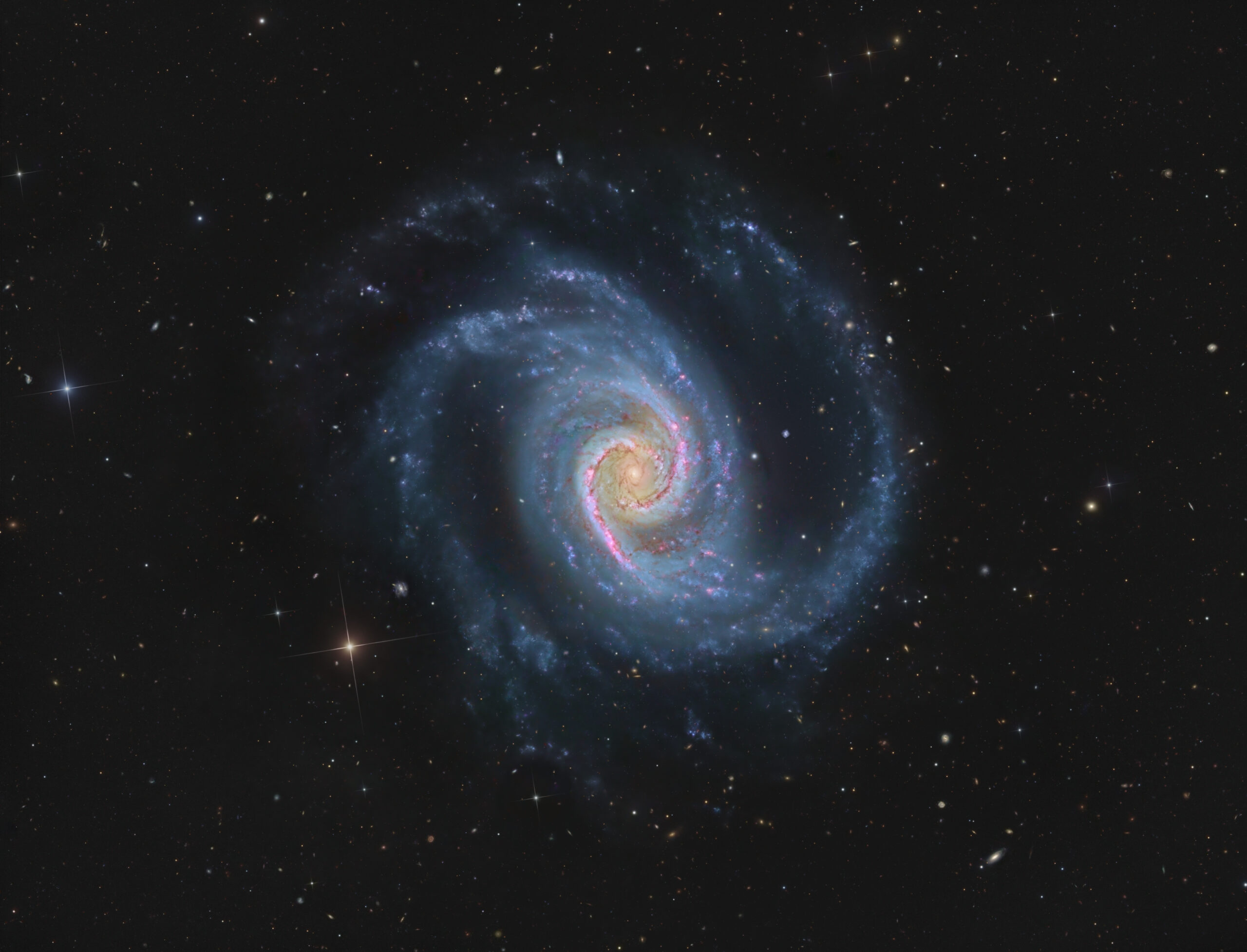
NGC 1566, the Spanish Dancer, is a grand design barred spiral galaxy in the southern constellation Dorado, classified (R’1)SAB(rs)bc, with a Seyfert 1 active nucleus at its heart. Its nickname comes from the sweeping curves of its two spiral arms, which recall the flowing arms and skirts of a dancer in mid-spin
It lies about 31 million light-years away and spans about 13 arcminutes on the sky, a physical diameter of roughly 118,000 light-years, with an apparent magnitude of [V MAG]
Two strikingly symmetric arms unwind from a compact, brilliant core and short bar, traced by chains of blue star clusters and pink hydrogen-alpha nebulae where new stars are forming, with dark dust lanes running along their inner edges. Farther out the arms fade and broaden into a faint outer pseudo-ring, and distant background galaxies scatter across the field, among them a small edge-on spiral near the lower right
NGC 1566 is a prominent member of the Dorado Group, a loose gathering of galaxies in the southern sky
Its nucleus hosts a supermassive black hole that is actively feeding, one of the nearest and brightest Seyfert nuclei known, and it has been observed to flare dramatically and change its spectral character over just a few years, a rare chance to watch a galaxy’s central engine switch on and off in human time
Imaged in LRGB and Hα, OTA ASA AZ 1500, Camera Moravian C5A 150M, at Observatorio El Sauce, Chile
Image Acquisition and Processing: Mike Selby