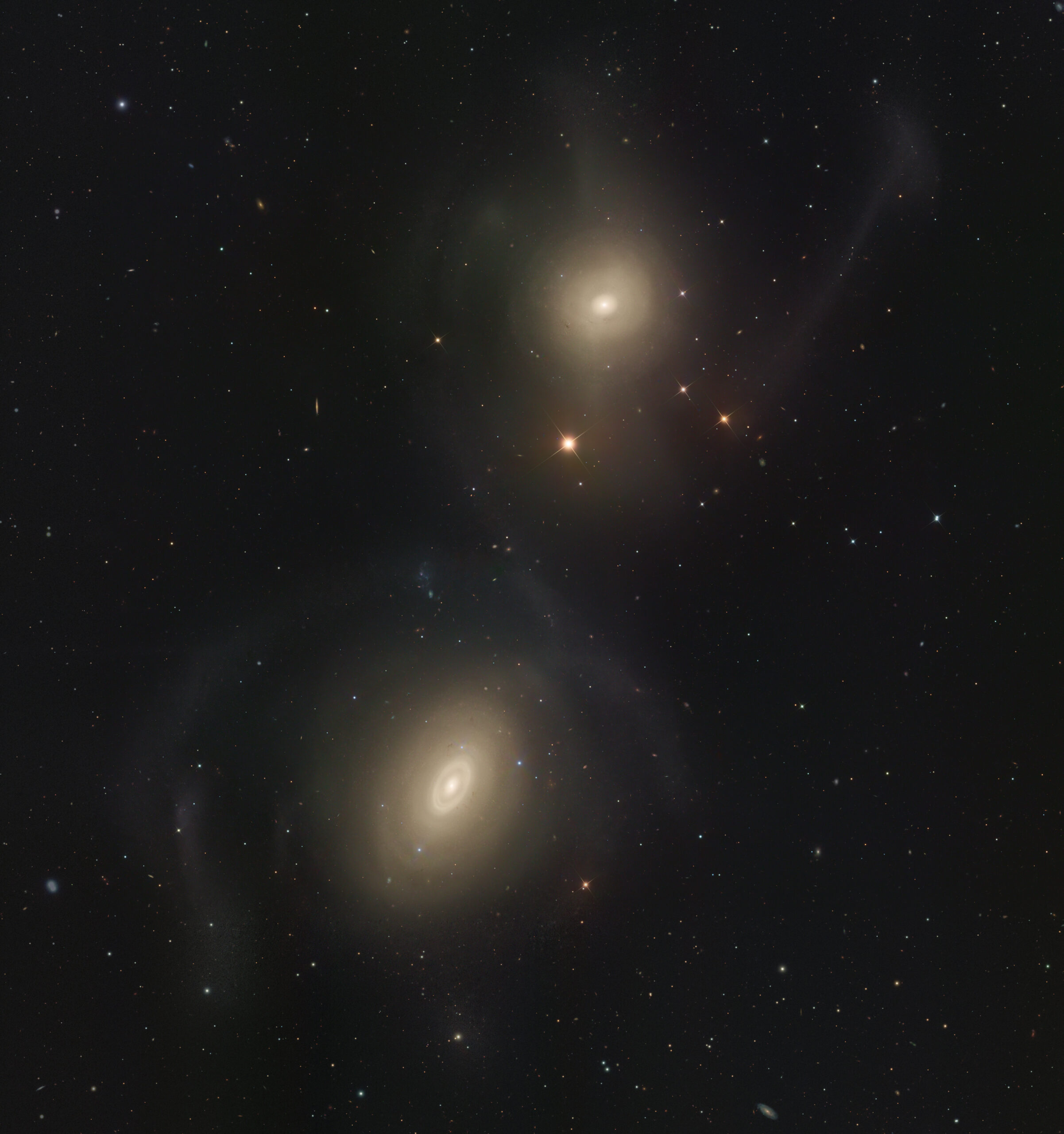
Two giants of the Dorado Group, each still wrapped in the shells and streams of the galaxies it consumed
NGC 1553 and NGC 1549 form a close pair in the southern constellation Dorado. NGC 1553 is a lenticular galaxy classified SA(rl)0^0, with an inner ring-lens structure and a LINER nucleus, while NGC 1549 is a nearly round elliptical galaxy of type E0-1. Both are among the brightest members of the Dorado Group
Surface brightness fluctuation measurements place both galaxies about 60 million light-years away. NGC 1553 spans 4.5 by 2.8 arcminutes, roughly 78,000 light-years across, and shines at magnitude 10.3. NGC 1549 spans 4.9 by 4.1 arcminutes, roughly 87,000 light-years across, at magnitude 10.7
At the heart of NGC 1553 a bright, compact nucleus sits inside a smooth lens traced by thin nested rings, all embedded in a broad, warm halo. NGC 1549 appears smooth and featureless at first glance, but deep exposure reveals faint concentric shells around it, a plume of starlight rising to the north, and a long, thin stellar stream curving away to the northwest. Faint arcs also wrap the outskirts of NGC 1553, most clearly on its eastern side
The two galaxies lie about 12 arcminutes apart, a projected separation of roughly 210,000 light-years, and their recession velocities of 1,080 and 1,256 km/s confirm that they are genuine neighbors rather than a chance alignment. They have long been regarded as an interacting pair, but recent deep imaging from ESA’s Euclid space telescope found no clear evidence of a direct encounter. The shells and streams around each galaxy instead record its own separate history
Shells and streams like these are the fossil record of galactic cannibalism. When a large galaxy absorbs a smaller companion, the stars of the victim spread out along its orbit and pile up at the turning points, forming sharp-edged shells that can persist for billions of years. NGC 1549 carries the imprint of an ancient major merger followed by several separate minor accretions, each leaving its own thin stream, the largest of them the plume to the north. NGC 1553 appears to have been transformed from a disk galaxy into a lenticular by a succession of minor mergers, its shells marking companions that fell in on nearly head-on orbits
Imaged in LRGB on Planewave CDK 1000, Camera Moravian C5 100, at Observatorio El Sauce, Chile
Image Acquisition and Processing: Mike Selby