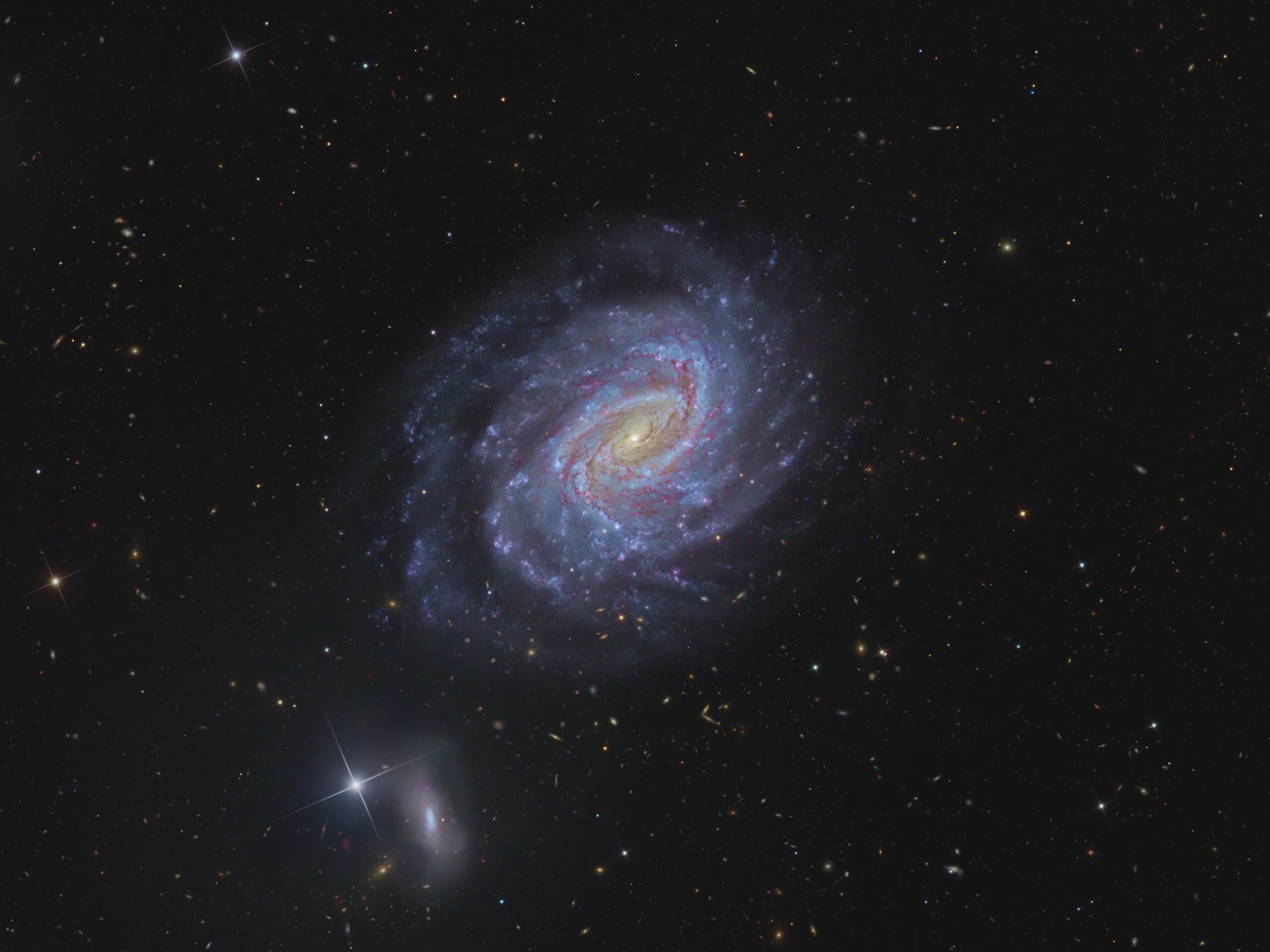
Peaceful from 54 million light-years away, but this spiral has blown up two stars since 1982 and is busy making replacements
NGC 1187 is a barred spiral galaxy of type SB(r)c in the constellation Eridanus, seen almost face-on
It lies about 54 million light-years away and shines at about magnitude 10.9. Standard catalog measurements give it 5.5 by 4.1 arcminutes, roughly 87,000 light-years across, while its faint outer arms reach nearly 8.3 arcminutes, some 130,000 light-years from end to end
A subtle bar crosses the warm yellow core, traced by fine dark dust lanes along its leading edges. Around it the inner arms wind into a near-ring studded with pink hydrogen regions, where hot young stars ionize the clouds that gave them birth. With the bar running straight through it, this oval ring gives the center the look of the Greek letter phi. Beyond the ring, half a dozen looser arms break into patchy blue star clusters that fade gradually into the dark, and countless far more distant galaxies, small yellow and orange smudges, are scattered across the field and even glimpsed through the disk itself
NGC 1187 has hosted two supernovae, SN 1982R and SN 2007Y. The second was a helium-rich Type Ib explosion, the collapse of a massive star that had already shed its outer hydrogen envelope. It was followed in detail from X-rays to radio waves, making it one of the best-studied explosions of its kind
The bar acts as a funnel, driving gas inward to fuel the ring of star formation, and the nucleus shows the signature of young stars rather than an actively feeding black hole. Much of the light of these young stars is absorbed by dust and re-emitted in the far infrared, where NGC 1187 shines almost as brightly as it does in visible light
Imaged in LRGB, OTA ASA AZ 1500, Camera Moravian C5A 150M, at Observatorio El Sauce, Chile
Image Acquisition and Processing: Mike Selby