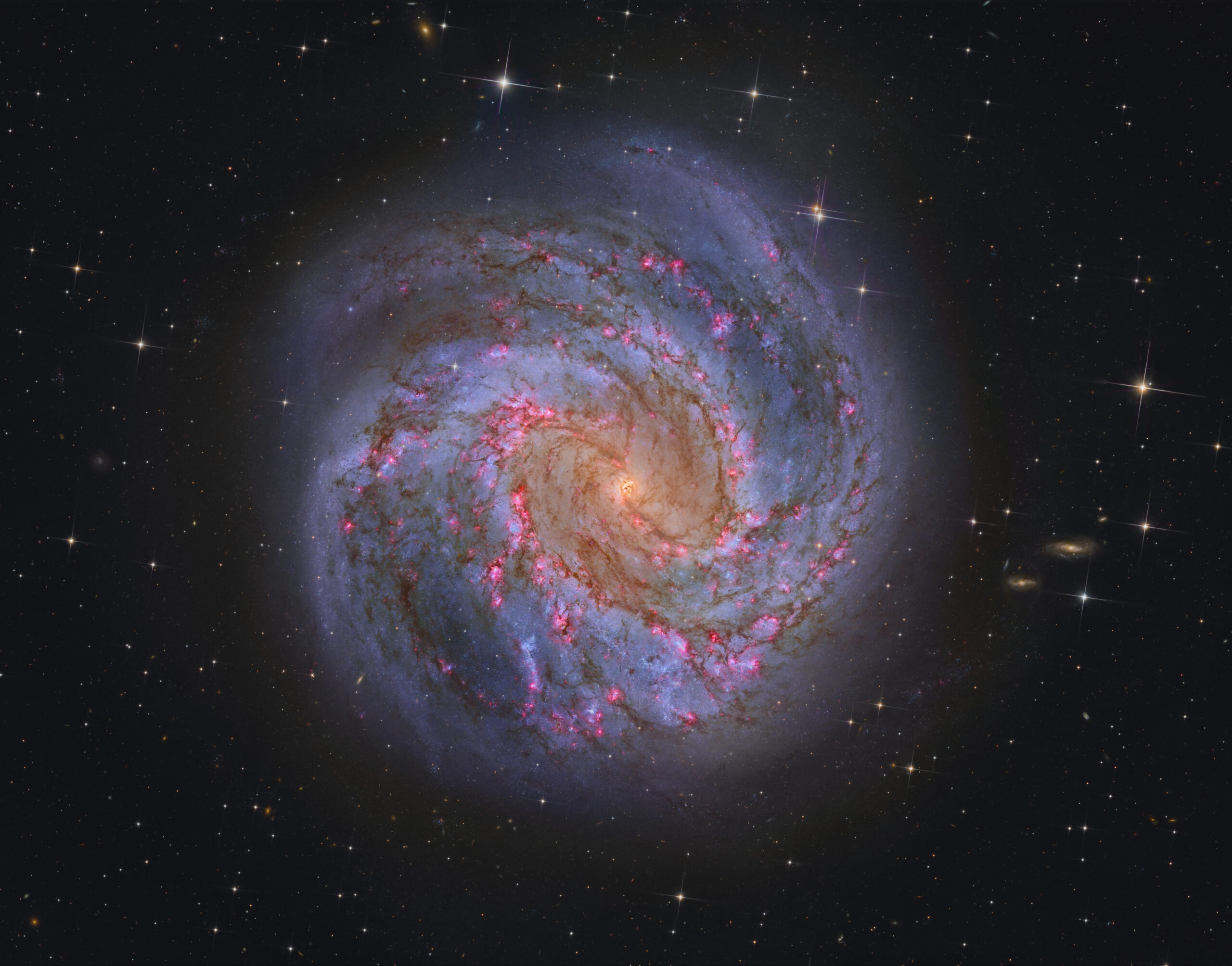
A luminous spiral where individual stellar nurseries and clusters emerge from the grand design
Messier 83 (NGC 5236) is a barred spiral galaxy of morphological type SAB(s)c, located in the constellation Hydra. Often called the Southern Pinwheel, it is one of the nearest and most structurally rich grand-design spirals, offering a detailed view of star formation on galactic scales
Situated at a carefully measured distance of about 14.9 million light-years, M83 spans approximately 12.9 × 11.5 arcminutes, corresponding to a physical diameter of roughly 55,000 light-years, with an integrated magnitude near 7.5. At this proximity, each arcsecond corresponds to about 72 light-years, and with a resolution approaching 0.7 arcseconds (~50 light-years), the image resolves structure on the scale of individual star clusters and stellar associations, revealing a level of detail rarely achieved in ground-based imaging
The loosely wound spiral arms are richly textured, breaking into chains of discrete star-forming complexes rather than smooth luminous bands. These bright knots, embedded in glowing hydrogen clouds, trace the density waves shaping the spiral pattern while also revealing local fragmentation and propagation of star formation across the disk. The dust lanes are equally intricate, appearing braided and irregular, reflecting turbulence and shock fronts within the interstellar medium
At the center, the nucleus is clearly resolved and non-stellar, showing a compact but structured starburst region. The inner morphology hints at a circumnuclear ring of star formation, where clusters are arranged in a partial ring-like distribution around the core. Subtle asymmetry in the central brightness suggests the well-known offset nuclear structure of M83, likely the result of past dynamical interactions and ongoing gas inflow. Across the outer disk, the galaxy shows mild asymmetry and uneven arm development, consistent with tidal influences within its local group environment
Astrophysically, M83 is a prototypical starburst spiral, with a high rate of star formation and frequent supernova activity. Its proximity and orientation make it an exceptional laboratory for studying how spiral density waves, turbulence, and stellar feedback combine to shape the evolution of a galaxy in detail
Imaged in LRGB and Hydrogen Alpha on the ASA Astrosysteme AZ 1500 at Observatorio El Sauce, Chile.
Image Acquisition and Processing: Mike Selby