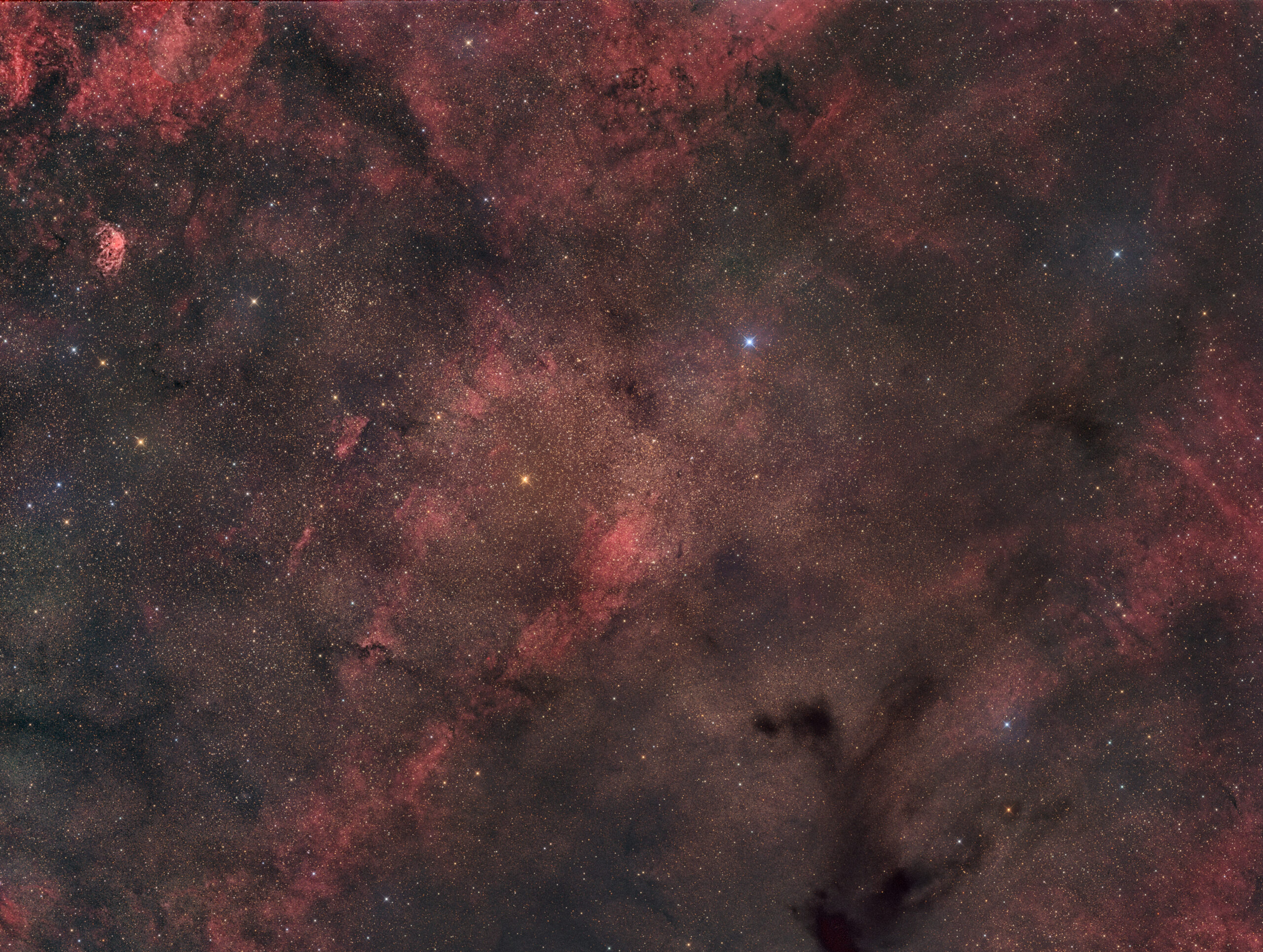
A synchrotron-dominated shell that accelerates particles beyond 100 TeV, and one of the strongest cases we have for cosmic ray production in the Galaxy
G347.3−0.5, also catalogued as RX J1713.7−3946, is a young shell-type supernova remnant in Scorpius, and one of the few remnants whose X-ray emission is almost entirely non-thermal synchrotron radiation rather than shock-heated plasma.
It lies at approximately 3,300 light years, spans roughly 60 by 50 arcminutes, and measures about 58 by 48 light years across, close to twice the apparent diameter of the Moon
Optically it is among the most difficult targets of its size in the sky, and this field is dominated instead by the star clouds of the Scorpius tail, threaded by dark absorbing clouds and diffuse hydrogen emission, with the remnant registering only as faint curved filaments of Hα and no meaningful OIII present, Ha is strongest toward the west where the X-ray and TeV shell is brightest
Near the centre lies 1WGA J1713.4−3949, a compact X-ray source with the temperature and spectrum of a central compact object, almost certainly the neutron star left by the explosion, while the molecular clouds along the western rim are both the gas the blast wave is now striking and the measurement that fixed the distance
Expansion of the outer filaments gives shock speeds near 3,900 kilometres per second and an age between roughly 1,500 and 2,300 years, which keeps alive the proposal that this is the remnant of the guest star recorded in the tail of Scorpius in AD 393, from a progenitor of some 12 to 16 solar masses that had already carved a wind-blown cavity before collapsing
Its importance lies in the spectrum rather than the appearance, since the gamma rays reaching about 100 TeV are the central test of whether the emission comes from accelerated electrons scattering starlight or from accelerated protons striking the surrounding gas, the second of which would be direct evidence that supernova remnants are the origin of Galactic cosmic rays
Imaged in Hα, RGB on the PlaneWave DR 350, Camera Moravian C5-100, at Observatorio El Sauce, Chile
Image Acquisition and Processing: Mike Selby