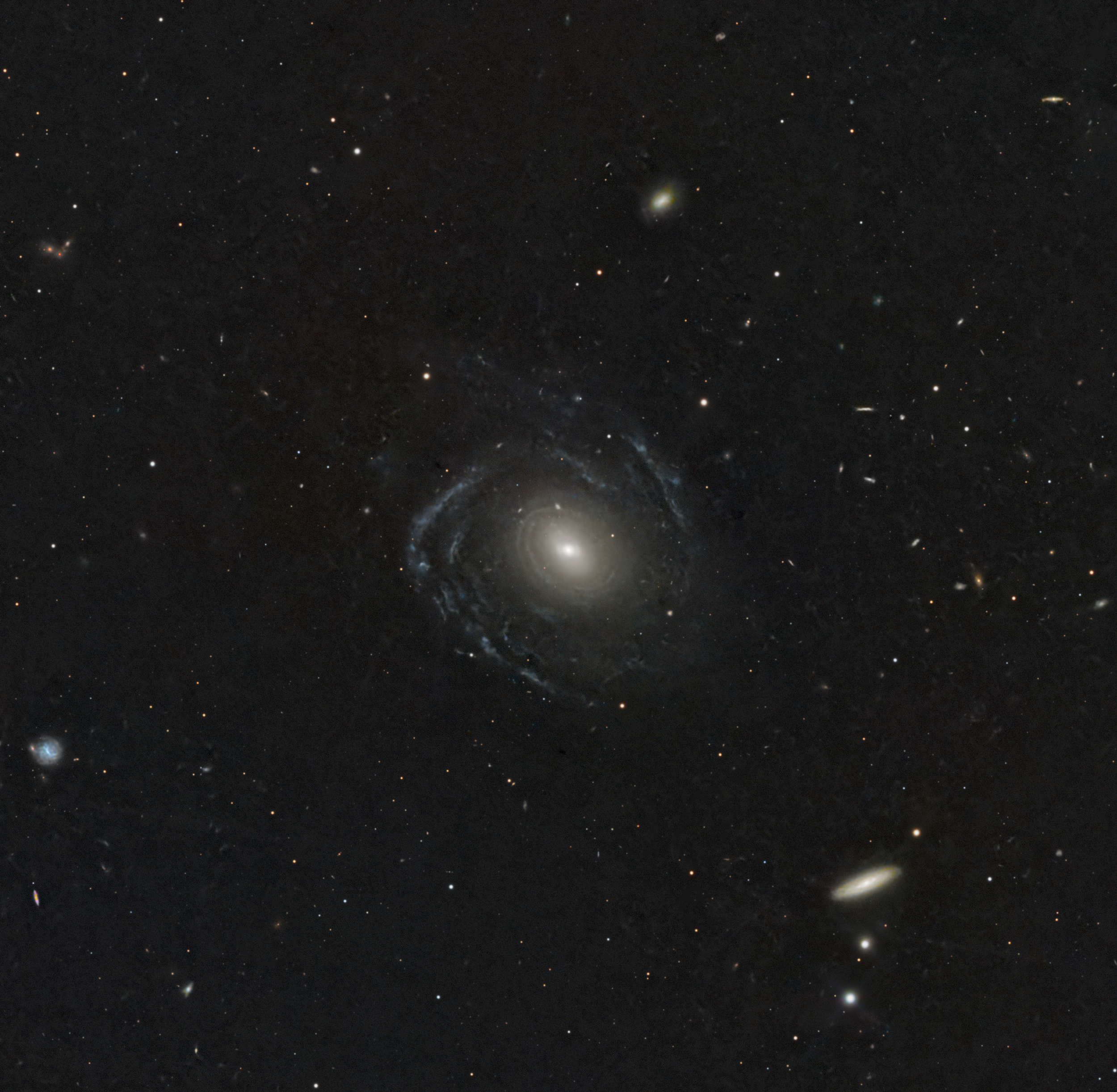
A galaxy that fooled astronomers for decades — UGC 1382.
For years it was thought to be an ordinary elliptical. Then, in 2015, astronomers using NASA’s GALEX ultraviolet telescope noticed faint star-forming regions far from its bright center. Optical follow-up revealed the truth: enormous, ghostlike spiral arms wrapping around the galaxy. What once looked smooth and featureless turned out to be one of the largest low-surface-brightness spirals ever discovered.
UGC 1382 is classified as SAB(r)ab. It lies about 250 million light years away in the constellation Triangulum Australe, stretching nearly 700,000 light years across — almost seven times the size of the Milky Way. On the sky it spans roughly 6.5 × 3.5 arcminutes.
The faint outer arms are extraordinarily dim, with an integrated magnitude of about 15.5–16 and a surface brightness near 26 mag/arcsec² — so diffuse that early surveys simply missed them. That’s easy to appreciate when you try to image this galaxy: in a single 5-minute exposure, nothing beyond the bright core shows up. This image required 10 hours of luminance integration to reveal the structure.
For scale, the famous interacting spiral NGC 6872 (the “Condor”) spans about 520,000 light years, making UGC 1382 even larger. Only the monster ellipticals, like IC 1101 in Abell 2029 at a staggering 6 million light years across, surpass it in size.
Of further note, the inner spiral of UGC 1382 rotates faster than the sprawling outer disk, suggesting this giant was pieced together through minor mergers long ago.
In my image, you can trace those delicate arms curling out into the darkness, surrounded by a backdrop of still more distant galaxies — a cosmic heavyweight hiding in plain sight.
Imaged in LRGB on my Planewave CDK 1000 at Observatorio El Sauce, Chile.
Image acquisition and processing: Mike Selby