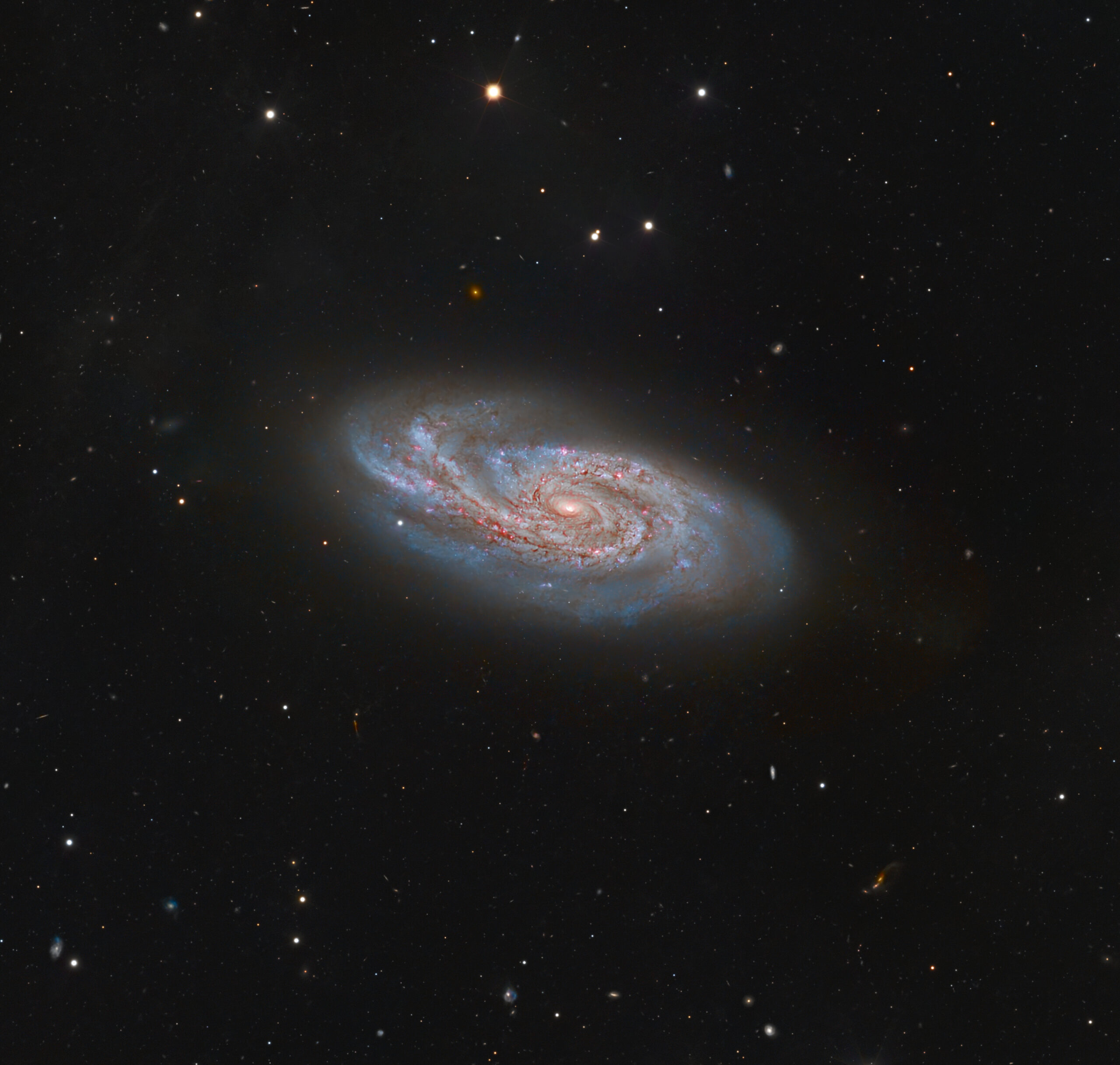
A spiral galaxy caught mid-eruption — tides, starbursts, and chaos in motion.
NGC 908 lies 56 million light-years away in the constellation Cetus, a SA(s)c spiral galaxy undergoing intense, asymmetric star formation likely triggered by a minor merger. The galaxy spans about 75,000 light-years, comparable in size to the Milky Way, and subtends 3.0 × 1.1 arcminutes on the sky.
Its most striking feature is the one-armed starburst wave sweeping across the disk — a rare structure seen when a satellite galaxy plunges through the disk and drives a density shock into the interstellar medium. The deep crimson H II regions mark chains of clustered stellar nurseries, while the faint outer envelope shows tidal distortion rather than a symmetric spiral geometry. NGC 908 also lacks a classical bulge — instead hosting a pseudo-bulge, a structure built by internal disk evolution rather than mergers.
The dust structure is equally revealing: tightly wound circumnuclear lanes abruptly transition into broader, more open filaments farther out, a signature of a disk recently disturbed from equilibrium. The Hα emission, rendered here in deep red, is strongly lopsided — with coherent chains of star-forming regions along one arm, while the opposite side shows scattered and disrupted nebular knots. This asymmetric burst pattern reflects the aftermath of a minor collision still propagating through the galaxy.
Imaged in LRGB and H alpha on my Planewave CDK 1000 at Observatorio El Sauce, Chile.
Image acquisition and processing: Mike Selby