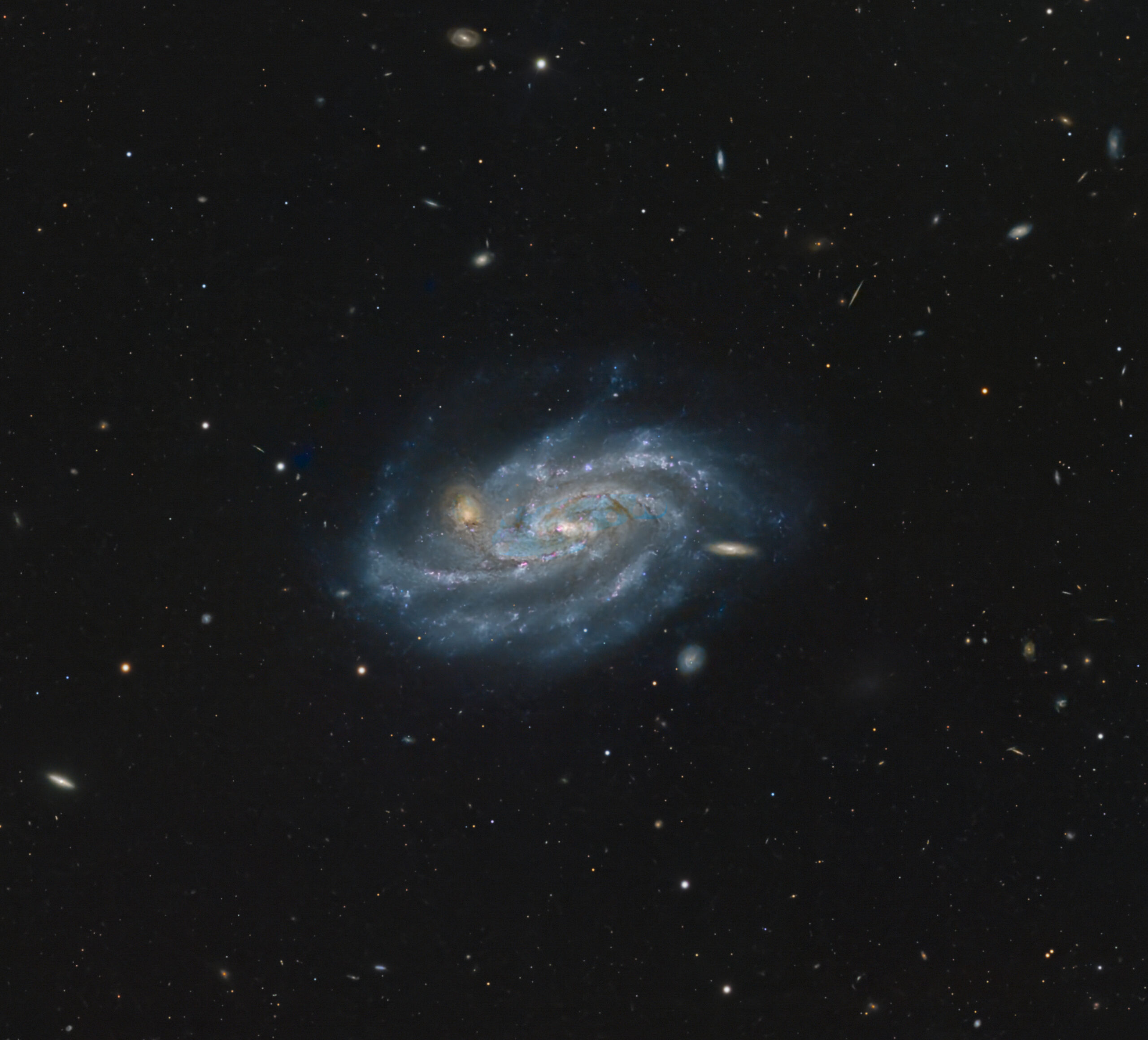
NGC 578 — A spiral sculpted by subtle asymmetry
Gracefully winding through the constellation Cetus, NGC 578 is a barred spiral galaxy (SB(rs)c) about 72 million light-years away. Its broad, uneven arms sweep outward in a slightly off-balance pattern — not the product of chaos, but the lingering signature of a mild gravitational encounter in the distant past. One arm stretches farther and more diffusely, while the other burns brighter with compact knots of H II regions, tracing areas of ongoing star formation.
Spanning roughly 80,000 light-years, the galaxy covers about 3.2 × 2.1 arcminutes on the sky. A slender bar crosses the nucleus, surrounded by faint Hα emission and delicate dust lanes that reveal steady star birth across its inner spiral. At the ten-o’clock position, a small background edge-on galaxy appears to pierce the faint halo — an unrelated but perfectly aligned intruder that adds depth to the scene. Catalog data from NED and HyperLEDA identify it as a faint background system, likely LEDA 1138165, whose distance based on redshift is around 110 million light-years, confirming it lies well behind NGC 578 and is not physically interacting. Though NGC 578 now drifts in apparent isolation, its uneven halo and warped structure hint that long ago, a smaller companion may have passed close enough to reshape its symmetry without tearing it apart.
NGC 578 reminds us that not all galactic transformations are violent — some are sculpted gently over eons, where gravity leaves its mark in the quiet tilt of a spiral arm.
Imaged in LRGB on my Planewave CDK 1000 at Observatorio El Sauce, Chile.
Image acquisition and processing: Mike Selby