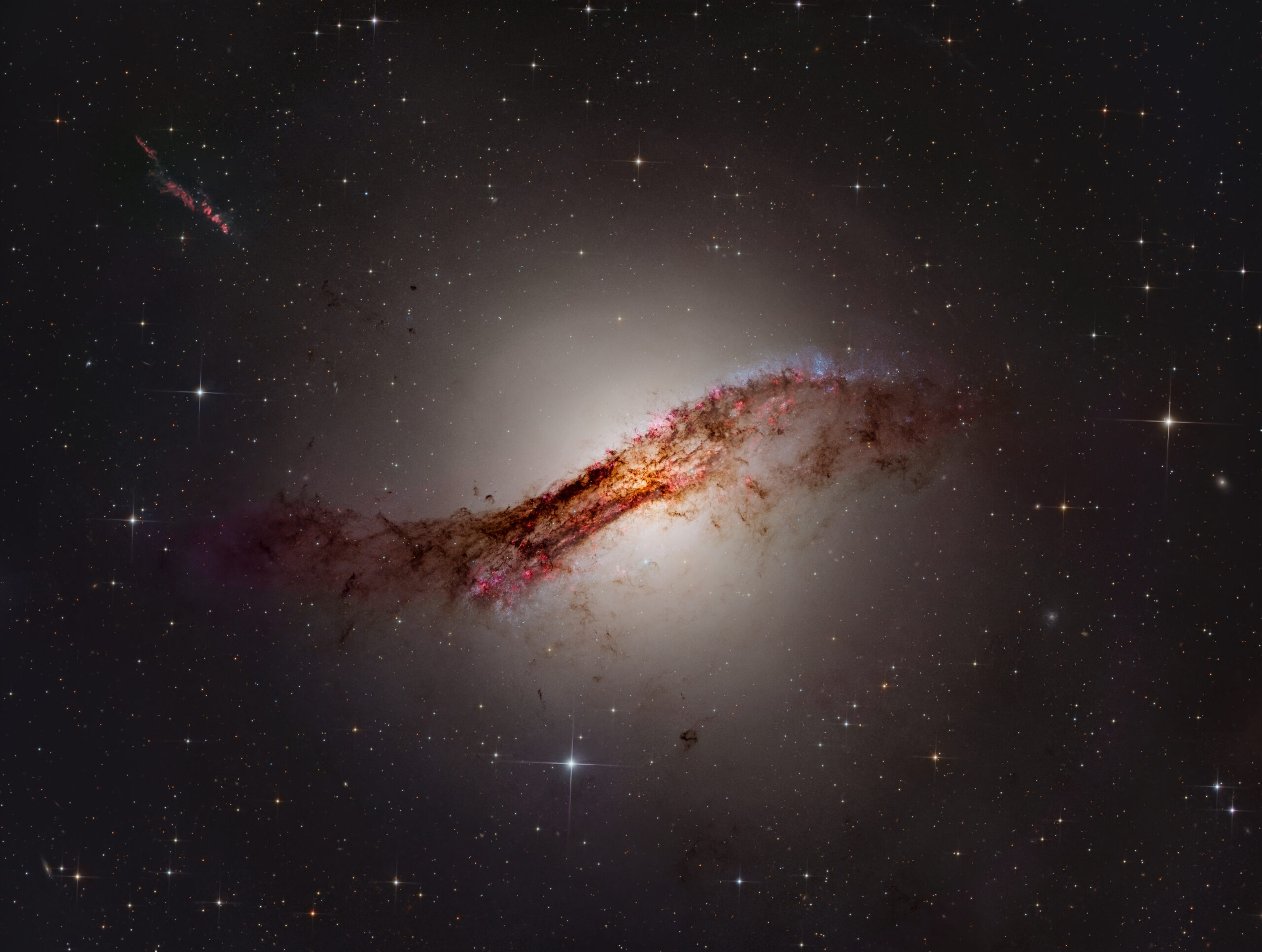
Centaurus A — A Giant Elliptical Torn Open by a Devoured Spiral Galaxy
NGC 5128, better known as Centaurus A, is a peculiar giant galaxy classified morphologically as S0 pec, a disturbed lenticular system embedded within an enormous elliptical stellar halo. Located in the constellation Centaurus, it lies at a precisely measured distance of approximately 12.4 million light-years. The galaxy spans about 25′ × 20′ on the sky, corresponding to a physical diameter of roughly 90,000 light-years, with an integrated magnitude of 6.8, making it one of the nearest and most significant active galaxies beyond the Milky Way.
Its most striking feature — the chaotic dust lane cutting diagonally across the galaxy — is the unmistakable remnant of a spiral galaxy that Centaurus A devoured several hundred million years ago. Giant elliptical galaxies do not naturally contain cold gas or dense dust structures like this. The presence of a massive, warped disk of dust and molecular gas, along with ongoing star formation embedded within it, confirms that this material originated in a gas-rich spiral galaxy whose structure was torn apart and absorbed. The elliptical halo seen here represents the original massive galaxy, while the dust lane and associated star-forming regions are the remains of its disrupted victim.
At the galaxy’s center resides a supermassive black hole containing approximately 55 million times the mass of the Sun, now actively accreting material supplied by the merger. Extending outward from the nucleus toward the upper left, a faint jet of ionized hydrogen can be seen reaching far beyond the galaxy’s core. This optical Hα jet spans approximately 35,000–40,000 light-years, tracing energetic outflows driven by the active nucleus. Observations by NASA’s Chandra X-ray Observatory reveal the same structure in high-energy X-rays, showing relativistic particles traveling near the speed of light along powerful magnetic fields. These jets transport enormous amounts of energy into intergalactic space and can compress surrounding gas, occasionally triggering localized star formation far from the galaxy’s center.
Beyond the visible galaxy, Centaurus A possesses enormous radio lobes extending nearly one million light-years end-to-end, making it one of the largest known structures associated with any nearby galaxy. These vast lobes are the accumulated result of millions of years of nuclear activity, powered by the black hole that was awakened when the spiral galaxy was consumed. Together, the ancient elliptical halo, the shattered remains of the devoured spiral, and the immense relativistic jet reveal a galaxy still evolving in the aftermath of one of the most dramatic types of events in cosmic history — the merger and destruction of an entire galaxy
Imaged in LRGB and H alpha on the ASA Astrosysteme AZ 1500 at Observatorio El Sauce, Chile.
Image Acquisition and Processing: Mike Selby