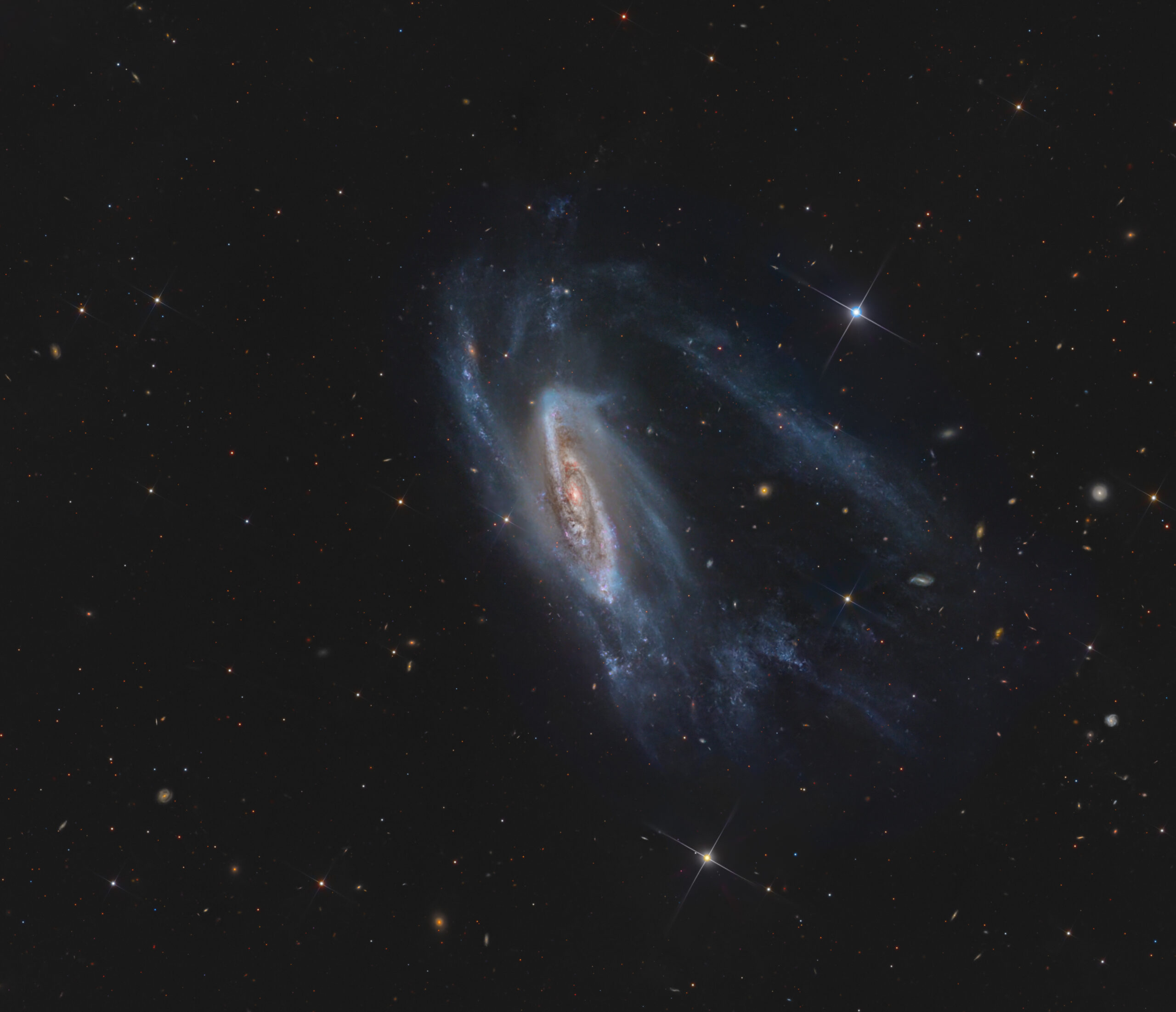
A spiral galaxy unraveling under tidal stress
NGC 3981 is a peculiar spiral galaxy classified morphologically as SA(rs)bc pec, located in the constellation Crater. Its structure reveals a moderately wound spiral pattern emerging from an elongated central region, surrounded by a partially developed inner ring. Unlike symmetric grand-design spirals, its disk appears visibly distorted and uneven, with fragmented arms, irregular dust lanes, and an overall asymmetry that immediately signals gravitational disturbance rather than isolated evolution.
At a precisely measured redshift-independent distance of 67.5 ± 3.0 million light-years, NGC 3981 spans approximately 5.3 × 2.5 arcminutes, corresponding to a true physical size of about 104,000 × 49,000 light-years. Its integrated magnitude of roughly 11.8 reflects a substantial stellar system comparable in overall scale to the Milky Way, yet its structure tells a story of disruption. The visible disk represents only part of the galaxy’s true extent, as faint stellar material stretches far beyond its main body.
The most striking features are the enormous tidal streams extending outward from the galaxy, especially toward the southeast, where stars have been gravitationally pulled into long, faint plumes. These stellar streams are the result of a past close gravitational encounter, most likely with a smaller companion galaxy that passed nearby several hundred million years ago. During this encounter, differential gravitational forces pulled stars from the outer regions of NGC 3981’s disk, stretching them into elongated tidal tails that still preserve the dynamical imprint of that interaction. The asymmetric nature of these streams, combined with the survival of the spiral structure, indicates that this was not a catastrophic merger but a strong tidal flyby that distorted the galaxy without destroying its fundamental form.
The spiral arms themselves are uneven and partially unraveled, populated with scattered blue star-forming regions and intersected by irregular dust lanes. The central region appears elongated and dynamically disturbed, reflecting the redistribution of gas and stars caused by tidal forces. These gravitational torques altered stellar orbits and triggered ongoing star formation, particularly along the distorted arms and inner disk. Across the outer regions, stars have been displaced from their original paths and redistributed into extended tidal debris, while a faint stellar envelope surrounds the galaxy, marking the transition between its bound structure and intergalactic space.
NGC 3981 captures a spiral galaxy in mid-transformation. Its tidal plumes, distorted arms, and disrupted outer disk provide direct evidence of a past gravitational encounter—an event that reshaped its structure and continues to influence its evolution. Over time, these tidal streams will slowly disperse, becoming part of the galaxy’s extended halo, but for now they remain as visible signatures of the powerful gravitational forces that govern the evolution of galaxies across cosmic time
Imaged in LRGB and H alpha on the ASA Astrosysteme AZ 1500 at Observatorio El Sauce, Chile.
Image Acquisition and Processing: Mike Selby