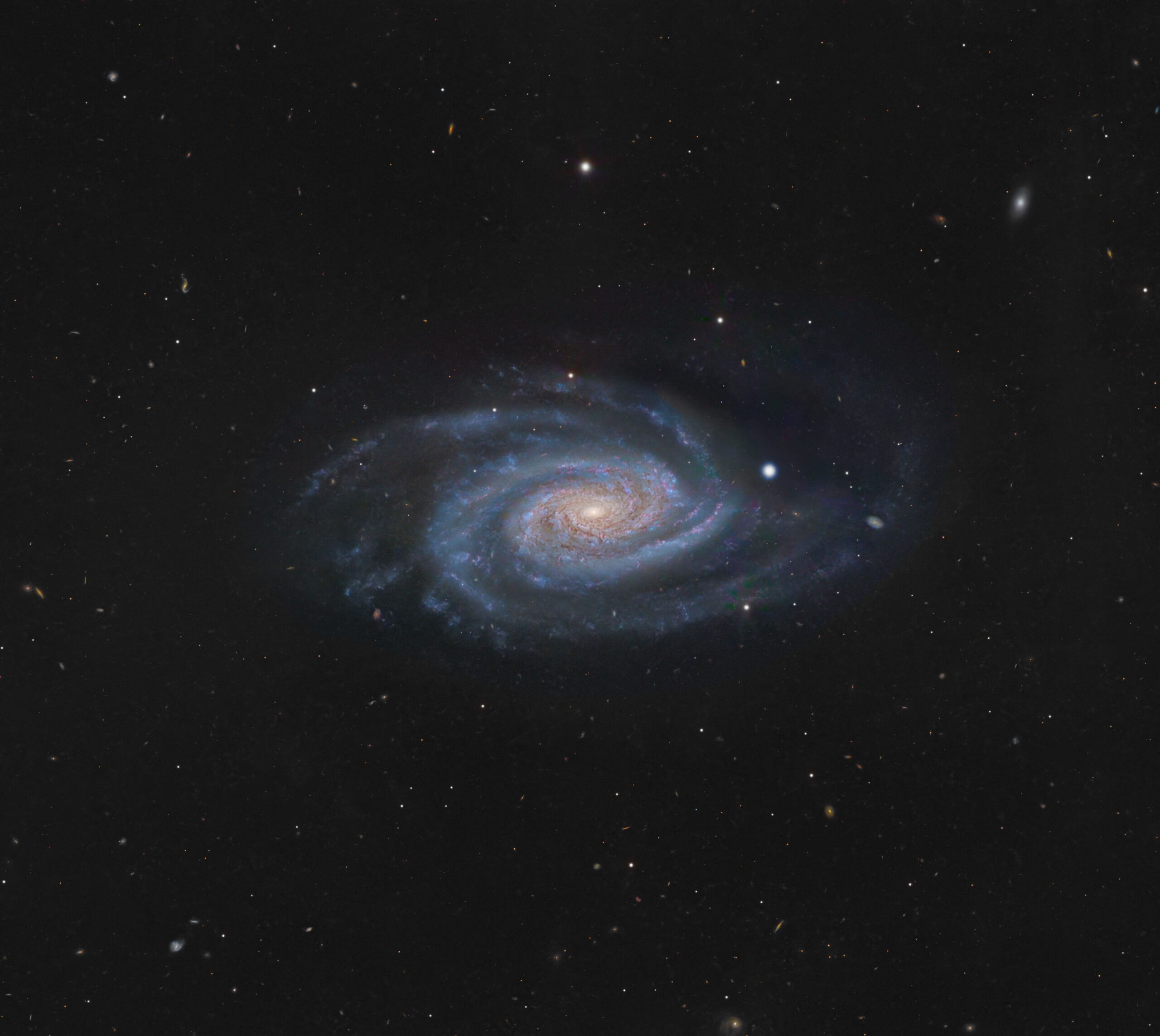
A Milky Way–scale spiral drawn in quiet light
NGC 3338 is a softly structured intermediate spiral galaxy of type SAB(rs)c in the constellation Leo Minor, presenting a balanced and composed appearance. A compact, warm-toned central bulge anchors the system, fading smoothly into a disk traced by loosely wound spiral arms that never dominate the scene, giving the galaxy its restrained character.
At a distance of about 54 million light-years, NGC 3338 spans roughly 6.9 × 3.1 arcminutes on the sky, corresponding to a physical diameter of approximately 110,000 light-years. In scale, it closely rivals the Milky Way, yet its visual impression favors subtle internal structure over dramatic contrast.
One of the most engaging aspects of NGC 3338 is the gentle transition from its orderly inner disk to a more fragmented outer spiral structure. The arms are dotted with blue star-forming regions, within which numerous compact Hα emission knots are embedded, tracing sites of active, ongoing star formation rather than continuous spiral lanes. This layered combination of blue stellar light and localized Hα emission gives the disk a finely textured appearance. Faint dust filaments thread through the inner arm segments, adding structure without obscuring the stellar disk. The spiral pattern shows mild asymmetry, suggestive of slow, long-term gravitational influences rather than any recent or disruptive interaction. Surrounding the galaxy, a rich population of faint background galaxies adds depth and situates NGC 3338 within a much larger extragalactic environment.
Imaged in LRGB on my Planewave CDK 1000 at Observatorio El Sauce, Chile
Image acquisition and processing: Mike Selby