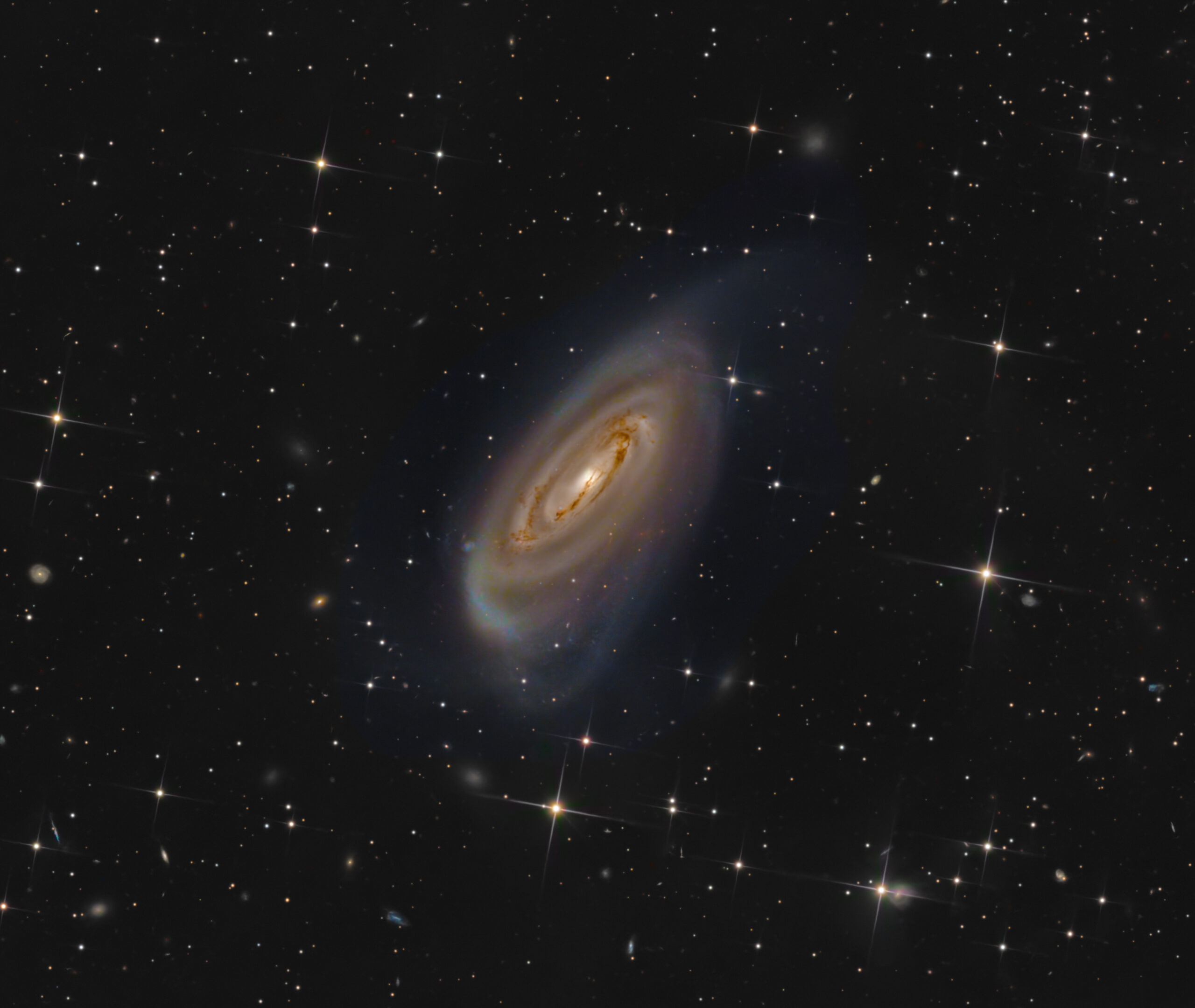
NGC 3281 — A hidden engine blazing behind a wall of cosmic dust
NGC 3281 is a highly inclined spiral galaxy in the constellation Antlia, morphologically classified as SA(s)ab pec and hosting a powerful Seyfert 2 active nucleus embedded deep within its luminous core. Its bright central bulge is bisected by a thick, irregular dust lane that absorbs and reddens the starlight, partially concealing the energetic nucleus. This dense obscuring structure gives the galaxy its striking asymmetric appearance, with warm golden light emerging from the bulge while the surrounding stellar disk fades into a diffuse outer envelope.
Located approximately 182 million light-years from Earth, NGC 3281 spans about 3.2 arcminutes across the sky, corresponding to a true diameter of nearly 170,000 light-years. This makes it somewhat larger than the Milky Way. Its classification as an early-type spiral reflects its dominant central bulge and tightly wound spiral structure, features that play a critical role in sustaining its active nucleus.
Early-type spirals like NGC 3281 are especially prone to hosting Seyfert nuclei because their massive bulges harbor correspondingly massive supermassive black holes. The strong gravitational influence of the bulge helps funnel gas inward from the surrounding disk, feeding the central black hole and sustaining its energetic output. The thick dust lane crossing the bulge is not merely an obscuring feature but part of this dynamic environment, channeling matter inward while simultaneously hiding the active core from direct view.
The fractured, asymmetric dust structure reveals a turbulent interstellar medium shaped by gravitational forces and nuclear activity. Though much of its central engine remains concealed, its presence is unmistakable in the intense luminosity concentrated at the galaxy’s heart. NGC 3281 stands as a powerful example of how spiral galaxies can harbor hidden active nuclei, illustrating the intimate connection between galactic structure, gas dynamics, and the growth of supermassive black holes
Imaged in LRGB on the ASA Astrosysteme AZ 1500 at Observatorio El Sauce, Chile.
Image Acquisition and Processing: Mike Selby