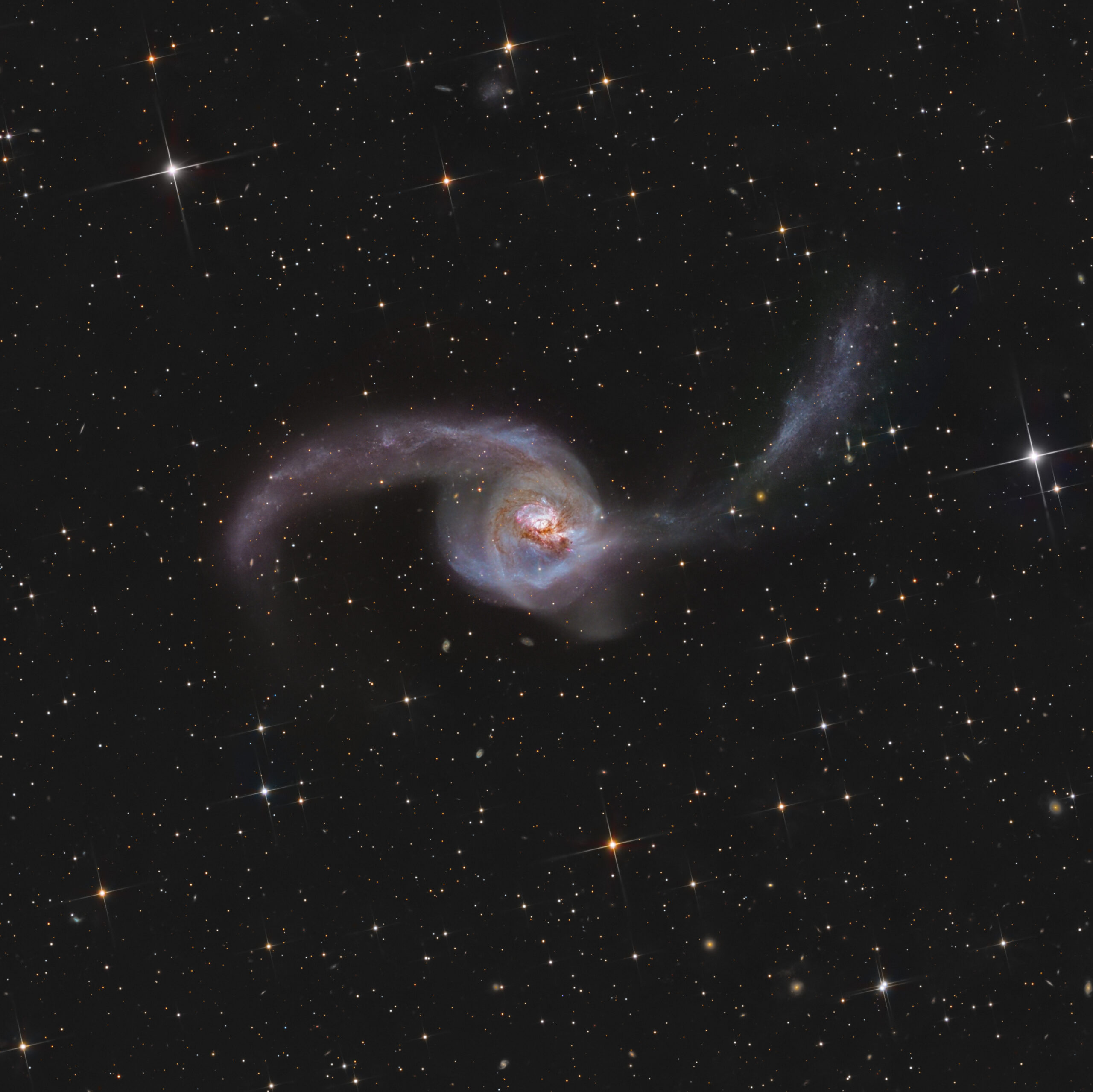
A cosmic collision frozen in mid-destruction, where two galaxies have already lost their identities but not yet their struggle
NGC 3256 is a peculiar interacting galaxy located in the southern constellation Vela, classified morphologically as a peculiar merger remnant (pec). It represents one of the clearest nearby examples of an advanced spiral–spiral collision, where the original galactic disks have been almost completely destroyed and replaced by a chaotic central structure. At its heart lies a double nucleus embedded within a dense stellar envelope, the surviving cores of the progenitor galaxies that continue to spiral inward as gravity completes their union. The surrounding structure no longer resembles a spiral or elliptical galaxy, but instead reflects the violent transitional phase between ordered disk galaxies and a future relaxed elliptical system.
According to the NASA/IPAC Extragalactic Database (NED), NGC 3256 lies at a luminosity distance of approximately 152 million light-years. Its apparent angular size of about 3.8 × 2.1 arcminutes corresponds to a true physical extent of roughly 168,000 × 93,000 light-years, making it larger than the Milky Way in overall tidal reach. With an integrated visual magnitude of approximately 11.3, much of its luminosity originates not from an ordered disk, but from stars redistributed into tidal streams and from intense starburst regions triggered by gravitational compression of interstellar gas.
The most striking features are its enormous tidal tails—vast arcs of stars flung outward by the gravitational torque of the collision. These tidal plumes extend tens of thousands of light-years into space and preserve the dynamical history of the merger, tracing the orbital paths of the original galaxies. The asymmetric brightness and curvature of these tails reveal that the progenitor galaxies likely differed in mass and orientation, producing uneven gravitational stripping. Surrounding the nucleus, a turbulent inner envelope of dust and young stars marks regions where gas clouds have collapsed under compression, igniting rapid star formation.
NGC 3256 is also one of the most powerful nearby starburst galaxies, producing new stars at a rate dozens of times greater than normal spiral galaxies. This intense activity is driven directly by the merger, which funnels gas toward the center and triggers widespread stellar formation. Observations at infrared and X-ray wavelengths reveal energetic outflows—galactic winds powered by massive young stars and supernovae—that are actively ejecting gas into intergalactic space. These feedback processes will eventually exhaust the gas reservoir, halting star formation and leaving behind a massive, quiescent elliptical galaxy. What remains visible today is a brief and violent phase in the long evolution of galaxies, when gravitational forces reshape structure on a scale spanning hundreds of thousands of light-years.
Imaged in LRGB on the ASA Astrosysteme AZ 1500 at Observatorio El Sauce, Chile.
Image Acquisition and Processing: Mike Selby