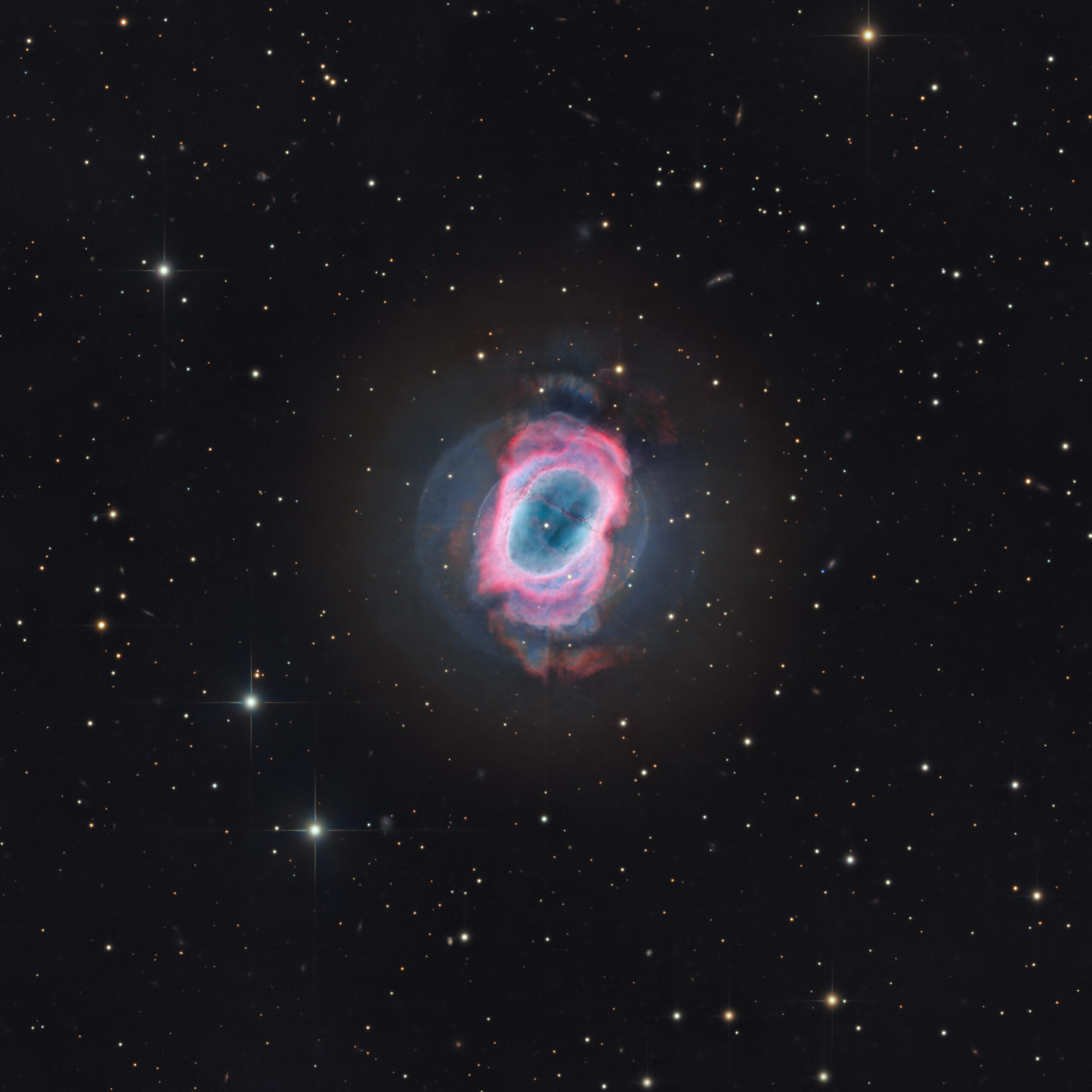
The glowing remains of a star that shed its outer layers and revealed its hidden core
NGC 3132 is an elliptical planetary nebula located in the southern constellation Vela, marking the final evolutionary stage of a Sun-like star. Its structure consists of a bright inner shell surrounded by multiple fainter outer layers, formed as the star gradually expelled its atmosphere into surrounding space. At the center lies a hot white dwarf, the exposed stellar core whose intense ultraviolet radiation now ionizes the expanding gas, causing it to glow in layered shells of color.
The nebula lies approximately 2,000 light-years from Earth. Its bright inner shell measures about 62 × 43 arcseconds, corresponding to a physical diameter of roughly 0.6 light-years, while the faint outer halo extends to nearly 1 light-year across. Based on its size and typical expansion velocities of 20–30 km/s, the visible nebula began forming approximately 2,500 to 3,500 years ago, with the outer halo representing material expelled during earlier mass-loss phases.
This transformation occurred during the star’s late red giant and asymptotic giant branch (AGB) phases. During this period, the star became unstable and began shedding its outer layers through sustained stellar winds over thousands of years. As the outer atmosphere expanded and dispersed, the exposed core heated to extreme temperatures and began emitting intense ultraviolet radiation. This radiation ionized the previously ejected gas, producing the layered emission structure seen today. Hydrogen emission defines the outer red shell, while doubly ionized oxygen dominates the inner regions, tracing zones of higher excitation closer to the central star.
This image was captured using H-alpha, OIII, and RGB data. The central region was recorded in true RGB, where the signal is sufficiently strong to preserve its natural broadband color, reflecting the true balance of emission and continuum light. The outer shell and faint halo are revealed through H-alpha and OIII imaging, which isolate the specific emission from ionized hydrogen and oxygen in the expanding gas. Luminance and fine structural detail were derived from the combined H-alpha and OIII data, allowing the faint outer layers to be rendered with clarity while preserving the natural RGB appearance of the inner nebula.
Planetary nebulae represent a brief transitional phase lasting only about 10,000 to 20,000 years. NGC 3132 is currently midway through this process, with its expanding shells continuing to disperse into interstellar space. Over time, the nebula will fade completely, leaving behind only the dense white dwarf remnant, slowly cooling over billions of years. These final stages return heavy elements such as oxygen, carbon, and nitrogen to interstellar space, enriching the material from which future stars and planetary systems will eventually form
Imaged in RGB H alpha and OIII on the ASA Astrosysteme AZ 1500 at Observatorio El Sauce, Chile.
Image Acquisition and Processing: Mike Selby