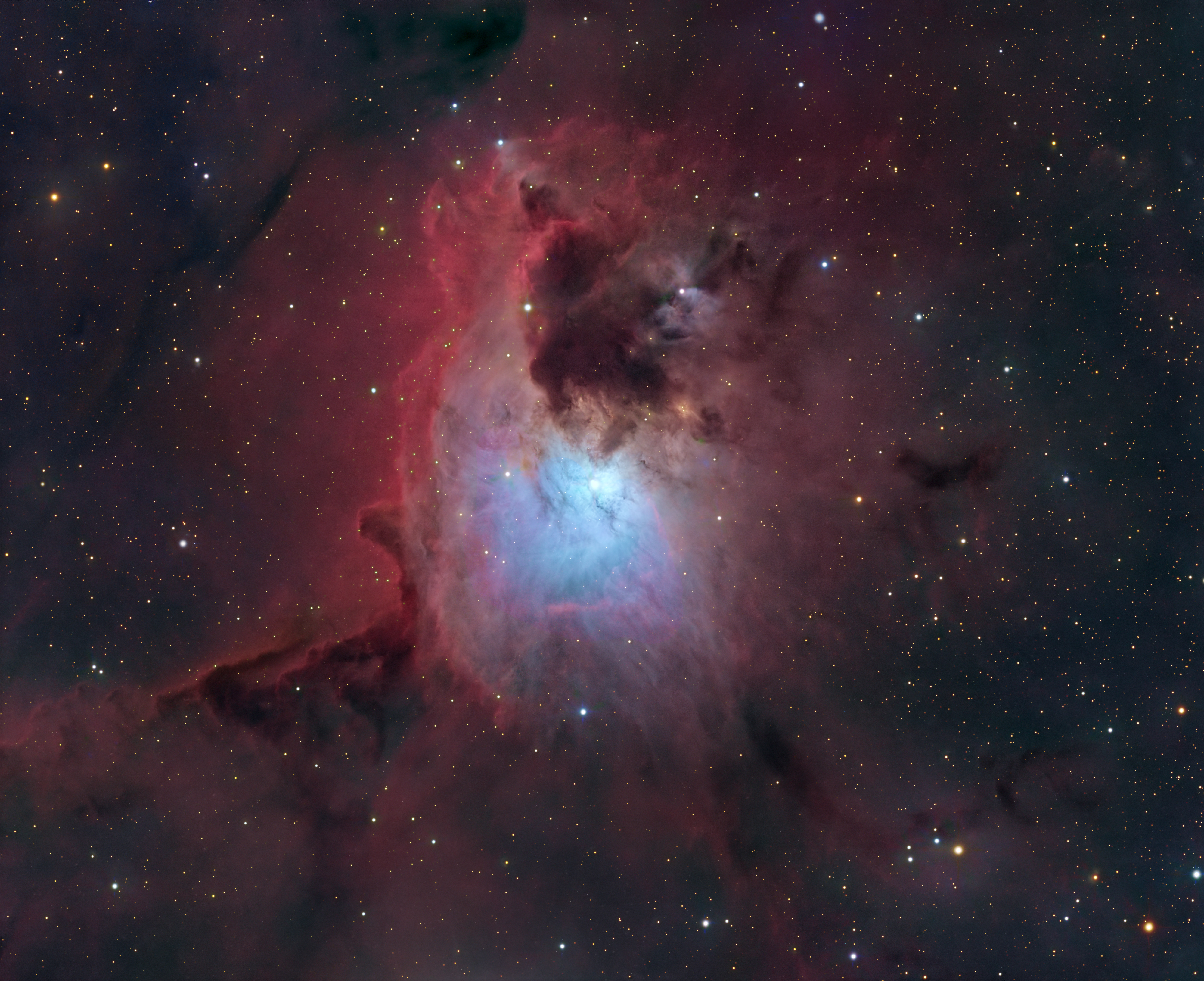
A blue heart inside a crimson cloud
NGC 2626 is a compact reflection–emission nebula embedded in the Vela star-forming complex, where a small cluster of young, energetic stars is actively sculpting its natal environment. The bright central glow is dominated by dust that reflects starlight in cool blue tones, while the surrounding envelope is ionized hydrogen radiating in deep red—two physical processes revealed side by side within a single object.
Located in the constellation Vela at a distance of roughly 3,000–3,500 light-years, NGC 2626 spans only about 4–5 arcminutes on the sky, corresponding to a physical size of approximately 3–5 light-years. Despite its modest scale, the nebula displays striking internal structure: dense foreground dust pillars absorb and silhouette the background glow, faint translucent veils trace outflows from the embedded stars, and the sharp transition from reflection to emission marks the boundary where starlight gives way to ionized gas.
What makes NGC 2626 particularly compelling is this layered interplay between light and matter. The blue core pinpoints the stars that illuminate the cloud from within, while the red envelope maps the regions where radiation is energetic enough to strip electrons from hydrogen. The dark lanes threading the nebula are not empty voids, but thick concentrations of dust—future raw material for the next generation of stars—caught in the act of being reshaped by their predecessors.
Imaged in LRGB on my Planewave CDK 1000 at Observatorio El Sauce, Chile.
Image acquisition and processing: Mike Selby