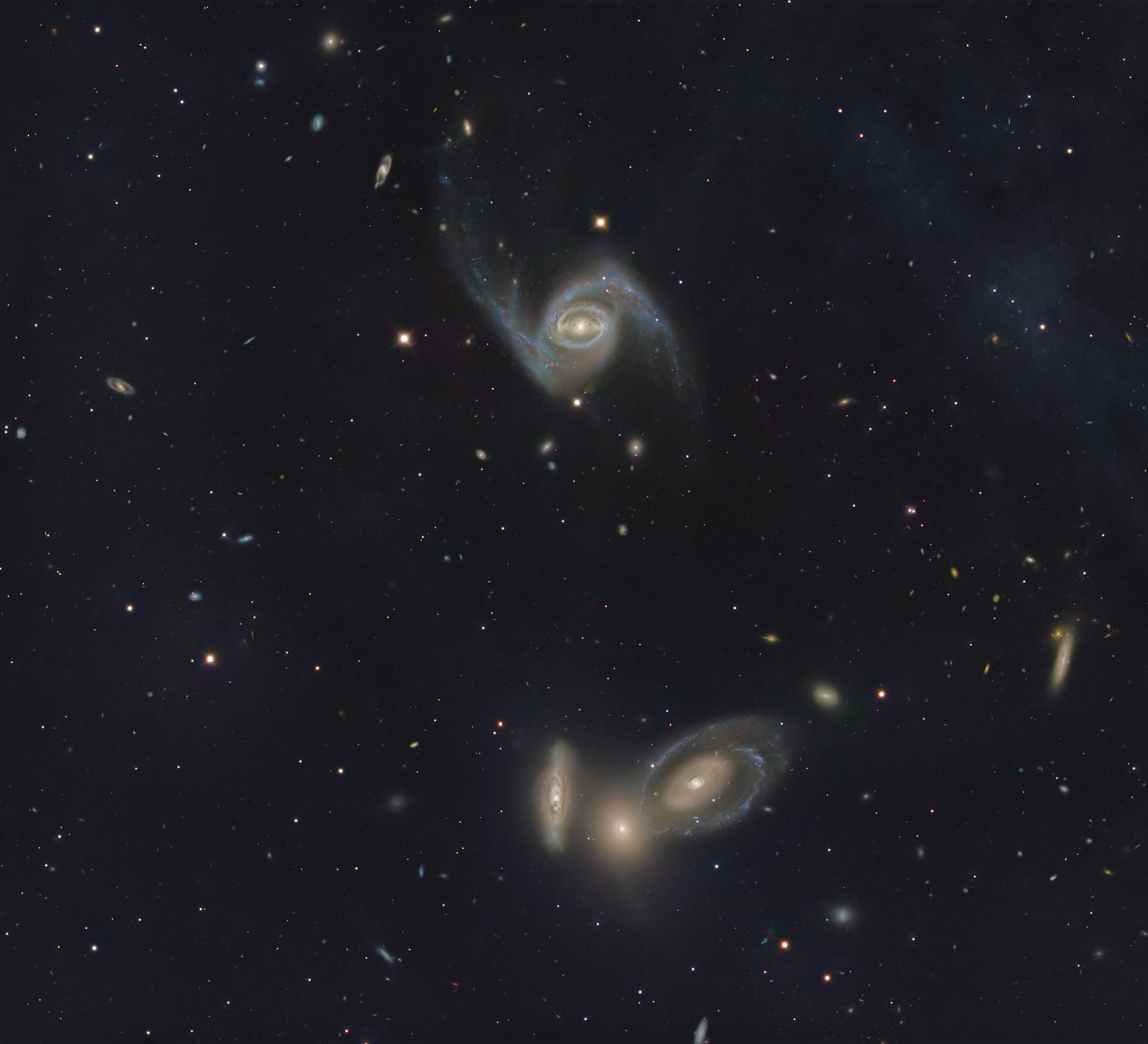
Four galaxies, one field — an evolutionary sequence with one exception
This deep field in Eridanus brings together four nearby galaxies at comparable distances, allowing their structures to be read as stages rather than coincidences. The outlier is NGC 1723, while the lower grouping forms a remarkably clean evolutionary progression.
At the top of the frame, NGC 1723 is a barred spiral galaxy of type SAB(rs)c) at a distance of 172 million light-years, with an apparent size of 2.6 × 1.8 arcminutes. Unlike the galaxies below, it shows clear structural imbalance: loosely wound spiral arms, patchy blue star-forming regions, and asymmetric outer extensions that break the otherwise regular disk. This asymmetry points to past dynamical disturbance or minor accretion, even though no active interaction is visible today. NGC 1723 stands apart as the only system in the field still showing signs of structural unrest.
In contrast, the bottom of the image presents a compact trio that reads naturally as an evolutionary sequence. NGC 1728, an unbarred spiral (SA(s)b) at 173 million light-years, retains an orderly disk with coherent spiral arms and ongoing, but subdued, star formation. Nearby lies NGC 1725, a lenticular or early-type disk galaxy (S0/a) at 179 million light-years, where spiral structure has largely dissolved and star formation has nearly ceased. Between them sits NGC 1727, an early-type galaxy (E/S0) at a similar distance, dominated by an older stellar population and entirely lacking dust lanes or spiral features.
Despite their proximity on the sky and their similar distances, there is no clear evidence of strong ongoing interaction. Instead, the field highlights divergence rather than collision: a dynamically unsettled spiral isolated above a tightly grouped progression from spiral disk to fully quiescent system. Surrounding all of them is a dense background of far more distant galaxies, reinforcing both the depth of the image and the broader cosmic context in which these nearby systems quietly evolve.
Imaged in LRGB on my Planewave CDK 1000 at Observatorio El Sauce, Chile.
Image acquisition and processing: Mike Selby