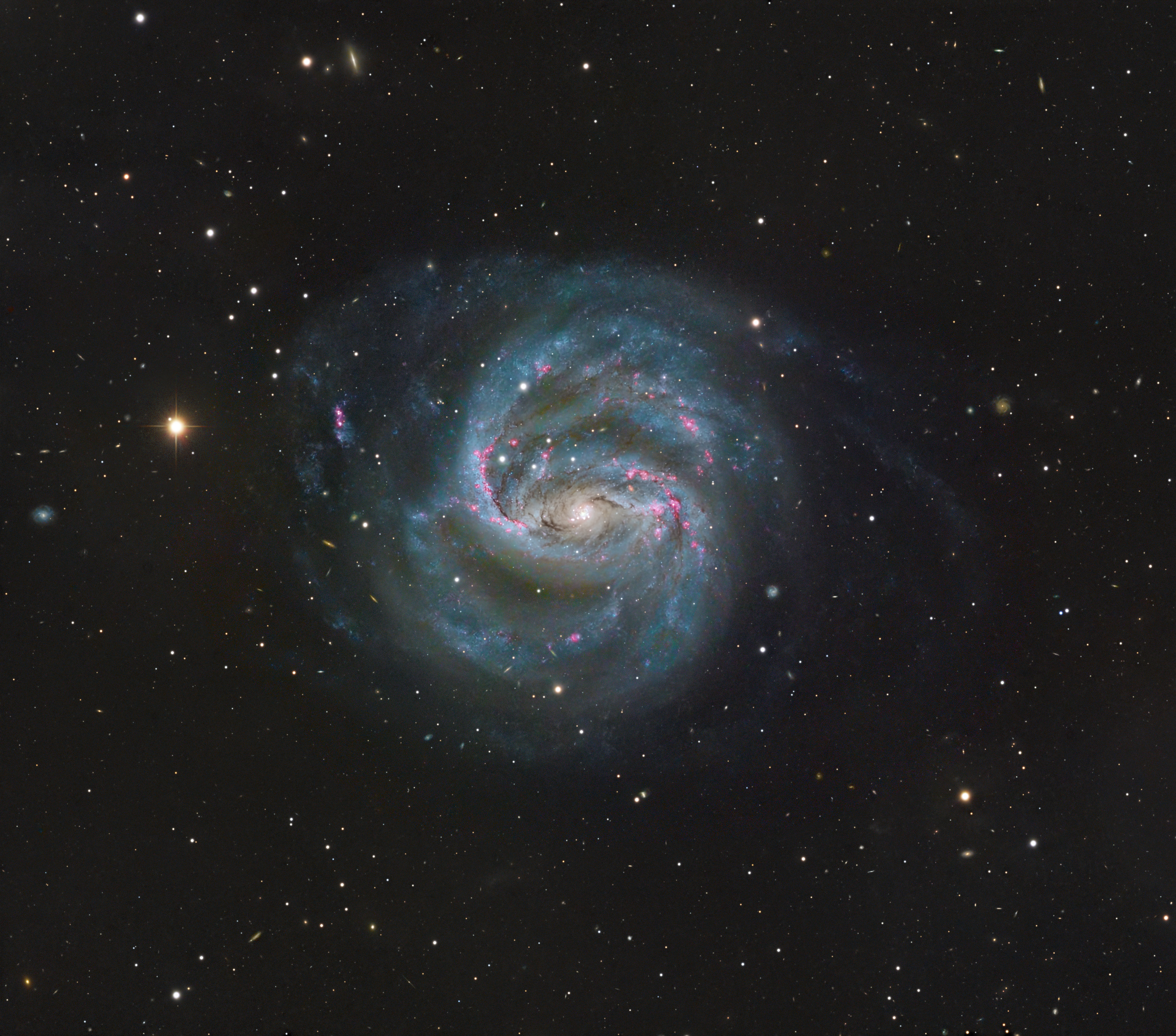
Where dust, star-birth, and a twisting bar shape a storm of cosmic motion
NGC 1672 is a striking barred spiral galaxy in the southern constellation Dorado, catalogued as SB(s)b and viewed almost face-on. At a distance of about 60 million light-years, it spans roughly 6.6 × 6.0 arcminutes in apparent size, corresponding to a physical diameter of nearly 115,000 light-years—comparable to the Milky Way, but with a more dramatic bar and a visibly energized central region. Its sweeping spiral arms emerge directly from the bar, carrying dust lanes, blue star-forming complexes, and bright Hα-glowing nebulae that trace ongoing stellar birth.
The core of NGC 1672 reveals a tight inner spiral wrapped around a bright, actively ionized nucleus, with dust lanes converging sharply as they funnel gas toward the center. The bar itself is lined with dark filaments that curve and twist as they transition into the main arms, creating a layered structure of chaotic dust patterns, young clusters, and diffuse starlight. The outer disk shows faint, extended tidal-like structures and low-surface-brightness regions, while the surrounding field contains numerous background galaxies far beyond the main spiral. This combination of a powerful bar, intense inner structure, and richly textured arms makes NGC 1672 one of the most intricate barred spirals in the southern sky.
Imaged in LRGB and H alpha on my Planewave CDK 1000 at Observatorio El Sauce, Chile.
Image acquisition and processing: Mike Selby