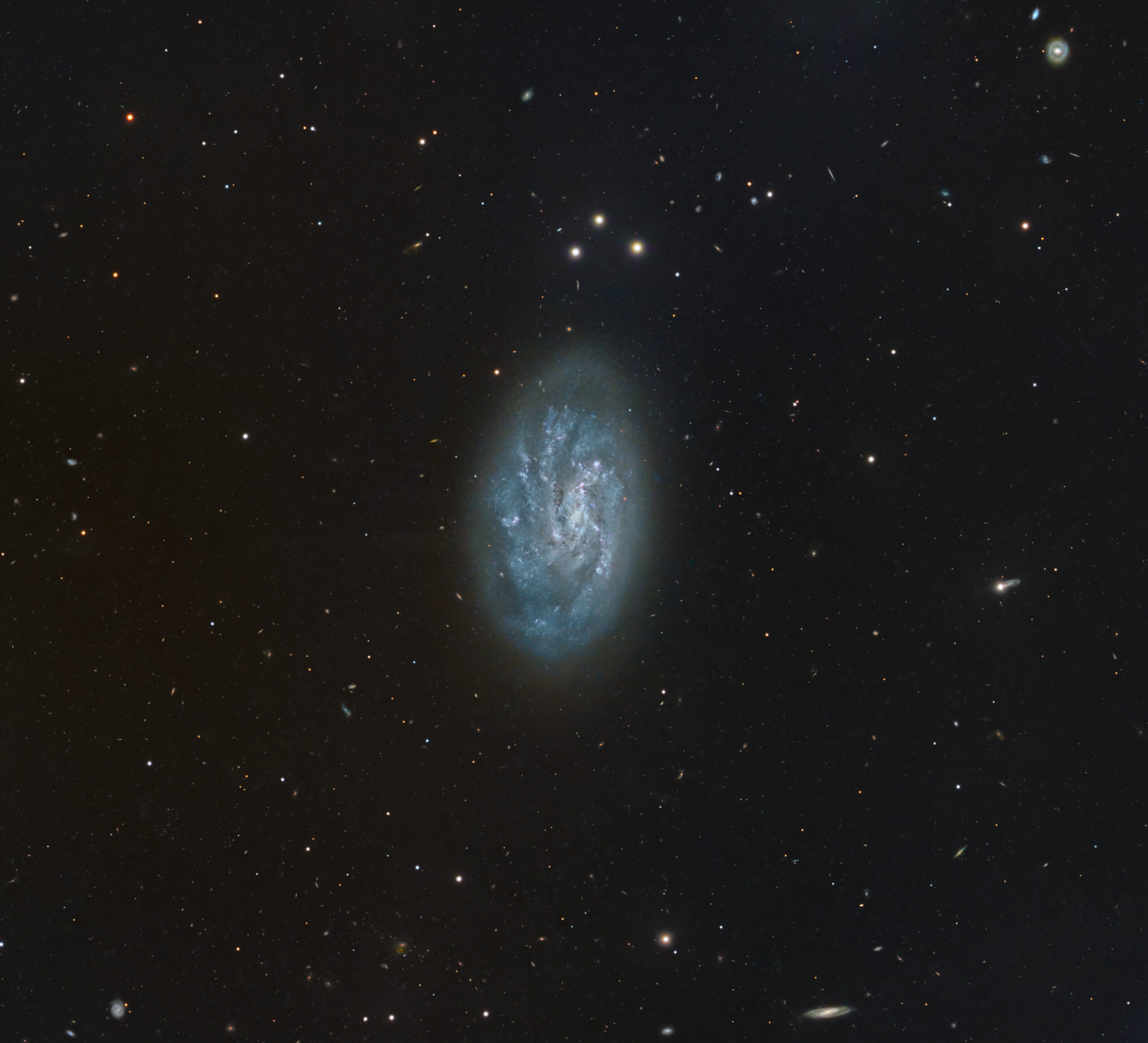
A galaxy whose shape emerges from scattered clusters rather than defined arms
In the southern constellation Horologium, the flocculent spiral NGC 1494 lies about 43 million light-years away, offering a compact but detailed glimpse into how small spirals build structure through scattered star formation rather than grand, sweeping arms. On the sky it spans roughly 3.3 × 2.0 arcminutes, corresponding to a physical diameter of about 55,000 light-years—a modest galaxy by cosmic standards, but one rich in fine structure.
Across its interior, blue star-forming knots mark recent bursts of OB-star formation. These clusters do not trace clean, continuous arms; instead, they punctuate the disk in a loose, flocculent pattern that defines the galaxy’s appearance. Faint Hα regions pick out pockets of ionized gas around newborn stars, while the core hosts a subtle network of asymmetric dust filaments that gently disturb the central light. The outer stellar envelope is slightly lopsided, with a faint extension toward the southwest that hints at mild tidal shaping or slow internal evolution rather than a major encounter.
Around NGC 1494, the field is crowded with distant background galaxies—tiny spirals, thin edge-on disks, and remote ellipticals—layered far behind this small, delicately structured southern spiral, giving the image a surprising depth for such a compact target.
Imaged in LRGB on my Planewave CDK 1000 at Observatorio El Sauce, Chile.
Image acquisition and processing: Mike Selby