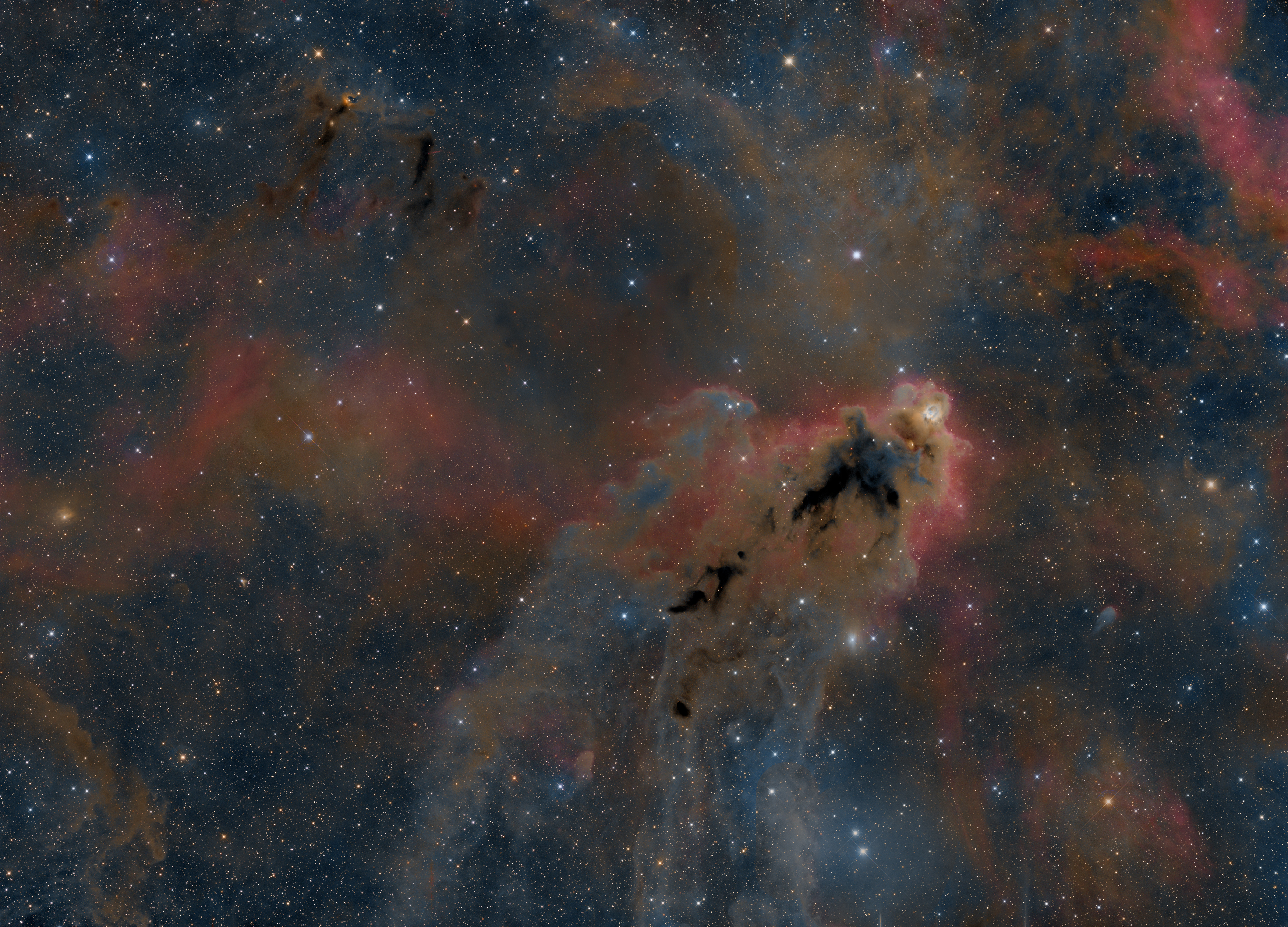
When the Boogey Man steps out of the dark
LDN 1617 and LDN 1622 form a striking complex of cold molecular clouds in the constellation Orion, with LDN 1622 — widely known as the Boogey Man — standing out as a classic cometary globule. Rather than glowing by emission, this region is revealed through what it obscures: background starlight is absorbed and scattered by dense interstellar dust, allowing the cloud’s structure to emerge as a three-dimensional silhouette against the rich star field of the Milky Way.
Located at an estimated distance of approximately 1,300 light-years, these clouds belong to the nearby Orion molecular environment, part of the same vast system that hosts some of the most active star-forming regions in our galaxy. The brightly edged head of the Boogey Man traces surfaces where ultraviolet radiation from nearby massive stars grazes the cloud, while its interior remains optically thick, marking the coldest and densest concentrations of matter. The elongated tail streaming away from the head records the ongoing interaction between radiation pressure and the surrounding interstellar medium, giving the globule its distinctive comet-like form.
Beyond this dramatic silhouette, the faint sheets and filaments of LDN 1617 reveal a much broader reservoir of molecular material extending across the field. Subtle variations in opacity and color map changes in dust density, grain composition, and illumination, exposing layered structures that would otherwise remain invisible. These dark nebulae are not empty space but vast stores of cold gas and dust — the raw ingredients from which future generations of stars may eventually form.
What appears here as darkness is not absence, but mass. In the Boogey Man and its surrounding cloud, the Milky Way shows that the architecture of star formation is written not in light alone, but in shadow.
Imaged in LRGB on my Planewave DR 350 at Observatorio El Sauce, Chile.
Image acquisition and processing: Mike Selby