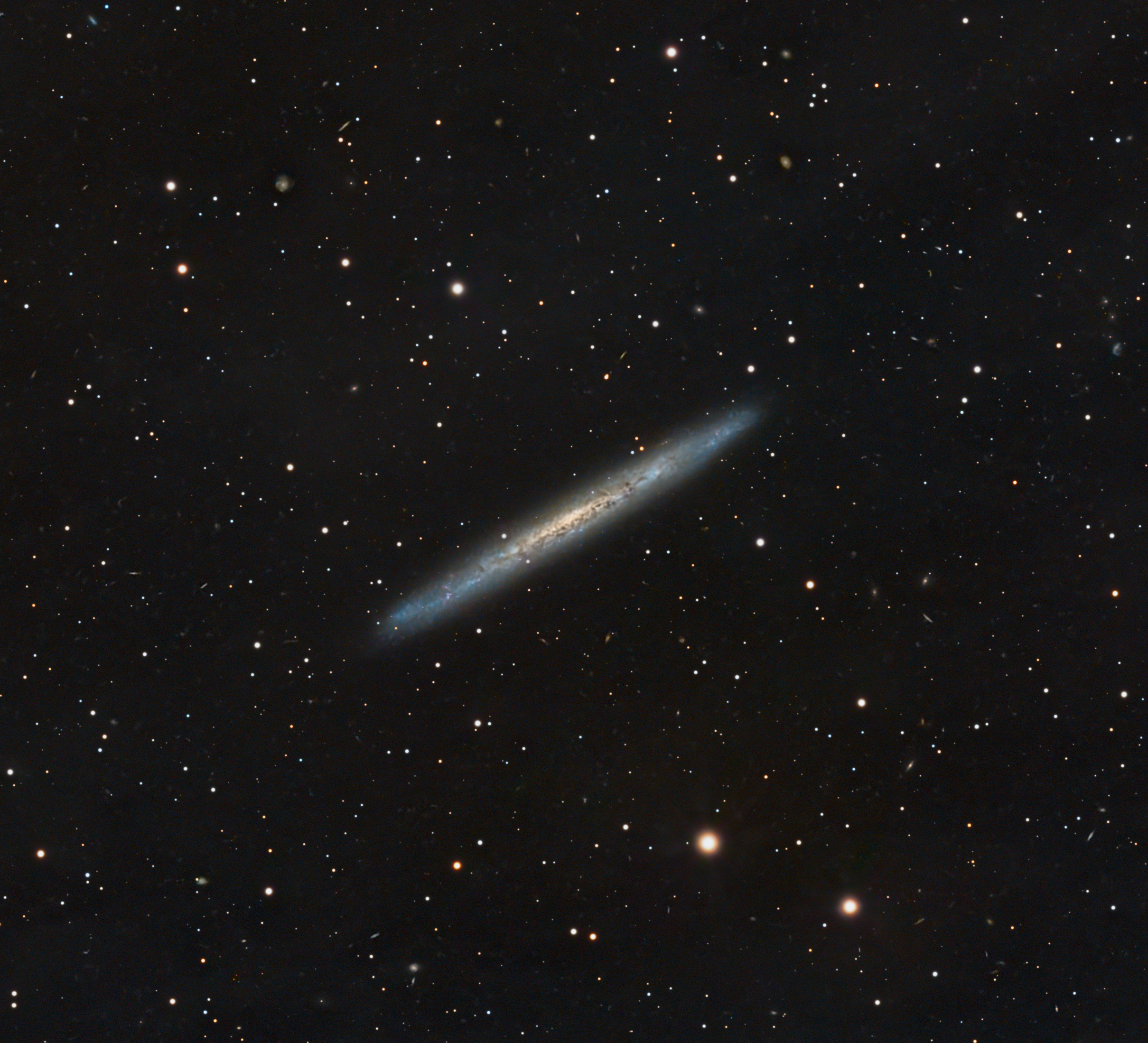
A Cosmic Needle in the Peacock’s Sky
IC 4871 is a rarely imaged intermediate barred spiral galaxy in the constellation Pavo, lying around 85 million light years away from here. Classified as SAB(s)d?, its precise subtype remains uncertain because its nearly edge-on orientation hides much of the spiral pattern and bar structure. What is clear is its elongated form, spanning about 3.8 by 0.8 arcminutes, which translates to a true diameter of nearly 95,000 light years—a scale comparable to the Milky Way.
Seen edge-on, the galaxy takes the form of a slender spindle of stars. Its razor-thin disk is streaked with dust lanes that interrupt the glow of an older stellar population, while patches of faint bluish light mark regions of ongoing star formation. Against the dark backdrop of space, IC 4871 appears almost like a needle of light, its fine structure emphasized by the edge-on view. The surrounding field is scattered with foreground stars and distant background galaxies, adding a sense of depth to the scene.
Galaxies seen on edge are especially valuable to astronomers, as they allow the study of vertical disk structure, showing how thin stellar systems can be, how dust is distributed, and where new stars emerge along the galactic plane. IC 4871, with its delicate form and quiet presence in the Peacock’s sky, stands as a graceful example of spiral galaxy evolution—an elegant thread woven into the cosmic tapestry.
Imaged in LRGB on my Planewave CDK 1000 at Observatorio El Sauce, Chile.
Image acquisition and processing: Mike Selby