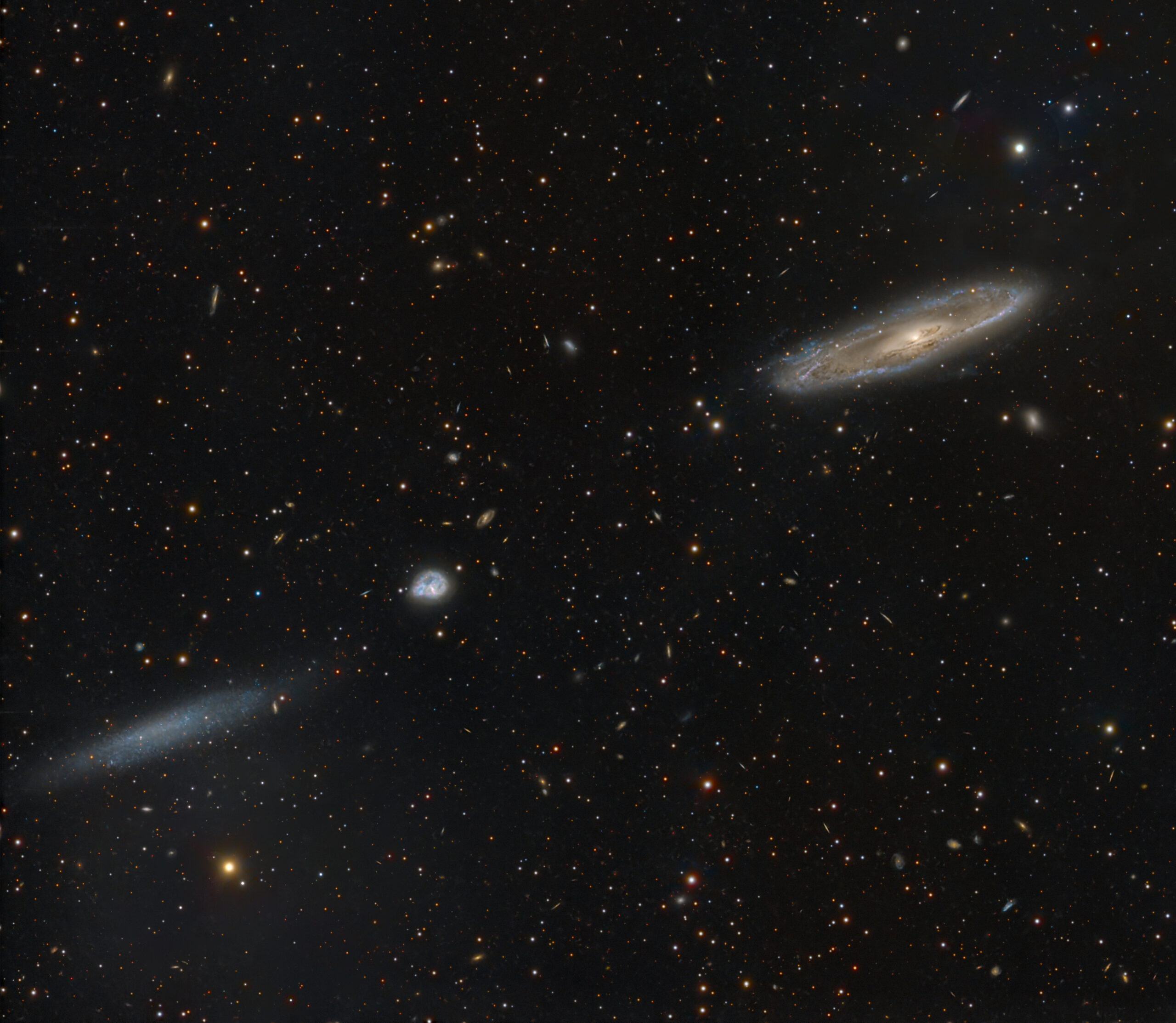
A galaxy trio drifts across this richly detailed field in Pavo, each with a different morphology, distance, and scale—offering a layered view of cosmic diversity.
Far left: PGC 62988 (Sd)
This faint, edge-on galaxy is classified as a late-type spiral (Sd) and lies remarkably close by cosmic standards—just ~36 million light-years away, based on its radial velocity of 782 km/s (corrected to the Local Group frame).
With an apparent size of 1.3′ × 0.5′, its true extent is only about 13,700 × 5,200 light-years, placing it firmly in the dwarf spiral category.
Its pale blue color hints at scattered regions of star formation, but the lack of a prominent bulge or tightly wound arms suggests a loosely organized structure—perhaps one that has evolved in relative isolation without strong external gravitational interactions. The softness of its profile, even in a deep exposure, reinforces its low surface brightness and delicate stellar population.
Center: PGC 62980 (S0)
This galaxy presents a dramatically different face—a lenticular (S0) galaxy seen nearly face-on, with a smooth, elliptical light profile and a yellowish hue.
At a distance of approximately 163 million light-years (radial velocity: 3515 km/s), and measuring 1.0′ × 0.9′ in the sky, its true diameter is about 47,000 × 43,000 light-years.
Lenticular galaxies bridge the gap between spirals and ellipticals: they often have a disk component, like spirals, but lack spiral arms and significant interstellar gas. PGC 62980’s uniform appearance, subdued color, and absence of visible dust all point to an older, passive stellar population. It may have once been a spiral whose star-forming fuel was stripped away, either by time or environment.
Far right: IC 4831 (SBab)
The most prominent galaxy in this frame is IC 4831, a barred spiral (SBab) tilted at high inclination. Its well-developed bar feeds into two moderately tight spiral arms that wrap around a bright central bulge.
With a radial velocity of 4223 km/s, it sits at ~196 million light-years, and at an apparent size of 3.5′ × 0.9′, its true scale is impressive: ~199,000 × 51,200 light-years, making it slightly larger than the Milky Way.
The arms are threaded with dark dust lanes—filaments of cold gas and interstellar dust that trace areas of density and help fuel new star formation. Blue knots nestled in the spiral arms mark regions of younger, hotter stars, while the bulge glows yellow with an older stellar population. Despite its high inclination, the symmetry of its structure is evident, and the layered dust bands give the disk remarkable depth and texture.
IC 4831 dominates the scene not just in size and brightness, but in structural richness—a spiral galaxy frozen in a moment of quiet evolution.
All three galaxies occupy this ~24′ × 17′ field, yet they lie at vastly different distances. Intervening and background galaxies—many only faint smudges or tiny edge-ons—populate the image like whispers of structure on deeper layers of the cosmic web
Imaged in LRGB and H alpha on my Planewave CDK 1000 at Observatorio El Sauce, Chile.
Image acquisition and processing: Mike Selby