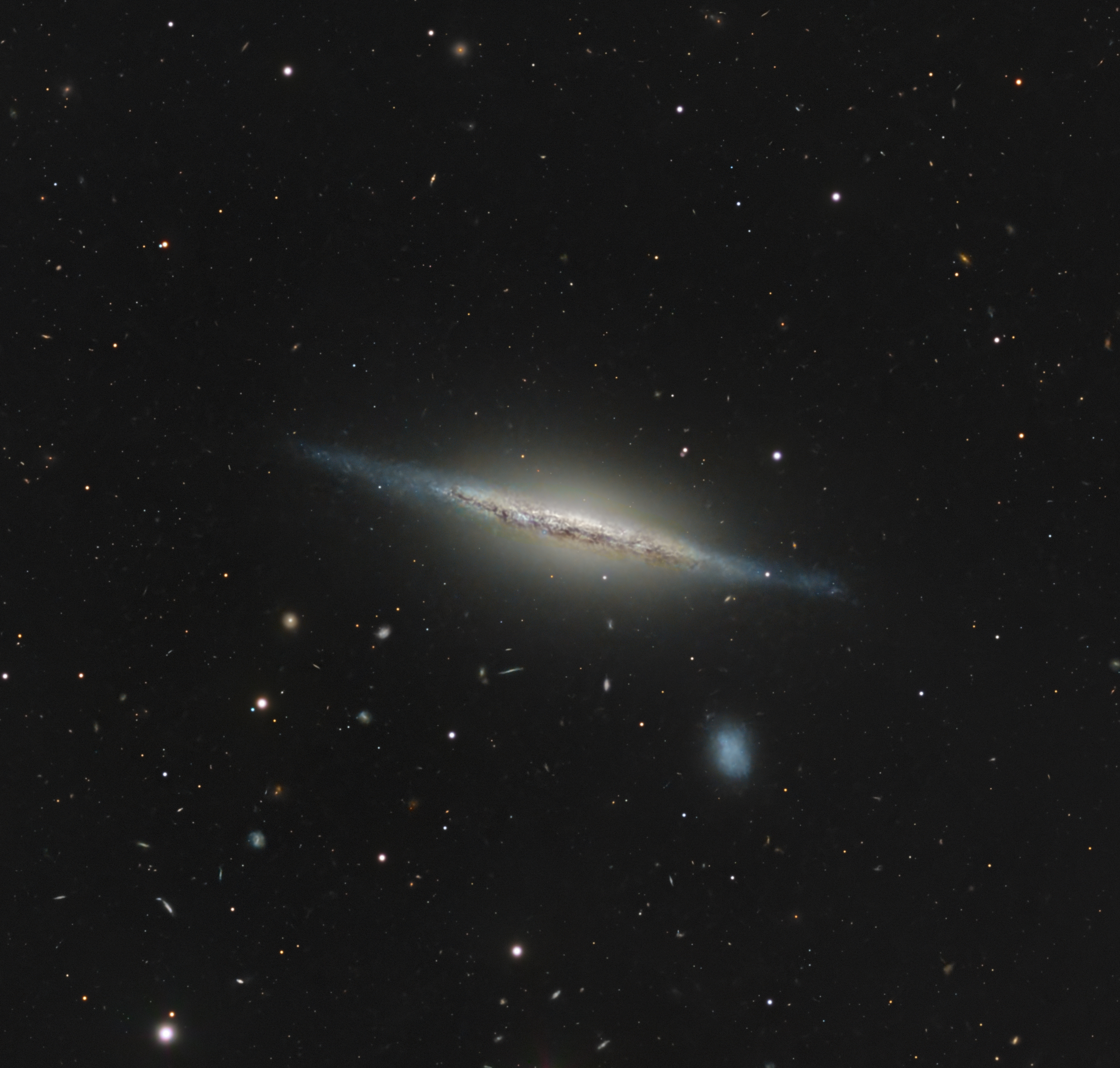
A razor-thin spiral divided by dust and wrapped in starlight.
In the southern constellation Eridanus, the edge-on spiral IC 1970 lies about 45 million light-years away, carving a narrow line of light through a deep extragalactic field. It spans roughly 3.1 × 0.6 arcminutes, corresponding to a physical length of about 52,000 light-years — a modest spiral whose structure becomes far more interesting when viewed in detail.
Seen from the side, the galaxy reveals a multi-layered dust lane rather than a single strip. A thick central band is interwoven with thinner filaments above and below the disk, giving the midplane a stratified, three-dimensional appearance. Toward the ends of the disk, faint feather-like blue projections trace young star clusters and OB associations extending slightly above the midplane. The outer disk shows a gentle flare — subtly thicker on one side than the other — while the entire system exhibits a soft warp, bending upward and downward in opposite directions.
The central bulge glows warmly through the dust, with a slight brightness asymmetry caused by uneven dust absorption and the disk’s gentle bending. Surrounding it is a smooth, extended stellar halo, whose gradual falloff gives the galaxy a soft luminous envelope. Beneath the main disk sits a small, irregular dwarf companion, showing a bright core and a faint, diffuse extension that hints at ongoing star formation.
All around IC 1970, the field is filled with ultra-faint background galaxies — tiny edge-ons only a few pixels long, distant reddish ellipticals, and faint groups — creating a layered depth behind the razor-thin profile of this rarely imaged edge-on spiral.
Imaged in LRGB on my Planewave CDK 1000 at Observatorio El Sauce, Chile.
Image acquisition and processing: Mike Selby