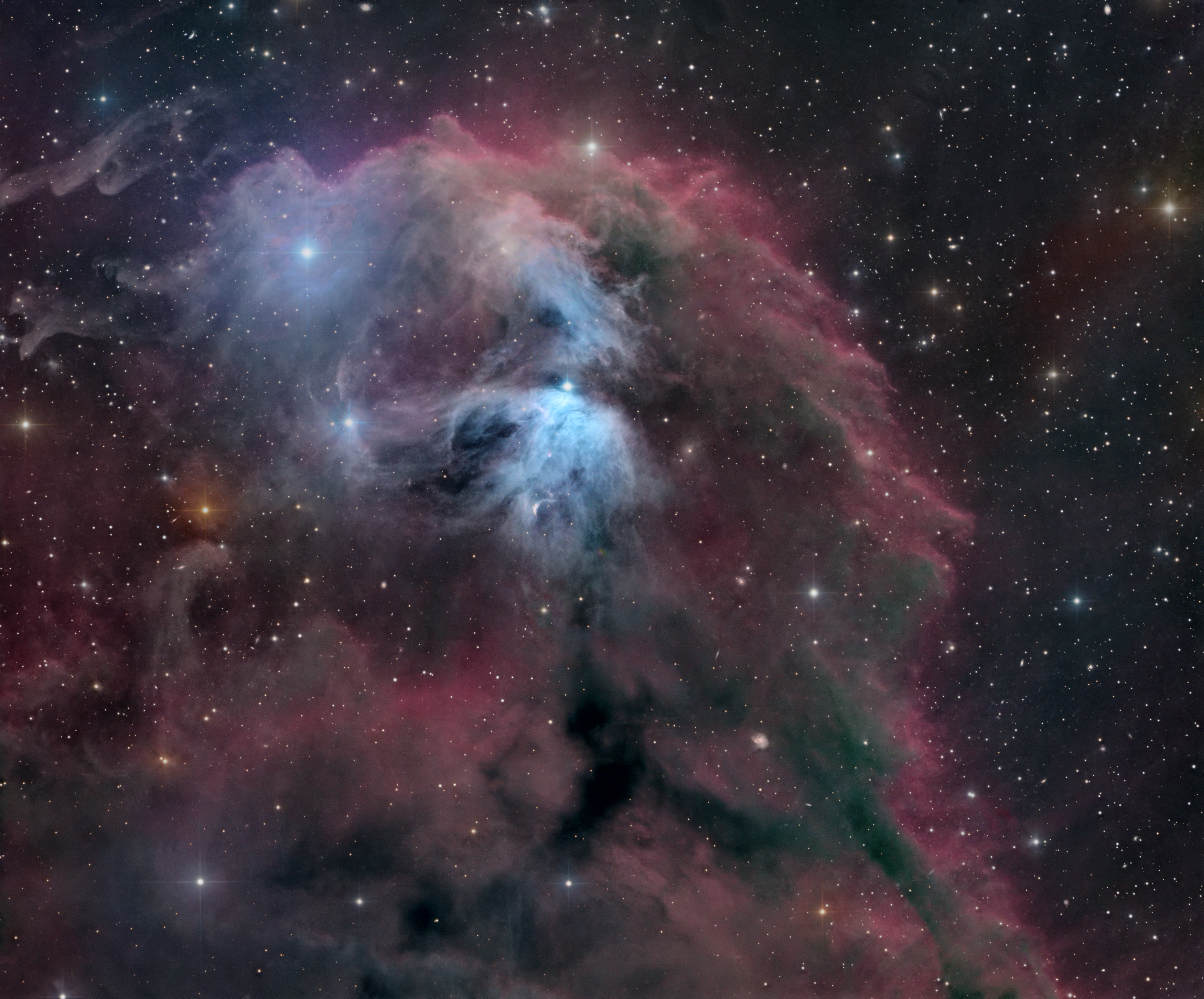
A blue knot of starlight in Orion’s head
This field shows Cederblad 51, a compact reflection nebula embedded in the vast H II region Sharpless 2-264 — the Lambda Orionis ring that forms the “head” of Orion. At roughly 1,300–1,500 light-years away, the central bluish patches are clouds of dust reflecting the light of nearby hot A- and B-type stars belonging to the Lambda Orionis association around Meissa. Cederblad 51 itself is made up of two main blue reflection lobes, split by a darker foreground dust lane, all set against the faint red glow of the emission nebula GN 05.30.0 that traces ionised hydrogen within Sh2-264.
Surrounding the bright core, delicate veils of dust and darker filaments weave through the frame. These structures are part of the same molecular complex that hosts dark nebulae such as Barnard 30–32 and LDN 1580–1584, as well as several Herbig–Haro jets signalling ongoing low-mass star formation. The subtle magenta and rose tones in the wider field reveal where cold dust and ionised gas overlap, while the patchwork of embedded stars hints at a young stellar population still emerging from its natal clouds. What appears at first as a single blue nebula is in fact just one bright knot in a much larger star-forming ring encircling Lambda Orionis.
Imaged in LRGB on my Planewave CDK 700 at Observatorio El Sauce, Chile.
Image acquisition and processing: Mike Selby