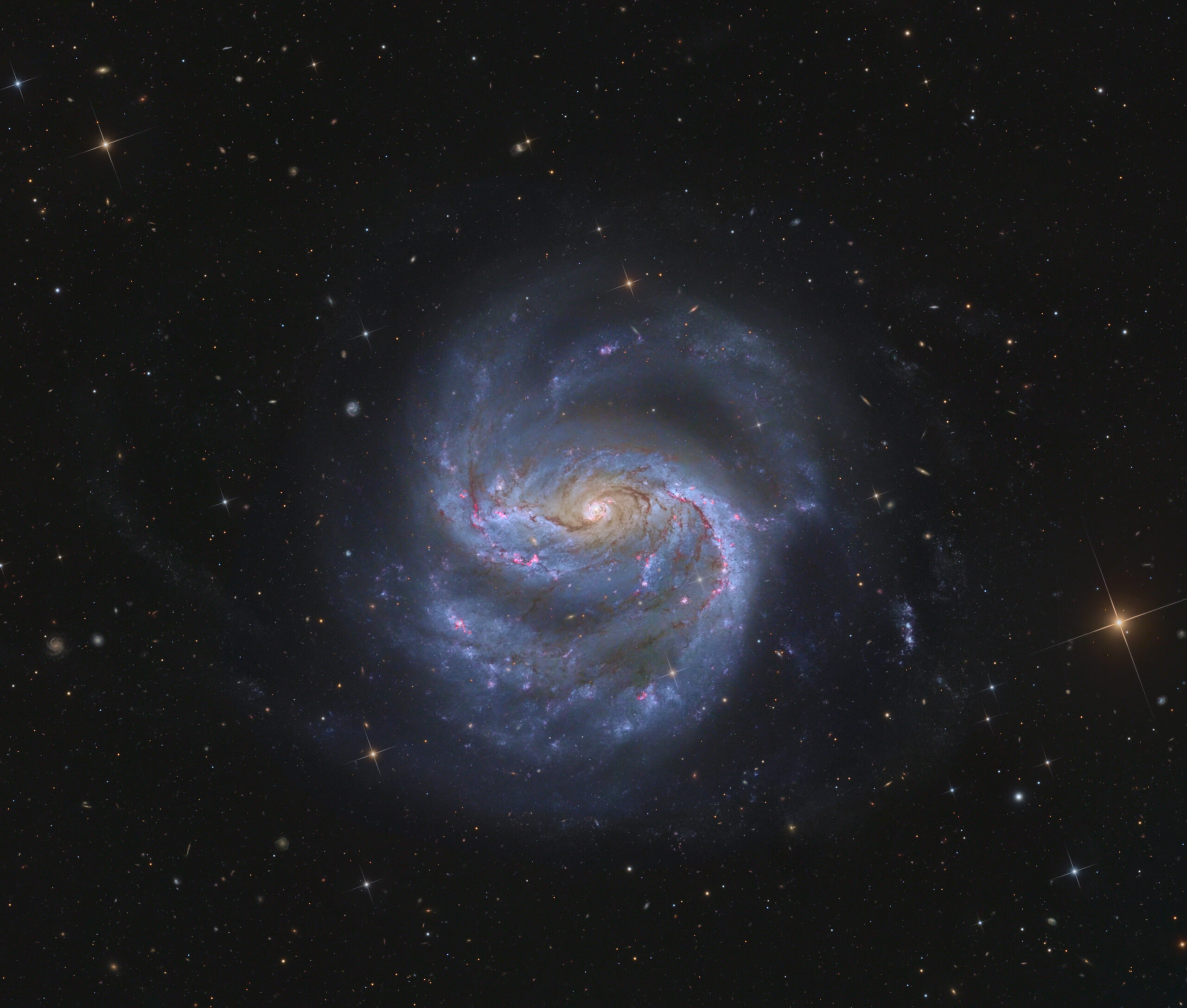
A great barred spiral with a ring of newborn stars blazing around its active heart, its light setting out some 65 million years ago, around the time the dinosaurs vanished
NGC 1672 is a barred spiral galaxy in the southern constellation Dorado, classified SB(s)b, with finer classifications describing an inner ring and a faint outer pseudo-ring, and it hosts a Seyfert 2 active nucleus
Its recession velocity places it about 65 million light-years away, although redshift-independent distance estimates put it considerably closer, near 38.5 million light-years, a discrepancy that remains unresolved, and at the Hubble-flow distance it spans roughly 9 arcminutes on the sky and measures about 170,000 light-years across, well over one and a half times the size of our own Milky Way, with an apparent magnitude of [magnitude]
A long, prominent bar crosses the warm golden center, its leading edges traced by dark dust lanes that sweep gas inward toward a compact ring of intense star formation surrounding the nucleus, while two principal arms spring from the bar ends lined with pink knots of ionized hydrogen and blue clusters of young stars, then divide into fainter, loosely wound outer arms with a bright, knotty arm fragment glowing on one side of the disk
The bar acts as a cosmic funnel, driving gas toward the center where it fuels both the starburst ring and the supermassive black hole powering the Seyfert nucleus, whose X-ray glow emerges through veils of dust, and nearly four times more energy escapes in the far infrared than in the ultraviolet, showing how much of the galaxy’s vigorous star formation lies hidden behind dust and is reradiated as heat
Imaged in LRGB and Hα, OTA ASA AZ 1500, Camera Moravian C5A 150M, at Observatorio El Sauce, Chile
Image Acquisition and Processing: Mike Selby