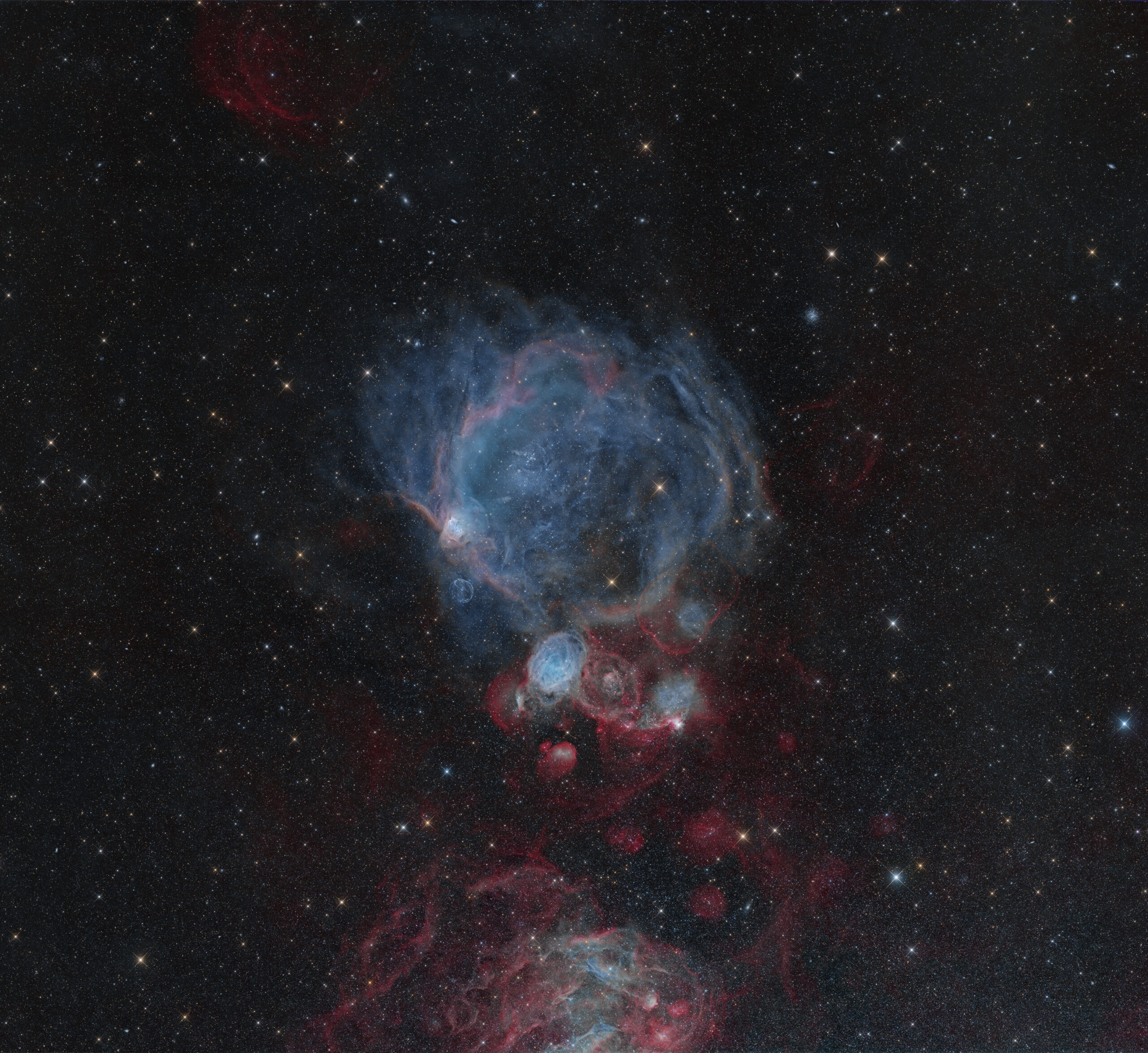
On the outer edge of a neighboring galaxy, a newborn star cluster, the expanding shell of a dead star and a bubble of gas some 2,000 light-years wide share a single field
NGC 602 is a young open cluster, only about 5 million years old, embedded in the ionized hydrogen region N90 in the Wing of the Small Magellanic Cloud, the dwarf irregular companion of the Milky Way, in the constellation Hydrus
At a distance of about 196,000 light-years, the bright N90 nebula spans roughly 3 arcminutes, about 170 light-years, while this wide field covers about 2.1 by 2.0 degrees of sky
NGC 602 lies on the southern rim of SMC-SGS 1, the only supergiant ionized shell known in the Small Magellanic Cloud, whose faint OIII filaments fill much of the frame, and the intense radiation of the cluster’s massive stars carves the bright head of N90 and its swept-back wings of glowing gas
About 7 arcminutes to the west floats the delicate blue ring of MCSNR J0127-7332, a supernova remnant roughly 150 light-years across and only 10,000 to 40,000 years old, still surrounding the neutron star it left behind, now the X-ray pulsar SXP 1062, which spins just once every 1,062 seconds as it orbits a hot Be star
Some 20 arcminutes to the northwest, the HII region N89 around the young cluster Lindsay 104 swells into a bright blue OIII bubble ringed with red hydrogen-alpha, while 33 arcminutes from NGC 602 the compact knot of N88A, only about 3 light-years across, marks the brightest and most highly excited of the compact star-forming cocoons in the Magellanic Clouds
Along the lower edge of the frame, toward the main body of the galaxy, glow the eastern reaches of the N83–N84–N85 star-forming complex and the stellar association NGC 465, while the looser cluster NGC 602c lies about 11 arcminutes northeast of NGC 602
About 46 arcminutes to the north-northeast, the compact star cluster Lindsay 110 bears all the appearance of a globular cluster, a dense, well-resolved sphere of stars, although it is classified as one of the few old star clusters of the Small Magellanic Cloud, about 6.5 billion years old, a survivor from star formation that took place long before NGC 602 and its nebulae were born
The Wing extends toward the Magellanic Bridge, a stream of neutral hydrogen pulled out by tidal interaction between the Small and Large Magellanic Clouds, which makes this one of the most isolated star-forming regions in the Magellanic system
With little dust and only a small fraction of the Sun’s heavy elements, this region resembles the conditions in which the first generations of stars formed in the early universe, and shells blown by earlier massive stars may have triggered new star birth along their edges
Imaged in Hα, OIII and RGB, OTA ASA H400, Camera Moravian C5-100, at Observatorio El Sauce, Chile
Image Acquisition and Processing: Mike Selby