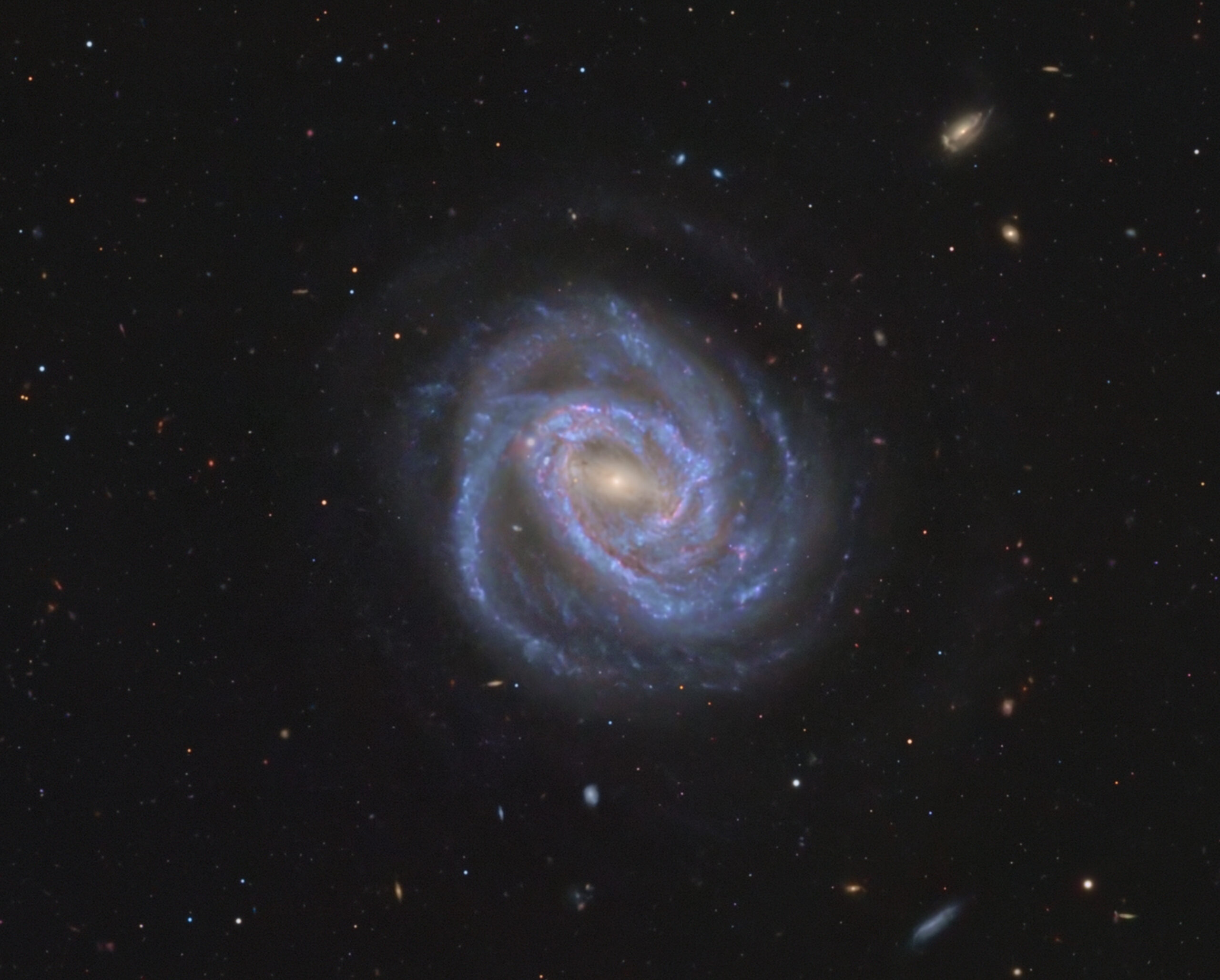
A luminous bar threads a ring of young star clusters, deep in the southern sky of Eridanus
NGC 782 (ESO 114‑G015) is a barred spiral galaxy in the southern constellation Eridanus, classified SB(r)b, a barred spiral with an inner ring and moderately open spiral arms
Its Hubble‑flow distance, based on a recession velocity of about 6,000 kilometers per second relative to the cosmic microwave background, places it about 288 million light‑years away, at that distance its 2.4 by 2.1 arcminute span corresponds to a true diameter of roughly 200,000 light‑years, about twice the size of our own Milky Way, and it shines at magnitude 12.6
Redshift‑independent estimates put NGC 782 much closer, near 141 million light‑years, which would make it about 99,000 light‑years across, a factor‑of‑two discrepancy that remains unresolved, at this recession velocity the expansion of the universe dominates the galaxy’s motion, so the Hubble‑flow distance is considered the more reliable
A short central bar crossed by thin dark dust lanes extends from a warm yellow bulge into a bright inner ring of tightly wound arm segments, studded with pink knots of ionized hydrogen where new stars are forming, beyond the ring two broad blue arms open outward, mottled with clusters of hot young stars, and fade into a faint smooth outer disk that wraps almost entirely around the galaxy
Rings like this form where the rotating bar’s gravity herds gas into a resonance zone, compressing it into dense clouds that collapse into new stars, the contrast between the old yellow bulge and the blue star‑forming ring traces how the bar steadily channels gas inward and renews the galaxy from within
Imaged in LRGB, OTA Planewave CDK 1000, Camera QHY 461, at Observatorio El Sauce, Chile
Image Acquisition and Processing: Mike Selby