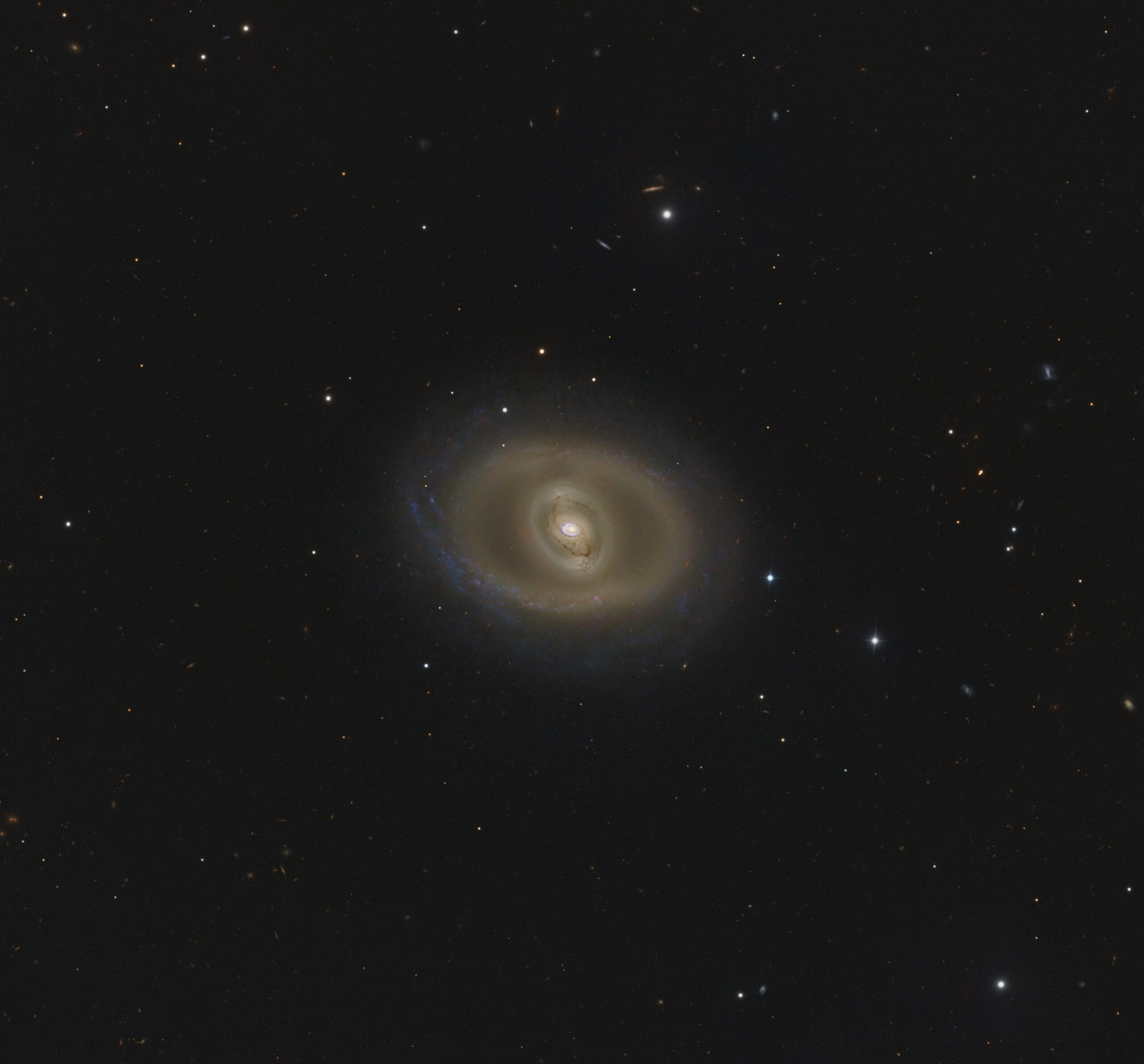
Three rings of light around a quiet golden heart — a galaxy where a slowly turning bar has gathered its gas into circles of new stars
NGC 1326 is a barred lenticular galaxy in the constellation Fornax, classified (R)SB0+(r) in the Third Reference Catalogue of Bright Galaxies and (R1)SB(rl)0/a in later ring studies, with a LINER-type nucleus at its centre Lying about 62 million light-years away, it spans 3.9 × 2.9 arcminutes in visible light, while its full near-infrared extent of 5.1 arcminutes corresponds to roughly 91,000 light-years, and it shines at a total visual magnitude of 10.5 At the core, a compact nuclear ring lined with young star-forming regions encircles the bright nucleus, threaded by dark dust lanes that wind through the inner oval — beyond it a broad golden lens and inner ring of older stars enclose the bar, and at the edge the outer ring stands out as an exceptionally bright example of the R1 class, its faint bluish knots marking scattered pockets of young stars, while near-infrared imaging has confirmed a second, smaller bar nested inside the nuclear ring, making NGC 1326 a true double-barred galaxy, and a scattering of distant background galaxies fills the surrounding field NGC 1326 is a member of the Fornax Cluster and is receding from us at about 1,360 kilometers per second These rings are signatures of resonance — the rotating bar drives gas into orbits that keep step with it, piling material up at the outer Lindblad resonance to build the outer ring and funnelling it inward to the inner Lindblad resonance, where the nuclear ring now turns that gas into new stars, leaving a galaxy whose disk has largely fallen quiet while star formation survives only at its centre and its outermost edge
Imaged in LRGB on Planewave CDK 1000, Camera Moravian C5 100 at Observatorio El Sauce, Chile
Image Acquisition and Processing: Mike Selby